- →A sitewide link is one referring domain, not N backlinks. Deduplicate by domain before any report leaves your desk, or your own dashboard will lie to you first.
- →Google has never announced a sitewide-specific penalty. The confirmed update record from the August 2025 spam update through the June 2026 spam update names no such target: what gets caught is the pattern, paid placement plus commercial anchor plus template repetition.
- →Ahrefs reports that only 0.01% of referring domains use rel=sponsored and 0.44% use rel=ugc, so Google cannot rely on disclosure for paid links and detects them by shape instead. A sitewide commercial anchor is the loudest shape there is.
- →The real value left in a sitewide link is referral traffic and brand exposure, not ranking credit. Measure it in GA4 referral data, and if there are no clicks after a quarter, there is nothing to keep.
- →The concept deserves far more attention inside your own site than outside it: your header and footer are sitewide links you control, and they decide which URLs receive equity on every single page.
- →Compare a sitewide package against the cost of one relevant editorial referring domain, not against the raw link count delivered. The Editorial.Link survey of more than 518 specialists, updated 26 December 2025, puts the average acceptable price of one high-quality backlink at $508.95.
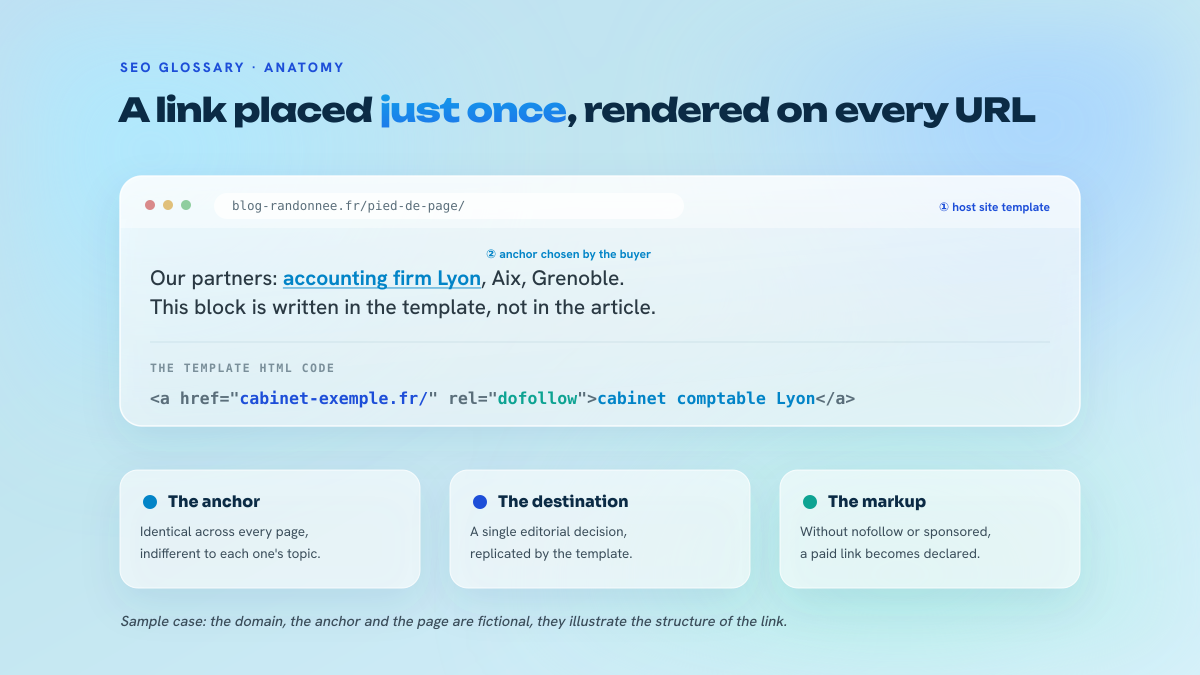
One placement multiplied by a template
A sitewide link lives in the template, not in the content. Header, footer, sidebar, blogroll, the theme credit at the bottom of a WordPress install: anything rendered by the layout file appears on every URL the site generates. Ship it once and a 40,000-page magazine reports 40,000 backlinks in your crawler by the next recrawl. Not one of those numbers describes editorial intent, which is the only thing a search engine is actually trying to estimate when it looks at a link.
The distinction that matters operationally is not sitewide versus single. It is template versus body copy. A link placed inside a paragraph that argues for it inherits the topic of the surrounding text, sits in a position a human chose for a reason, and can be evaluated against the page it points to. A footer link inherits the topic of a PHP template. Both are technically dofollow, both travel through the same crawl and indexing pipeline, and only one of them carries information.
Sitewide links come from a small number of recurring situations, and knowing which one you are looking at tells you most of what you need. Developer and agency credits at the bottom of client sites. Theme and plugin attribution links. Blogroll exchanges inherited from a 2011 link strategy nobody has revisited. Group footers linking sister brands inside the same company. And paid footer or sidebar placements sold by domain owners who discovered that a template edit takes thirty seconds and can be billed monthly. The first four are usually artefacts. The fifth is the one that gets audited.
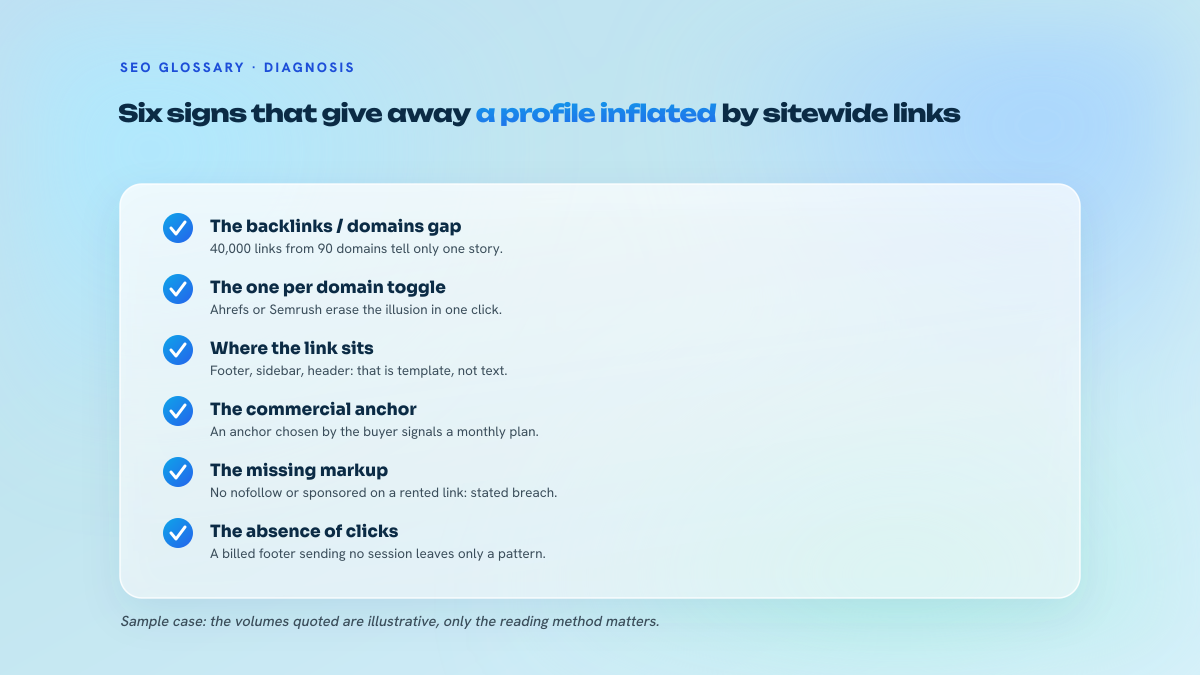
How Google actually handles it in 2026
Start with what is documented rather than what is repeated on LinkedIn. Google’s confirmed update record for the period covers the August 2025 spam update, which ran from 26 August to 22 September 2025, the March 2026 spam update of 24 March 2026, the March and May 2026 core updates, and the June 2026 spam update between 24 and 26 June 2026. None of them was described by Google as targeting footer, sidebar or sitewide placements specifically. Every article you have read claiming that one of those releases « killed footer links » is industry interpretation dressed as a finding.
What is actually written down is the link spam policy, which prohibits links intended to manipulate rankings, including paid links that pass ranking credit, excessive reciprocal arrangements and automated schemes. A sitewide link is not spam by structure. A paid sitewide link with a commercial anchor repeated across tens of thousands of templated pages happens to match nearly every clause of that policy simultaneously, which is a different problem and a self-inflicted one.
The second mechanic is consolidation. Repeated links from a single host do not accumulate like unique endorsements, and the correlation work published in the December 2025 Editorial.Link survey summary makes the same point from the data side: unique referring domains track rankings more closely than total backlink count. Practically, the marginal value of link number 12,000 from a domain you already link from is indistinguishable from zero, and has been for well over a decade. Ahrefs’ current statistics roundup adds a useful angle here: higher-ranking pages tend to acquire new followed referring domains at a rate between 5% and 14.5% per month. A sitewide placement contributes to that curve exactly once, on the day it goes live, and never again.
Third, disclosure. Ahrefs reports that 10.6% of backlinks to the top 110,000 sites are nofollow, but only 0.44% of referring domains use rel=ugc and a mere 0.01% use rel=sponsored. Paid links are essentially never declared. Google knows this, which is why detection is pattern-based rather than attribute-based: relevance of the linking site, placement in the template, anchor text, commercial intent of the destination, and whether the identical link repeats across thousands of identical page shells. A sitewide commercial anchor lights up four of those five at once.
Where a sitewide link still earns its place
Referral traffic is the honest case. A sidebar link on a site whose audience overlaps yours can send real, measurable, converting visits, and that value has nothing to do with PageRank. It is also trivially verifiable: open GA4, filter on the referrer, and look at sessions over a full quarter. If the answer is fourteen sessions and no assisted conversions, you are paying for a metric, not for traffic.
Brand exposure is the second case, and it has become more interesting rather than less. Repeated exposure of a brand name across a site an audience reads regularly builds the kind of recognition that shows up later as branded search, which is a signal you cannot buy directly. That said, keep it in proportion. Semrush’s AI Overviews study, first published in March 2025 and refreshed with data through November 2025, measured AI Overview coverage moving from 6.49% of queries in January 2025 to 24.61% in July 2025 and 15.69% in November 2025, with commercial-triggering queries climbing from 8.15% to 18.57%. Generative surfaces cite passages, not templates. A footer link will never be quoted as a source. Earning a citation requires a page worth citing, which is a content problem, not a placement problem.
Crawl discovery is the third, and it is largely obsolete. A footer link on a frequently recrawled domain does get a new site found quickly, but so does an XML sitemap submitted through Search Console, and so does an IndexNow ping. Buying template placement for discovery in 2026 is solving a problem that was solved for free.
Worth saying plainly since we operate on the other side of this transaction: across the French editorial media we own and run in-house, we sell no footer or sidebar placements at all, because we cannot price what we do not believe transfers value. Every link is inside an article written for the host site’s audience, which is the whole reason the catalogue of media stays public and browsable without an account: you should be able to read what the site publishes before deciding whether a link from it means anything.
The category where sitewide genuinely matters is the one most people ignore: your own site. Header and footer links are sitewide links you control completely, and they determine which URLs receive equity from every page you own. A footer stuffed with forty navigation items spreads that thin across forty destinations. A footer pointing at six commercially critical pages concentrates it. That is a free lever, and it is chronically under-pulled.
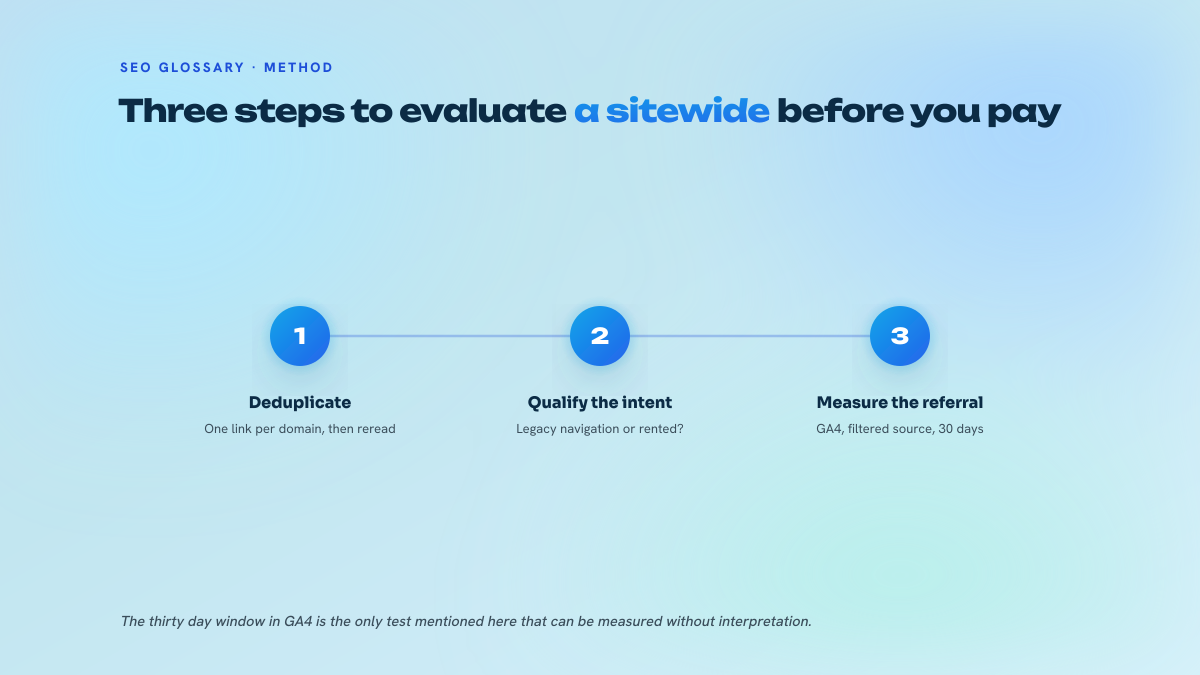
What we see go wrong
The pricing error comes first and costs the most. A vendor offering « 10,000 backlinks » for two hundred euros is not offering a discount on editorial links, they are selling a different product entirely: one undisclosed paid referring domain, template placement, zero topical fit. The Editorial.Link survey of more than 518 SEO specialists, updated 26 December 2025, found an average acceptable price of $508.95 for a single high-quality backlink, with a practical range around $350 to $1,000, and more than 40% of respondents rating link building the hardest activity in SEO. The correct comparison is that one relevant editorial referring domain against the sitewide package, not the link counts. Once you set your budget against what a single published placement actually costs to produce, most sitewide offers stop looking cheap and start looking like risk priced at the wrong end.
Anchor handling is the second failure. A commercial exact-match anchor in a sitewide link is the single most detectable configuration in the entire link graph, because it repeats identically at scale with no linguistic variation whatsoever. If a sitewide placement exists and cannot be removed, the anchor should be the brand name or the bare domain, full stop.
Agency and developer credits at scale are the quiet one. Three hundred client sites all carrying the same footer anchor to the same agency homepage is a machine-readable network signature, and it is the pattern that turns up first in any competitive footprint analysis. Vary it, brand it, or nofollow it.
Then there is reporting hygiene. Ahrefs reports that 73.6% of domains have reciprocal links and that 66.5% of links to sites over the last nine years are dead, which reframes two habits at once. Reciprocity alone is unremarkable and normal, so stop treating a blogroll exchange as evidence of anything; but reciprocal plus template plus commercial anchor is three patterns stacked, which is a different conversation. And because template links are structurally durable, they do not decay one at a time like editorial mentions: they vanish all at once on redesign day, taking a large share of a nominal backlink count with them and producing a panic that has no ranking consequence whatsoever.
Auditing sitewide links without wasting a week
Export your backlinks with one link per referring domain as the default view, never the raw list. Any profile where the total link count is an order of magnitude above the referring domain count contains sitewide placements, and the ratio tells you how many before you inspect a single URL. Sort the offending domains by link volume, then crawl two or three of their pages with Screaming Frog to confirm whether the link sits in the template or in body copy. That takes twenty minutes and settles the question that vendor screenshots never do.
The decision on each one is short. If it sends measurable referral traffic, keep it and stop worrying about the equity question. If it is a paid arrangement you can end, end it and reallocate the budget toward earning a relevant referring domain instead: this is precisely the trade where picking the host media yourself and ordering one article at a time beats a bulk package, because you are buying a domain and a context rather than a multiplier. If it is legacy, unremovable and commercially anchored, ask for nofollow before you consider anything else. Disavow is the last resort and almost never justified for sitewide links absent a manual action, since the alternative is quietly discounted rather than penalised.
Finish inside your own template. Count the URLs your footer and header point to, check that the pace of your external acquisition is not being read against a link total inflated by someone else’s footer, and make sure the six pages that actually convert are the ones every page of your site links to. That audit costs nothing, ships in an afternoon, and moves more than the sitewide package you were about to buy.
Nautilinks operates an owned network of editorial media. In-house written articles, transparency disclosures respected, anchor mix calibrated.
Frequently asked questions
Does a sitewide link count as one backlink or as thousands in Google’s eyes?
Functionally one. Google consolidates repeated links from a single host, and the marginal value of each additional copy collapses very quickly. Your crawler counts URLs because that is what it indexes, not because each URL represents an independent endorsement. Report on referring domains and the discrepancy disappears. The December 2025 Editorial.Link survey summary makes the same point from correlation data: unique referring domains track rankings more closely than raw backlink totals.
Did any recent Google update specifically target footer or sidebar links?
No. The confirmed record covers the August 2025 spam update from 26 August to 22 September 2025, the March 2026 spam update, two core updates in March and May 2026, and the June 2026 spam update between 24 and 26 June. None was described by Google as addressing sitewide placement as a category. What the link spam policy does prohibit is paid links passing ranking credit, which is where most problematic sitewide links actually fall.
I inherited three hundred client-site footer credits from a previous agency. Liability or asset?
Liability if they all carry the same commercial anchor to the same page, because that is a network signature any competitor can map in an afternoon. Convert the anchor to the brand name or bare domain wherever you still have template access, and nofollow the rest. Keep the ones on sites that actually send referral clicks. Do not disavow them: there is nothing to gain absent a manual action.
Is it ever worth paying for a sitewide placement?
Only when you are buying audience rather than equity, and only when you can prove the audience exists. Set a measurement window of one quarter, track referral sessions and assisted conversions in GA4, and treat the ranking question as irrelevant to the decision. Judged as a link, the same budget spent on one relevant editorial referring domain is the better trade almost every time, and it is the comparison vendors selling by the thousand carefully avoid.
How do I tell a sitewide link from a genuine editorial link in an export?
Compare total links to referring domains. A ratio far above ten to one signals template placements. Then crawl two or three pages of the linking domain and check whether the anchor and destination are identical across unrelated URLs: identical on a product page and a contact page means template. Screaming Frog answers this in minutes and is more reliable than any vendor description of where the link « sits ».
Do sitewide links help with AI Overviews or LLM citations?
Not meaningfully. Generative surfaces cite passages that answer a query, and a footer anchor is not a passage. Semrush measured AI Overview coverage at 15.69% of queries in November 2025 after a July 2025 peak of 24.61%, with commercial queries rising sharply, so the surface matters more each quarter. Getting cited there is a content and entity problem. Template repetition contributes nothing to it.
Test your knowledge
Quiz: Sitewide link
1/3A footer link on a 40,000-page site appears in your backlink export. What is the correct way to report it?