- →Sitelinks are an output of Google's model of your site, not an input you control: there is no schema type, no Search Console request form, and the legacy demotion tool never returned to the current interface.
- →The Sitelinks Search Box is dead. Google removed the feature globally on 21 November 2024 and archived the nositelinkssearchbox rule, so the WebSite/SearchAction block in your JSON-LD is now dead weight unless it serves another purpose.
- →The only real lever on a bad sitelink is to change what makes the page prominent: internal link count, navigation placement, title tag, or a noindex if you are ready to lose the page from search entirely.
- →No confirmed Google update in the last twelve months targeted organic sitelinks. What moves them are broad core updates reassessing page quality (December 2025, March 2026, May 2026, per Search Engine Land) and your own architecture changes.
- →September 2025 is a measurement break: Google stopped honoring &num=100 around 10 to 14 September 2025, so any before/after comparison of SERP feature visibility spanning that date is comparing two different instruments.
- →Sitelinks track brand demand. They follow from digital PR, brand mentions and a consolidated entity far more reliably than from any volume of transactional link building.
What a sitelink actually is, beyond the definition
Type a brand name into Google and look at the first result. If the site is well understood, the homepage comes with a block of indented links underneath. A retail bank query typically returns the homepage plus « Branches », « Rates », « Online banking » and « Contact ». A software brand returns « Pricing », « Docs », « Login », « Blog ». A French media site returns its three or four strongest sections. Those indented links are the sitelinks, and the pattern is always the same: Google has decided it knows which pages a user asking for this brand actually wants, and it spends four to six extra rows of the results page saying so.
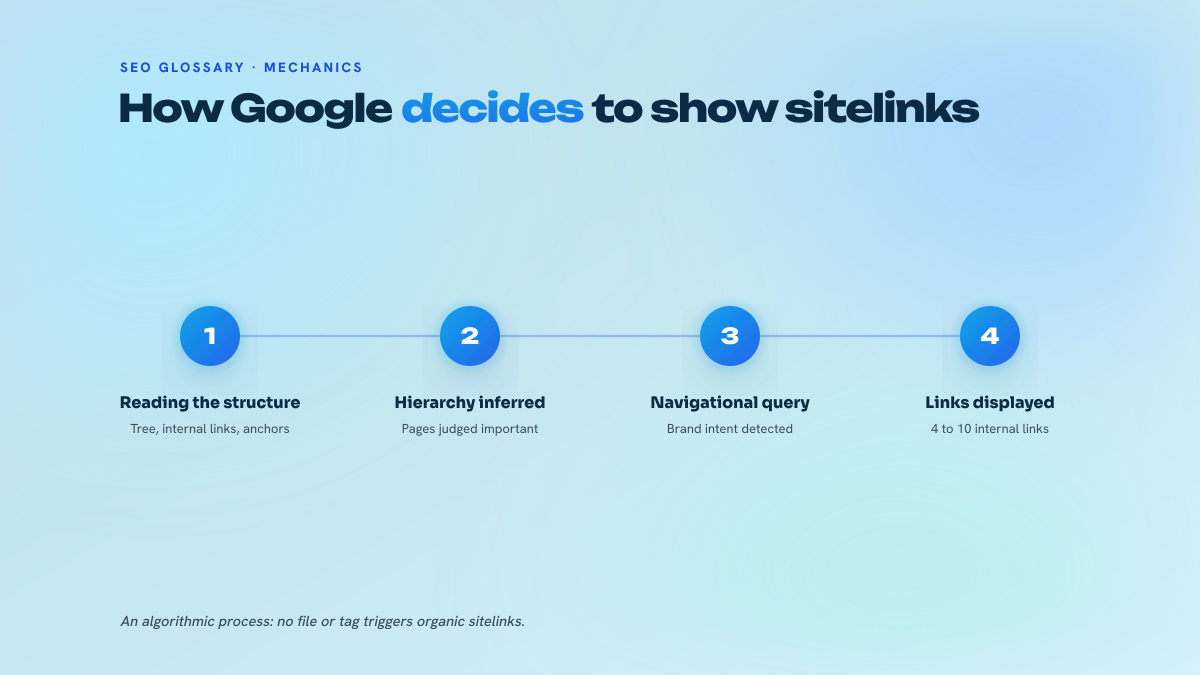
The definition most pages stop at, extra links displayed under a search result, misses the operational point. Sitelinks are not a feature you enable. They are a confidence readout. Google generates them from its own model of your site structure, and there is no markup, no tag and no Search Console setting that requests them. When they appear, the crawler has resolved your domain into a coherent hierarchy with a clear entry point and a small set of pages that dominate internal prominence. When they do not appear, either that hierarchy is ambiguous, or the query is not navigational enough to justify the space.
This matters because sitelinks get misfiled as an SEO objective. They are a symptom. A site with clean architecture, distinct titles and a navigation that reflects real user paths gets them almost automatically on its brand query. A site with forty menu items, six near-identical category pages and a homepage that links to everything equally does not, and no amount of technical work aimed specifically at sitelinks fixes that. You fix the architecture and the sitelinks follow, in that order.
How Google picks sitelinks in 2026
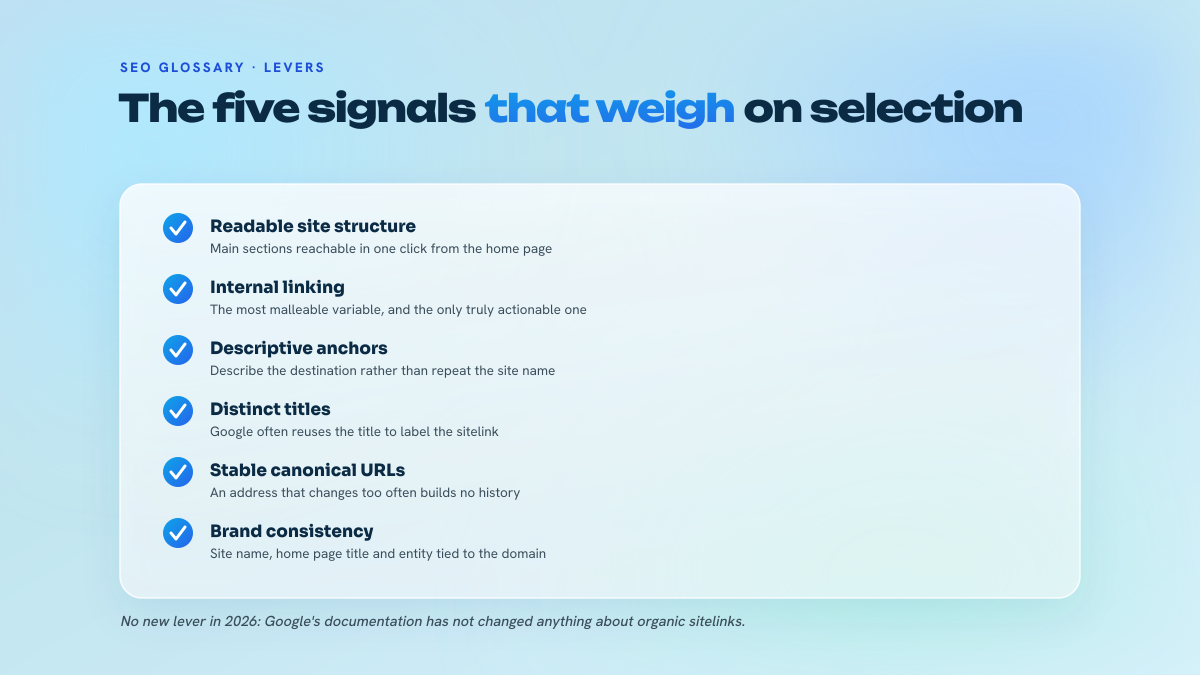
Google is deliberately vague here, and the vagueness is honest: the selection is algorithmic and query-dependent, which means the same site can show different sitelinks for « brandname » and « brandname login ». What we observe consistently in audits is that the candidate pool is drawn from pages with high internal prominence. the way internal links distribute prominence across a site is the single strongest lever, ahead of anything you can put in the head of a document. Pages linked from the main navigation, from the footer on every template, and from body copy across many articles are the pages Google treats as structurally important.
Three other signals show up repeatedly. Title tags matter because the sitelink label is usually derived from the target page title or its main heading, so a page titled « Home | Brand | Official Site of Brand » gives Google nothing usable to display. Anchor consistency matters: if every internal link to your pricing page says something different, the entity behind the page is fuzzier than if the anchor is stable. And URL structure matters in a boring but real way, since a flat, readable path signals a top-level section better than a query-string page buried three redirects deep.
What did not happen over the last twelve months is any sitelink-specific algorithm change. Google's Search Central changelog records nothing sitelink-specific in the period, and the notable releases were the August 2025 spam update, which ran 26 August to 22 September 2025 and which Google explicitly said did not target link spam (Search Engine Roundtable, September 2025), plus three broad core updates: 11 to 29 December 2025, 27 March to 8 April 2026, and 21 May to 2 June 2026 (Search Engine Land). Core updates do move sitelinks, but indirectly: they reassess which of your pages deserve prominence, and the sitelink block reshuffles as a side effect. Reading a sitelink change as evidence of a sitelink-targeted update is a diagnostic error.
One more thing worth stating plainly. Google published guidance on appearing in generative AI features on 15 May 2026, and it introduced no special sitelink markup, no AI-specific structured data requirement, and confirmed that files like llms.txt are not required for Search visibility. If a vendor is selling you a schema block that « unlocks sitelinks in AI results », it does not exist.
The types that still exist, and the one that died
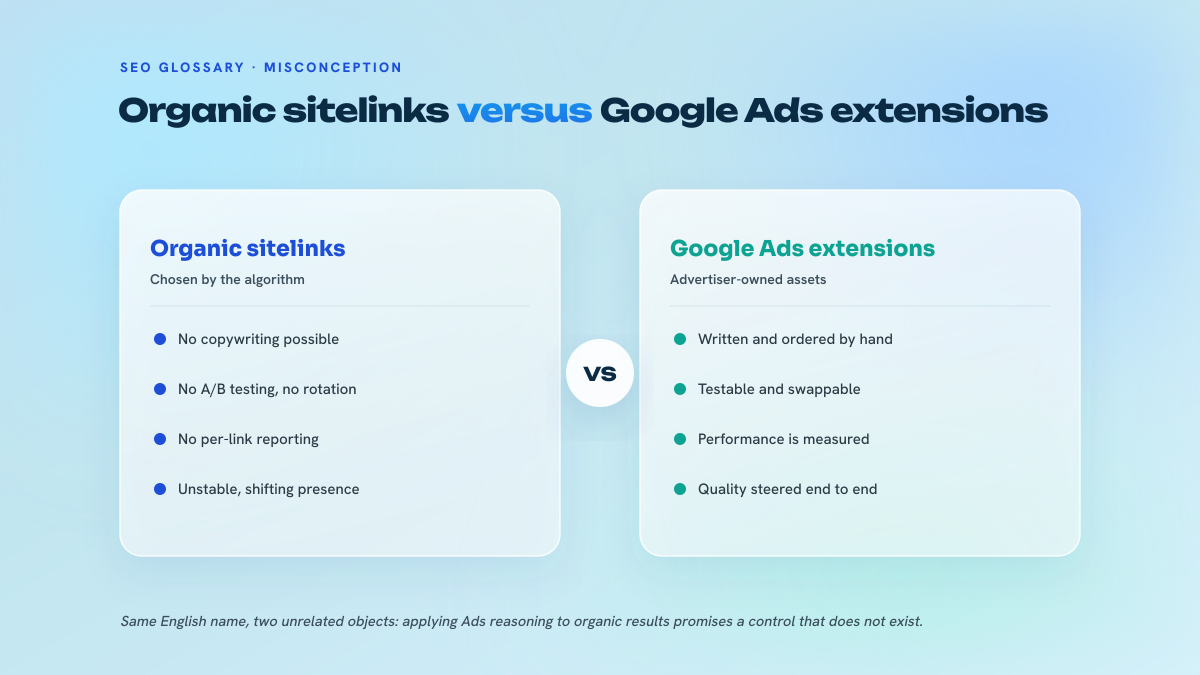
Practically, you deal with three live formats. The full organic block sits under the first result on a strong navigational query and shows a grid of four to six links with short descriptions on desktop. The one-line variant appears under deeper results, usually two or three inline links with no description, and it is far more common than the full block: most sites that think they have no sitelinks actually have these. Then there are Google Ads sitelink assets, which are a different product entirely, manually configured, and where Google reports 15% more conversions when Responsive Search Ad and sitelink asset strength moves from Poor to Excellent, based on internal data collected 15 to 20 August 2025 (Google Ads Help). Do not let the shared vocabulary confuse the two: the paid ones you write yourself, the organic ones you never touch.
The Sitelinks Search Box is dead and you should treat it as such. Google announced the deprecation on 21 October 2024 and the feature disappeared globally on 21 November 2024, after which the documentation was removed and the nositelinkssearchbox rule was archived. Leaving the old WebSite/SearchAction JSON-LD in place carries no penalty, but it also does nothing, and in a 2026 technical audit it is one of those artefacts that quietly signals a template nobody has reviewed in two years. Strip it unless another consumer of your structured data depends on it. What it is not, and this confusion is everywhere, is the same thing as ordinary sitelinks. The search box died; the indented link block did not.
Removing or steering unwanted sitelinks
This is the part almost no competing page covers, and it is the question clients actually ask. The scenario is familiar: Google shows a sitelink pointing at a stale landing page, a discontinued offer, an old promotional URL, or worse, an internal-facing page that was never meant to be a front door.
The honest answer is that you have no direct control. The demotion tool that existed in the legacy Search Console never made it into the current interface, and no Google documentation from the past year introduces manual sitelink selection, a sitelink schema type or an eligibility threshold you can target. Anyone promising to « fix your sitelinks » in a week is selling you a coin flip.
What you have are indirect levers, ranked by how blunt they are. The cleanest is to reduce the page's internal prominence: pull it out of the main navigation, remove the sitewide footer link, and cut the body links that point to it. If the page still deserves to rank on its own query, that is usually enough over a few crawl cycles. The second lever is the title tag and heading, since a rewritten, more specific title can change the label or make the page a worse fit for the navigational query. The third is a noindex directive on the offending page, which reliably removes it from the sitelink pool because it removes it from the index entirely. That is the point: noindex is not a sitelink control, it is an amputation, and it is the right call only when the page has no organic value. Blocking the URL in robots.txt is the wrong tool, because a disallowed page can still surface in results with no snippet, which is a worse outcome than the sitelink you were trying to remove. If the page is genuinely obsolete, a 301 to its successor is cleaner than all of the above.
Expect latency. In our experience the sitelink block updates on Google's own recrawl and reassessment schedule, and a structural change made today typically shows up in the SERP over one to several weeks, not overnight. Clients who redeploy their navigation three times in a fortnight because « nothing happened yet » are the ones who never converge.
Sitelinks in a netlinking operation, and why measurement broke
Sitelinks sit on brand queries, which makes them a brand demand indicator more than a link indicator. You can buy a hundred contextual links into a category page and never trigger a sitelink block, because nobody is searching your brand name. Conversely, a site with modest link metrics and real brand search gets them. This is why the honest framing in a netlinking brief is that sitelinks are downstream of entity consolidation: consistent naming, a stable homepage, unlinked brand mentions across credible publications, and enough coverage for Google to build a confident picture of who you are. The same work that eventually produces a knowledge panel on a branded search is the work that produces stable sitelinks.
Across the French editorial media we operate in-house at Nautilinks, the pattern holds without exception: the sites that show a full sitelink block are the ones with real branded search demand, not the ones with the best link metrics. That is worth stating when you calibrate expectations on a campaign. If the objective is entity strength and brand visibility, editorial placements on topically coherent hosts do the job, and the media catalogue we publish openly, with metrics visible before you order lets you filter hosts on relevance rather than on a vanity score. If the objective is ranking a specific commercial page, that is a different budget line, and it is worth checking what a placement actually costs before you build the plan rather than after.
One measurement caveat that catches people out. Around 10 to 14 September 2025, Google stopped honoring the &num=100 parameter, which had let tools pull one hundred results in a single request. Tools now need roughly ten requests for the same top-100 dataset, and the immediate consequences were widely documented: less complete SERP feature collection, broken historical comparability of visibility datasets, and a wave of Search Console impression drops with no matching traffic loss. If you are comparing sitelink or SERP feature visibility across September 2025, you are comparing two different instruments, not two states of your site. Treat that date as a break in the series and say so in the report.
What we see go wrong
The most expensive mistake is treating sitelinks as a KPI. We have seen roadmaps with « obtain sitelinks » as a quarterly objective, which is roughly as actionable as « obtain a good mood from Google ». The objective should be a legible architecture and real brand demand; sitelinks are how you verify you got there.
Second, over-application of noindex. A team wants one bad sitelink gone, applies noindex to three pages, and loses the long-tail traffic those pages were quietly earning. Check the page's own impressions in Search Console before you cut it.
Third, navigation bloat. A menu with thirty-five entries does not give Google more candidates, it dilutes the prominence signal so that no page stands out. Sites that trimmed their navigation to a real hierarchy get cleaner sitelinks, and the internal linking gain is worth more than the sitelinks anyway.
Fourth, duplicated or templated titles. If your category pages all read « Category | Brand », the labels Google can display are near-identical, and the block either does not render or renders uselessly. Distinct, short, descriptive titles are the cheapest fix on this list.
Fifth, stale structured data. The retired search box markup is the obvious one, but the same audit usually turns up a breadcrumb block that no longer matches the URL path, which is a genuine problem: inconsistent breadcrumbs give Google a second, conflicting model of your hierarchy alongside your navigation. Pick one hierarchy and make every signal agree with it.
Sixth, panic after a core update. Sitelinks shifting during a December 2025 or May 2026 core update rollout window is expected behaviour, not a bug to be patched mid-rollout. Wait for the rollout to complete, then read the change.
Nautilinks operates an owned network of editorial media. In-house written articles, transparency disclosures respected, anchor mix calibrated.
Frequently asked questions
Can I tell Google which pages to use as sitelinks?
No. There is no markup, no Search Console form and no supported request. The demotion tool from the legacy Search Console was never carried over, and no Google documentation from the past year introduces manual selection or a sitelink schema type. Your levers are all indirect: internal link prominence, navigation placement, title tags, canonical and redirect hygiene, and noindex as a last resort. Anyone selling direct sitelink control is selling a coin flip.
My site shows no sitelinks at all. Where do I start troubleshooting?
Check three things in order. First, is there actual branded search volume? Sitelinks need a navigational query to attach to, and a brand nobody searches will not get them. Second, is your homepage unambiguously the canonical entry point, with a single indexed version and no www/apex duplication? Third, does your navigation express a real hierarchy with distinct page titles? Most missing sitelink cases we audit are resolved by the second or third point.
Is the WebSite/SearchAction structured data still worth shipping?
Not for sitelinks. Google removed the Sitelinks Search Box globally on 21 November 2024, removed the documentation and archived the nositelinkssearchbox rule. Keeping the markup costs you nothing in ranking terms but produces no feature, and it is a reliable sign that a template has not been reviewed since 2024. Remove it unless another consumer of your structured data reads it. Ordinary Organization and BreadcrumbList markup is a different matter and stays.
Do sitelinks measurably improve click-through rate?
They plausibly help on brand queries by capturing intent that would otherwise cost a second click, but Google publishes no organic figure and Search Console does not break impressions down by SERP feature, so anyone quoting a precise organic uplift is guessing. The one sourced number is on the paid side: Google reports 15% more conversions when Responsive Search Ad and sitelink asset strength improves from Poor to Excellent, from internal data collected 15 to 20 August 2025.
Will buying backlinks help me get sitelinks?
Not directly, and framing it that way misreads the mechanism. Sitelinks attach to navigational queries, so what moves them is branded search demand and a consolidated entity, not raw link volume into a category page. Editorial coverage that generates brand mentions and brand searches contributes; a batch of transactional links pointed at a money page does not. If sitelinks are the goal, budget toward brand visibility work, not toward link count.
Our sitelink visibility looks different since late 2025. Is that a Google change?
Check your instrument before your site. Google stopped honoring the &num=100 parameter around 10 to 14 September 2025, which changed how third-party tools collect SERP data and triggered widespread Search Console impression drops with no corresponding traffic loss. Any comparison spanning that date is comparing two measurement regimes. If the change is real, the likelier cause is one of the December 2025, March 2026 or May 2026 core updates reshuffling page prominence.
Test your knowledge
Quiz: Sitelinks
1/3What happened to the Sitelinks Search Box?