- →Organization markup is an identity declaration, not a ranking input: Google's own generative-search guidance states no special schema.org markup is required for AI Overviews or AI Mode.
- →An Ahrefs follow-up tracking 1,885 pages that added JSON-LD between August 2025 and March 2026, matched against 4,000 similar pages, found no statistically significant citation lift across AI Overviews, AI Mode or ChatGPT.
- →The sameAs array is the only part of the block whose value comes from outside your site: it is worth exactly as much as the third-party profiles it points at.
- →One Organization node per entity, declared once on the homepage with a stable @id, referenced everywhere else. Duplicating the full block on every page is the most common defect we find.
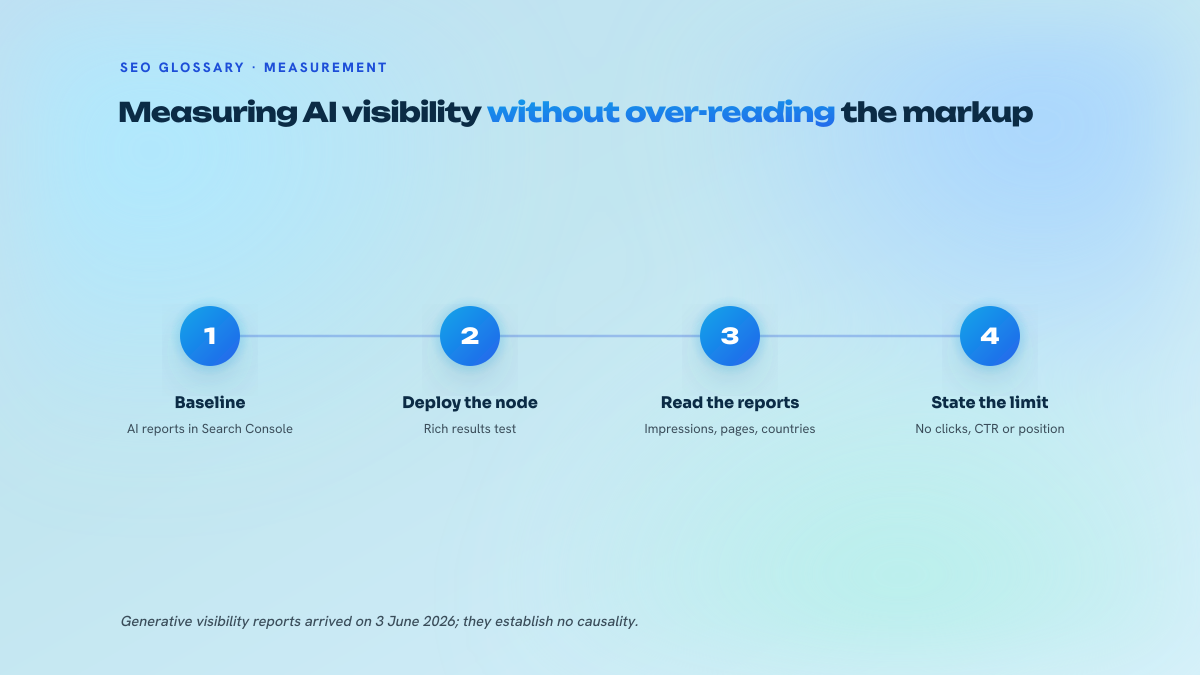
- →Since 3 June 2026 Search Console exposes AI Overviews, AI Mode and generative Discover impressions, but with no clicks, CTR, position or query data, so you cannot attribute an AI-visibility change to a schema deployment.
- →Google retired seven rich-result types in June 2025 (Book Actions, Course Info, Claim Review, Estimated Salary, Learning Video, Special Announcement, Vehicle Listing). Organization survived because it feeds entity understanding, not SERP decoration.
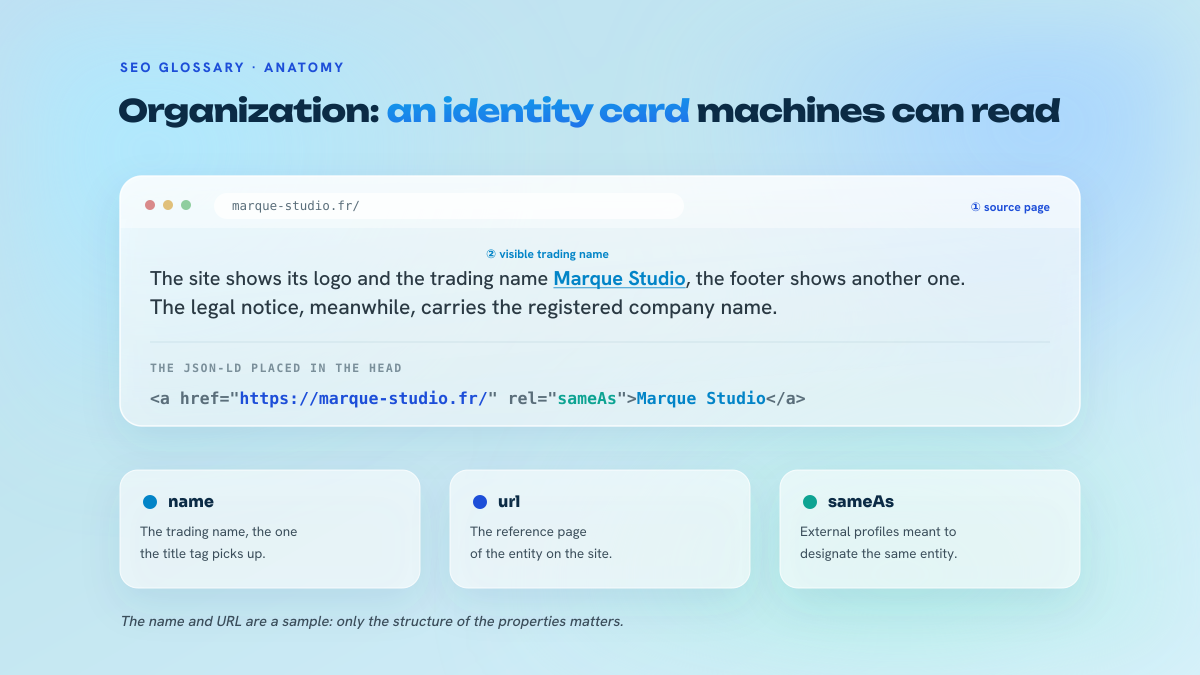
An entity record, not a ranking lever
Every domain gives a search engine two versions of its identity: the one scattered across the footer, the legal page, the LinkedIn profile and the press coverage, and the one written down in machine-readable form. Organization schema is the second version. It is a JSON-LD node that names the entity operating the site, gives it a canonical URL, a logo, a legal name, contact points and a list of profiles that corroborate it elsewhere. Nothing more, and that limit is the whole point.
The reason this needs saying in 2026 is that the market spent three years selling schema as a ranking lever, then quietly repositioned it as an AI-visibility lever. Both framings are wrong in the same way. Google's own optimization guide for generative search features states that structured data is not required for AI Overviews or AI Mode and that no special schema.org markup exists for generative visibility: the recommendations are crawlability, indexing, clean technical structure and useful content. That is a documented position from the vendor, not an opinion from a consultant, and it should settle the argument.
What Organization markup does buy is disambiguation. If your brand name collides with a product, a town, a band or a competitor in an adjacent market, the entity resolution step is where you lose. A correctly declared Organization node with a stable identifier, a logo, a legal name and outbound references to authoritative profiles removes ambiguity that Google would otherwise resolve by inference. Inference is cheap for a well-known brand and expensive for a three-year-old B2B site with a generic name. That asymmetry is the reason we still ship the markup on every property we operate, while telling clients plainly that it will not move a single position.
Treat it the way you treat language and region declarations: an instruction layer that prevents misinterpretation, never a source of authority.
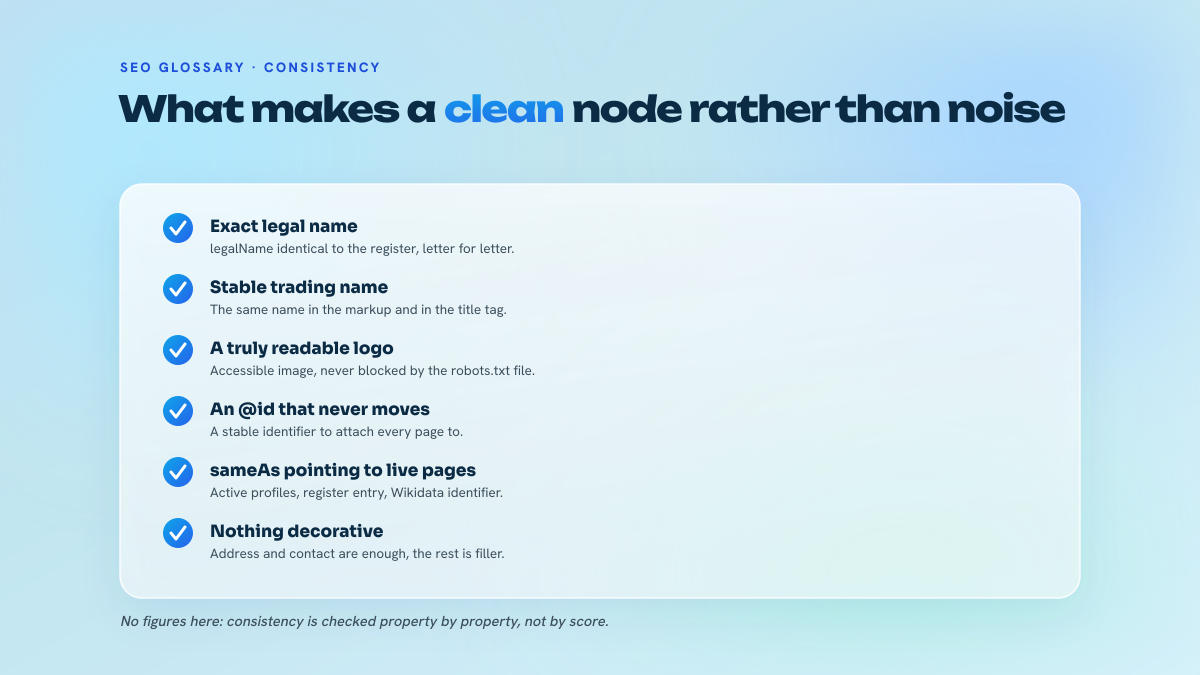
The fields that actually carry weight
The schema.org Organization type accepts dozens of properties. Perhaps eight of them matter operationally, and the rest are inventory.
The identifier comes first. Give the node an explicit @id built on your canonical domain, something like https://example.com/#organization, and reuse that same string as the publisher reference in every article-level markup block across the site. This is the single change that turns a pile of disconnected snippets into one coherent entity graph. Sites that repeat the full Organization object on 4,000 article pages are not sending a stronger signal, they are sending 4,000 opportunities for one of those copies to drift out of sync.
Then name, legalName and url. Name is the brand as the public knows it, legalName is what appears on the registry filing, and they are frequently different. Declaring both is how you stop Google from treating your commercial brand and your registered company as two entities. Add the address, the VAT or registration number where the jurisdiction has one, and a contactPoint with a real, monitored channel rather than a generic mailbox.
Logo deserves its own note because it is the most commonly broken field on otherwise clean implementations. Google reads it for knowledge panel and brand rendering purposes and it needs to be a directly crawlable raster image at a reasonable resolution, not an inline SVG, not a lazy-loaded asset behind JavaScript, not a file blocked in the crawler exclusion file. We keep finding blocked logo paths in technical audits, and the failure is silent: the markup validates, the image never gets fetched.
Finally sameAs, which is the only property whose value is generated outside your own site. More on that below, because it is where the netlinking angle lives.
Worth tracking rather than shipping blind: industry coverage reported that in June 2025 Google extended Organization-related structured data to membership and loyalty program information via MemberProgram structures, with a reported rollout on 10 June 2025. That came from trade press rather than a first-party announcement we could retrieve, so verify it against the current Search Central documentation and the Rich Results Test before you deploy it. The broader signal is more reliable: during the same June 2025 pruning Google retired seven low-use rich result types, including Book Actions, Course Info, Claim Review, Estimated Salary, Learning Video, Special Announcement and Vehicle Listing. Organization was not touched. Types that describe entities survive, types that decorate a SERP listing get cut.
Organization schema and AI visibility: read the evidence
This is where the market is currently lying to itself, so the numbers matter.
The bullish case usually cites an Ahrefs dataset reporting that 65 % of pages cited in AI Mode and 71 % of pages cited by ChatGPT contained structured data. Read that carefully: it measures adoption among cited pages, not lift. Structured data correlates with the kind of site that also has an engineering team, a CMS that ships clean templates and a content operation worth citing. The markup is a proxy for competence, not a cause of citation.
The controlled version of the question has now been asked. An Ahrefs follow-up tracked 1,885 pages that added JSON-LD between August 2025 and March 2026 and matched them against 4,000 similar pages that did not. It reported no statistically significant citation lift across Google AI Overviews, AI Mode or ChatGPT. That is a before-and-after design with a control group, which is about as close to evidence as this industry gets, and it points the opposite way from the correlation stat everyone quotes.
The measurement environment changed too. On 3 June 2026 Google launched dedicated Search Console reports covering AI Overviews, AI Mode and generative Discover, exposing impressions, pages, countries, devices and dates. The first version ships without clicks, CTR, average position or query-level data. You can now establish an AI-visibility baseline, which is real progress, but you cannot isolate whether a schema deployment caused an impression change. Anyone selling you attribution on that surface today is selling you a story.
Context on volatility, since it explains a lot of the panic: a Semrush study published on 15 December 2025 analysed more than 10 million keywords across January to November 2025 and found AI Overviews on 6.49 % of tracked queries in January, peaking at 24.61 % in July and settling near 15.69 % in November. A surface that swings by a factor of four inside eleven months will produce plenty of coincidences that look like schema wins. It also shifted in composition: informational queries drove 91.3 % of AI Overview triggers in January 2025 and 57.1 % by October, so the commercial exposure is growing.
Our stance: ship Organization markup because entity clarity is cheap and permanent, and build your generative visibility work on content and off-site corroboration, which is where the causal evidence actually sits.
Where it fits in a netlinking operation
The connection between Organization schema and link acquisition runs through one property: sameAs. That array is a set of claims about where else your entity exists. A claim pointing at a LinkedIn page with eleven followers and an abandoned Crunchbase profile is technically valid markup and operationally worthless. A claim pointing at a Wikidata item, a well-maintained professional profile and a set of editorial mentions across independent media is the same syntax carrying real corroboration.
Which means the markup is downstream of the campaign, not a substitute for it. You cannot declare your way into being a recognised entity. The declaration only helps once the external footprint exists, and building that footprint is a content and relationship problem. The 2025 Editorial.Link survey of 518 SEO professionals put digital PR at 48.6 % as the most effective link-building tactic, against 16 % for guest posting and 12 % for linkable assets. Those are practitioner opinions rather than controlled evidence, but they match what we see: coverage that names your brand in editorial context does more for entity resolution than any markup change, because it is what the sameAs targets are made of.
The operational discipline is consistency. Same legal name, same brand string, same logo file, same primary URL, everywhere: on the site, in the markup, in the author bios of placed articles, on the business directories, on the profiles you list in sameAs. Across the French editorial media we run in-house at nautilinks, each property carries its own Organization node with its own legal identity, and keeping those coherent is a maintenance task that never ends. The moment a site rebrands and half the external profiles keep the old string, entity resolution degrades and no amount of clean JSON-LD repairs it.
If you are planning brand-context placements rather than raw link volume, the catalogue of media you can browse without creating an account is the practical starting point, and the published rates per media let you size the entity-corroboration budget before you commit to anything.
What we see go wrong in audits
Duplicate entities, first and most damaging. A site declares an Organization node on the homepage, a second one inside the WordPress theme header on every page, and a third from an SEO plugin that was never disabled. Three nodes, three different @id values or none at all, sometimes three different logos. Google is left to reconcile them and often does not.
Second, the WebSite and Organization confusion. WebSite describes the property, Organization describes the entity operating it. They are separate nodes linked by publisher, and merging them into one blob with a searchAction bolted on produces markup that validates and communicates nothing useful.
Third, aspirational sameAs. Profiles that do not exist, profiles that 404, profiles for a former brand name, social accounts that were deleted two years ago. Every dead reference in that array is a claim you failed to substantiate, and cleaning it is a fifteen-minute job nobody does.
Fourth, markup that describes a client rather than the publisher. Agency-built sites frequently ship the agency's own Organization block because it was in the boilerplate. We have found the same agency legal name declared as publisher across half a dozen unrelated client domains, which is a footprint problem on top of an accuracy problem.
Fifth, and the quietest one: markup rendered client-side on a JavaScript framework where the JSON-LD is injected after hydration. It shows up in the Rich Results Test because that tool renders. It may or may not show up in a plain fetch. Check the raw HTML source, not the rendered DOM, and check what the URL inspection tool reports on the live URL rather than trusting a local validation.
What to actually ship
One Organization node, declared once, on the homepage, with an explicit @id anchored to the canonical host. Every other structured data block on the site references that @id rather than restating the object. Name, legalName, url, logo as a crawlable raster file, address, registration identifier, one real contactPoint.
A sameAs array containing only live, maintained, brand-consistent profiles. Audit it twice a year and delete anything dead. Add a Wikidata item if the entity is notable enough to sustain one, since that is the reference most consistently useful for entity resolution.
Then stop. Do not add properties speculatively because a competitor has them, do not chase every new sub-type that trade press announces before it appears in Search Central, and do not expect a measurable outcome from the deployment. The right success criterion for Organization schema is that your brand renders correctly, resolves to the right entity, and never gets confused with something else. That is a hygiene outcome, and hygiene outcomes do not show up in a traffic chart. They show up as the absence of a problem you would otherwise spend a quarter diagnosing.
Nautilinks operates an owned network of editorial media. In-house written articles, transparency disclosures respected, anchor mix calibrated.
Frequently asked questions
Should the Organization node live on every page or only the homepage?
Homepage only, with an explicit @id such as https://example.com/#organization. Every other block, article markup, breadcrumb, product, references that @id as publisher instead of restating the object. Repeating the full node site-wide creates no additional signal and multiplies the chance that one copy drifts after a rebrand or a logo change. The only exception is a genuinely multi-entity setup, where each legal entity gets its own node with its own identifier and its own set of pages pointing at it.
Is Organization schema worth deploying purely for AI Overviews and AI Mode?
No. Google's generative-search guidance states no special schema.org markup is required for those surfaces, and an Ahrefs follow-up tracking 1,885 pages that added JSON-LD between August 2025 and March 2026 against 4,000 matched pages found no statistically significant citation lift. The frequently quoted stat that 65 % of AI Mode-cited pages carry structured data measures adoption among competent publishers, not causation. Deploy it for entity disambiguation, which is a defensible reason, and budget your generative work elsewhere.
How do I know whether my sameAs entries are doing anything?
You cannot measure them directly, so judge them on substance instead. Ask whether each profile is live, actively maintained, uses the exact brand string declared in name, and would be recognised as authoritative by a human evaluator. A Wikidata item, a well-populated professional profile and a business registry entry carry weight. An empty social account created for the array does not. Dead or 404 entries are worse than absent ones because they are unsubstantiated claims about your own identity.
What changed for Organization schema in the June 2025 structured-data pruning?
Nothing directly. Google retired seven low-use rich result types: Book Actions, Course Info, Claim Review, Estimated Salary, Learning Video, Special Announcement and Vehicle Listing. Organization, Product, Article, Person and Review remained supported. Separately, trade press reported an extension to membership and loyalty program data via MemberProgram structures around 10 June 2025, which we have not been able to confirm against a first-party announcement, so verify it in Search Central and the Rich Results Test before shipping it.
Can the new Search Console AI reports prove a schema deployment worked?
Not yet. The reports launched on 3 June 2026 for AI Overviews, AI Mode and generative Discover, and they expose impressions, pages, countries, devices and dates. There is no clicks, CTR, average position or query-level breakdown in the initial version. You can build a baseline and watch it move, which is genuinely useful, but with AI Overview presence itself swinging from 6.49 % of tracked queries in January 2025 to 24.61 % in July per Semrush, attributing any movement to your markup is not defensible.
Does duplicating the agency's Organization block across client sites cause a problem?
Two problems. The accuracy one is obvious: the declared publisher is wrong, so every entity claim on those sites resolves to the wrong company. The subtler one is footprint. Identical legal name, identical @id pattern and identical logo URL across a set of otherwise unrelated domains is a machine-readable declaration that the same operator runs all of them. If the sites are meant to read as independent properties, that block undoes the effort.
Test your knowledge
Quiz: Organization schema
1/3What did the Ahrefs study tracking 1,885 pages that added JSON-LD between August 2025 and March 2026 report?