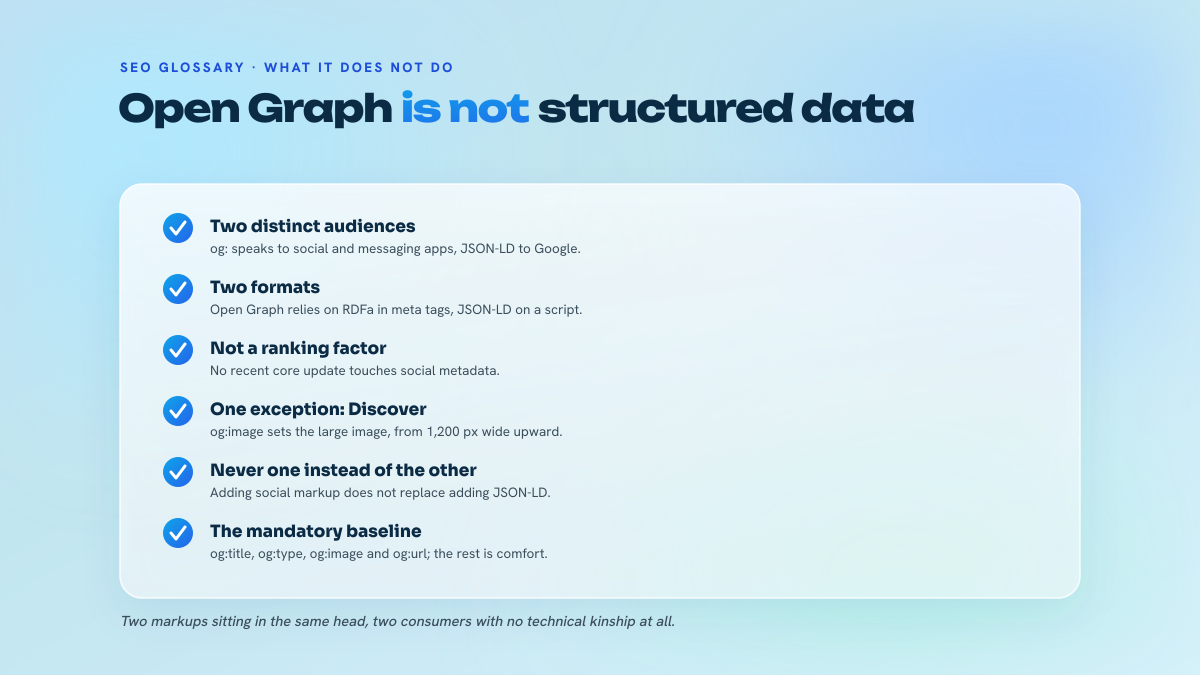
- →Open Graph is not a Google ranking signal and never was. The one documented exception is Discover, where Google's own documentation says og:image can be used to pick the large preview image, minimum 1,200 px wide.
- →The protocol specification has not changed since 2014. Everything that moved in the last two years is platform-side: caching behaviour, image selection, and the collapse of X's public card debugging.
- →Social crawlers read the initial HTML and generally do not execute JavaScript. An og:image injected after hydration is an og:image that does not exist for LinkedIn or Slack.
- →1,200 × 630 px at roughly 1.91:1 is the only baseline worth standardising on across Facebook, LinkedIn, Slack, Discord, WhatsApp and X-compatible renderers.
- →A site-wide default og:image is the single most common failure on publisher properties: every article shares as the same logo card, which quietly flattens click-through on every placement the site hosts.
- →Open Graph does not replace structured data. They answer different consumers: og:* feeds preview renderers, JSON-LD feeds search engines and increasingly the models reading your pages.
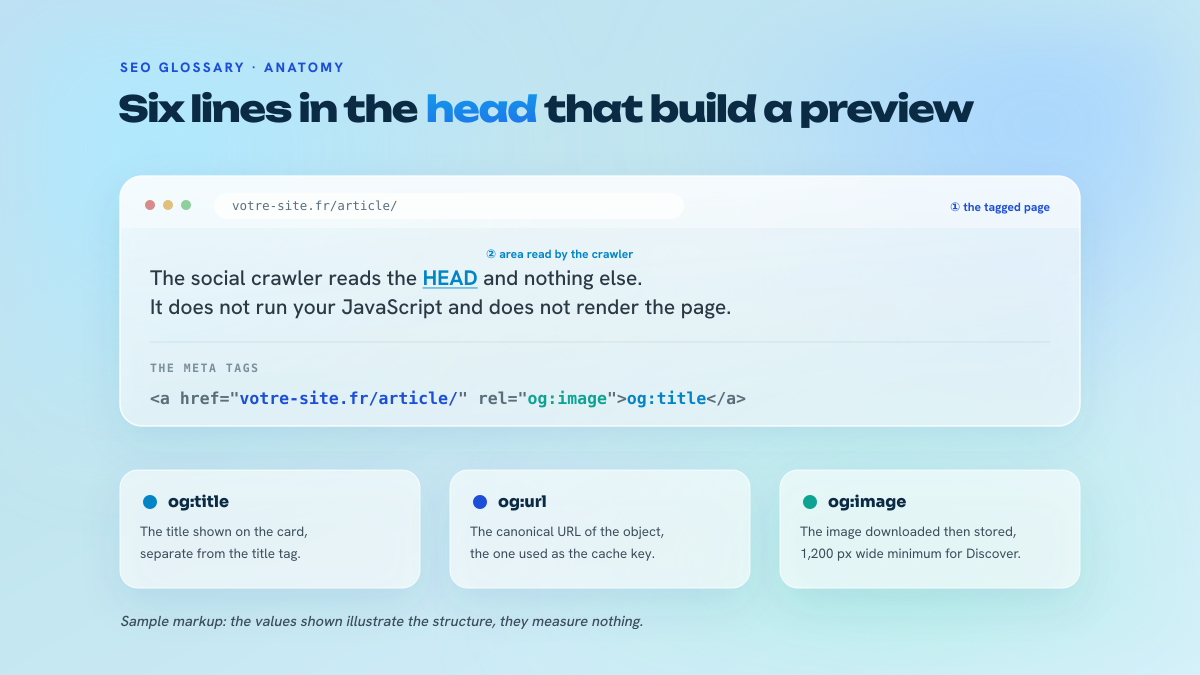
What Open Graph really is, past the definition line
Paste a URL into LinkedIn and something fetches the page within a second, reads the head, and renders a card. Open Graph is the contract that governs what goes into that card. Facebook published the protocol so any web page could declare itself as a rich object in a social graph, with four required properties: og:title, og:type, og:image and og:url. The specification has not moved since 2014. That immobility tells you what kind of asset this is: plumbing, not a moving target.
The dictionary version stops there. The operational version is that Open Graph quietly became the preview layer of the whole distribution web, far past Facebook. LinkedIn, Slack, Discord, WhatsApp, Signal, Telegram, iMessage, Notion and most X-compatible renderers all parse og:* meta tags. A 2026 industry-statistics compilation put Open Graph adoption at 67.7 % of sites using structured data, ahead of Twitter Cards at 52.4 % and JSON-LD at 49.7 %. Treat that as a secondary compilation rather than a primary crawl publication, but the ordering matches what we see in audits: the OG block is present long before anyone has bothered with a proper Article markup on their posts.
This short explainer covers the ground most people expect when they first meet the term:
Where the confusion starts is the ranking question, so let us settle it. Open Graph is not a Google ranking factor. No amount of og:description tuning moves a position, and Google's own list of the meta tags it supports treats social-preview metadata as a separate concern from indexing directives. There is exactly one documented exception, and it is the one worth knowing: Google's Discover documentation states that og:image can be used to specify the large image for a page, with a stated minimum of 1,200 px wide. That single property feeds a real Google surface, and for a publisher it is worth more than every other Open Graph refinement put together. Google ran a confirmed Discover ranking update from 5 to 27 February 2026, twenty-two days on the official status record, which is a reminder that the surface where og:image matters most is also the one Google keeps rebalancing.
How the protocol actually behaves in 2026
The mechanics are simple enough to fit in a paragraph, and the failure modes all live in the gaps between them. A platform crawler requests your URL, reads the initial HTML response, extracts every meta element carrying a property attribute in the og namespace, and caches the result. The four core properties define the object. og:description, og:site_name and og:locale refine it. Structured sub-properties do the rest of the work: og:image:width, og:image:height, og:image:alt, og:image:secure_url, and for editorial content the article:published_time and article:author extensions. og:type selects the object vocabulary, which is where article, video.movie, music.song and product live. You can declare an array of images by repeating the tag, and renderers pick the first one they can fetch.
Two behaviours dominate everything else. The first is that crawlers read the initial HTML and generally do not execute client-side JavaScript. Metadata injected after hydration produces a missing or stale card, which is why rendering your head on the server stopped being an optimisation and became a prerequisite for any React or Next.js property. The second is caching. Each platform holds its own copy of your card, on its own schedule, and none of them re-fetch just because you edited the tag. LinkedIn exposes a free re-scrape at linkedin.com/post-inspector, which refreshes the cached preview for future shares, but posts already published keep the preview they were born with. That asymmetry is why fixing an og:image after a campaign has gone out recovers nothing.
This walkthrough shows the sharing side of the same mechanism:
Measurement is the honest weak point of this topic, and most articles on it are not honest. The circulating figures, an often-quoted claim of 2.3× click-through for optimised previews versus generic ones, or a 25 % lift for descriptions opening with a question, come from marketing benchmarks whose sample, platform mix and controls are not published. Use them as a direction, never as a forecast. What you can measure yourself is cleaner: referral sessions per share, and Discover impressions in the Search Console performance report before and after you replace a site-wide default image with per-page images. That comparison is closed-world and it settles the argument in one reporting cycle.
Where it matters in a netlinking operation
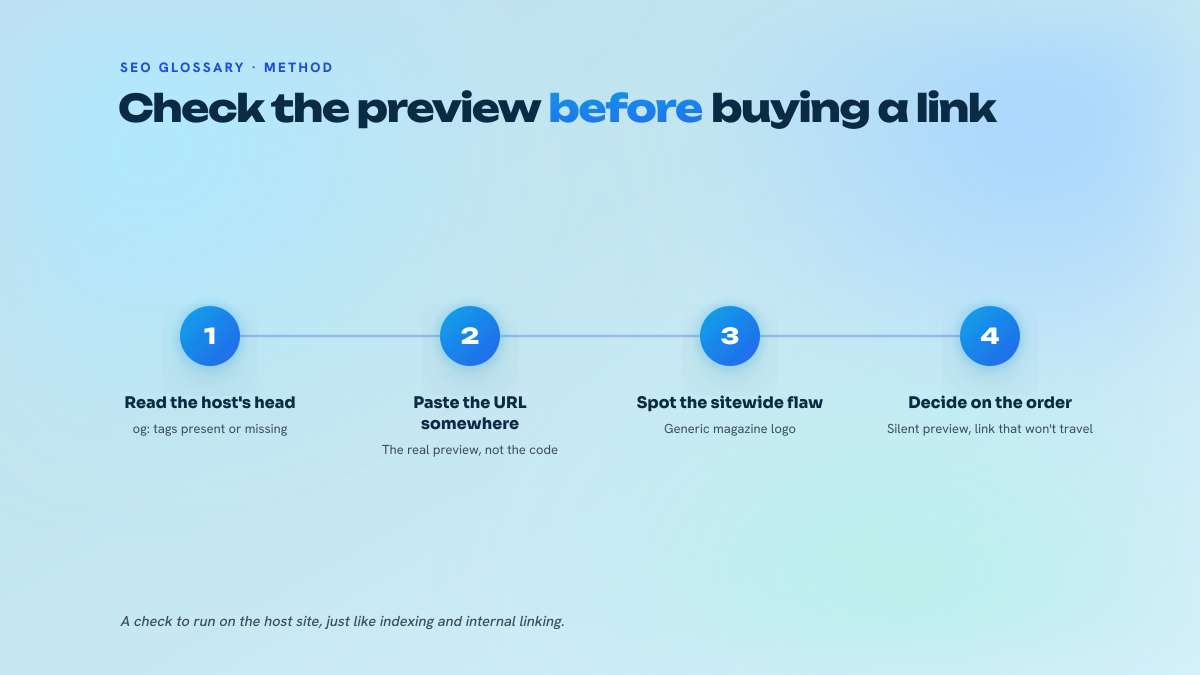
For a link-building team, Open Graph is a host-side quality signal that almost nobody checks. When you place a sponsored article on a media property, the preview that circulates is generated by that property's head, not by yours. If the host ships a single site-wide og:image, every article it publishes shares as the same logo card, and the placement you paid for gets a preview indistinguishable from a homepage link. That is not a ranking problem, it is a distribution problem: the article gets fewer secondary shares, fewer natural citations, and it ages faster.
This is one of the reasons operating your own media beats renting placements blind. Across the owned French editorial media we run at Nautilinks, per-page Open Graph is part of the template rather than an afterthought, because the same head also has to serve Discover correctly. If you are evaluating hosts you do not control, open the catalogue of media you can browse without an account, pick three article URLs at random on a candidate site, and diff their og:image values. Identical across all three is a template that was never finished, and it usually correlates with the rest of the head being neglected too.
The second reason this matters more in 2026 than in 2021 is that click-through on classic results is under pressure. A benchmark cited across the industry put AI Overviews at 13.14 % of queries against 6.49 % in January 2025, and Seer Interactive's September 2025 analysis reported organic click-through falling from 1.76 % to 0.61 % on queries showing an AI Overview, a 61 % decline. Those are study results, not a universal expectation for your site, but the direction is not in dispute: a share of discovery is migrating away from the ten blue links toward feeds, messaging apps and generative surfaces. Every one of those channels renders a card before a human decides to click. The preview stopped being cosmetic when the preview became the impression.
What we see go wrong in audits
Client-side injection is the number one offender on modern stacks. The tags exist in the DOM, they show up in the browser inspector, the developer swears the ticket is closed, and the LinkedIn card is still blank because the crawler never ran the bundle. Always verify with a raw fetch of the HTML, never with devtools.
Relative image paths come second. og:image must be an absolute URL with its scheme. A path starting with a slash resolves for your browser and for nothing else. Right behind it: images blocked to crawlers by a CDN rule or a robots directive, which produces the same empty card with no error anywhere in your logs.
Then there is the ratio trap. The practical cross-platform baseline that current implementation guidance converges on is 1,200 × 630 px, roughly 1.91:1. Teams design a beautiful square visual, every renderer centre-crops it to 1.91:1, and the headline baked into the image loses its top and bottom lines. If you must put text in an OG image, keep it inside the safe centre band and assume the edges will be eaten.
A mismatch between og:url and the canonical you declare elsewhere splits engagement counters across two identities and gives you two half-populated caches instead of one correct one. Keep them identical, always.
Finally, the tooling gap nobody warns juniors about: X deprecated its public Card Validator and there is no dependable official replacement. Current practice is to test through a draft post or a third-party validator. LinkedIn's Post Inspector still works and costs nothing, Facebook's Sharing Debugger still works, and for everything else you are on your own. Budget for that friction rather than discovering it on launch day.
Implementation that survives contact with production
Generate the image per page, not per site. Dynamic Open Graph image generation, rendering a page-specific visual at build time or at the edge from the title and a template, is now standard practice for editorial and campaign content, and it is the single change with the clearest return. For a magazine-shaped site it removes the default-logo problem permanently instead of relying on an editor remembering to upload a visual.
Render the head server-side, unconditionally, on every route. If your framework offers a metadata API that runs on the server, use it and forbid the client-side path in review. Ship og:image:width and og:image:height alongside the image so renderers can reserve layout before the fetch completes, and ship og:image:alt because it is the accessible label several platforms actually read out.
Keep Twitter Cards as a thin complement rather than a parallel system. Most X-compatible renderers fall back to og:* when a twitter:* equivalent is absent, so a single twitter:card declaration set to summary_large_image plus your Open Graph block covers the ground. Duplicating title and description across both namespaces just doubles the surface where they can drift apart.
This tutorial covers the hands-on part end to end:
And do not let anyone sell Open Graph to you as a substitute for real markup. It coexists with the structured data your pages already ship, it does not replace it, and the two answer different consumers. Google's December 2025 core update, eighteen days of rollout aimed at surfacing content the company describes as relevant and satisfying, is the reminder that no metadata layer compensates for weak content or a thin link profile. If the underlying page has nothing behind it, a perfect card just makes the bounce faster. When you are budgeting a campaign and want to see what a placement actually costs before committing, the head of the host page is worth thirty seconds of your attention, but it is the content and the link that you are buying.
Nautilinks operates an owned network of editorial media. In-house written articles, transparency disclosures respected, anchor mix calibrated.
Frequently asked questions
Is Open Graph free, or does using it require anything from Facebook?
Free, with no registration, no API key and no relationship with Meta. Open Graph is an open specification you implement by adding meta tags to your own HTML. Facebook authored it and hosts the spec, but nothing about using it is gated. The free part extends to the tooling: LinkedIn's Post Inspector and Facebook's Sharing Debugger both cost nothing. The only real cost is engineering time, mostly around generating per-page images and making sure the head renders server-side.
Is Open Graph still used in 2026, or has something replaced it?
Still used, and nothing has replaced it. The specification has not changed since 2014, which reads as abandonment but is actually stability: LinkedIn, Slack, Discord, WhatsApp, Telegram and most X-compatible renderers all still parse og:* tags, and Google's Discover documentation still names og:image as a way to specify the large preview image. What changed is the surrounding context, not the protocol. More discovery now happens in feeds, messaging apps and generative surfaces, so previews get rendered more often than they did five years ago.
Does Open Graph do anything for rankings, or is it purely social?
Purely social, with one documented exception. Google's supported meta tags list keeps preview metadata separate from indexing signals, and there is no evidence og:title or og:description influences a position. The exception is Discover, where Google's own documentation says og:image can be used to select the large image, minimum 1,200 px wide. If Discover is a traffic channel for your property, that one property is worth optimising seriously. Everything else in the OG block is distribution quality, not search performance.
Open Graph or Twitter Cards: do I need both?
Implement Open Graph fully, then add one twitter:card declaration set to summary_large_image and stop. Most X-compatible renderers fall back to og:* when the twitter:* equivalent is missing, so duplicating title, description and image across both namespaces buys nothing and creates a second place for values to drift. Worth knowing before you plan the work: X deprecated its public Card Validator, so verification now means posting a draft or using a third-party validator.
Why does my card still show the old image after I fixed the tag?
Each platform caches your card independently and none re-fetch on your schedule. LinkedIn re-scrapes on demand through Post Inspector, which refreshes the preview for future shares, but posts already published keep the preview they were created with. Facebook's Sharing Debugger does the same job on its side. There is no global purge, so plan the fix before a campaign goes out rather than after, because anything already circulating is frozen.
How do I check Open Graph on a site I do not control before buying a placement?
Fetch the raw HTML of three article URLs on the property, not the rendered DOM, and compare their og:image values. Identical images across all three means a site-wide default, which flattens the preview of every article the site publishes including yours. Then check that og:url matches the canonical and that the image resolves as an absolute URL over HTTPS. Two minutes of work, and it tells you how carefully the rest of the template was built.
Test your knowledge
Quiz: Open Graph
1/3Which Google surface does an Open Graph property feed according to Google's own documentation?