- →PageRank was retired as a public toolbar number in 2016, never as a computation: the 2024 Content Warehouse leak documented rawPagerank, pagerank2 and a nearest-seed variant as live attributes, plus a domain-level siteAuthority signal.
- →Link equity decides which URLs enter the consideration set; NavBoost-style behavioural re-ranking then reorders pages with comparable link profiles. Buying more links to close a three-position gap is usually the wrong lever.
- →Since March 2020 nofollow is a hint, not a directive, and internal nofollow sculpting has been dead since 2009: the blocked share evaporates instead of redistributing. Remove competing links or add pointing links instead.
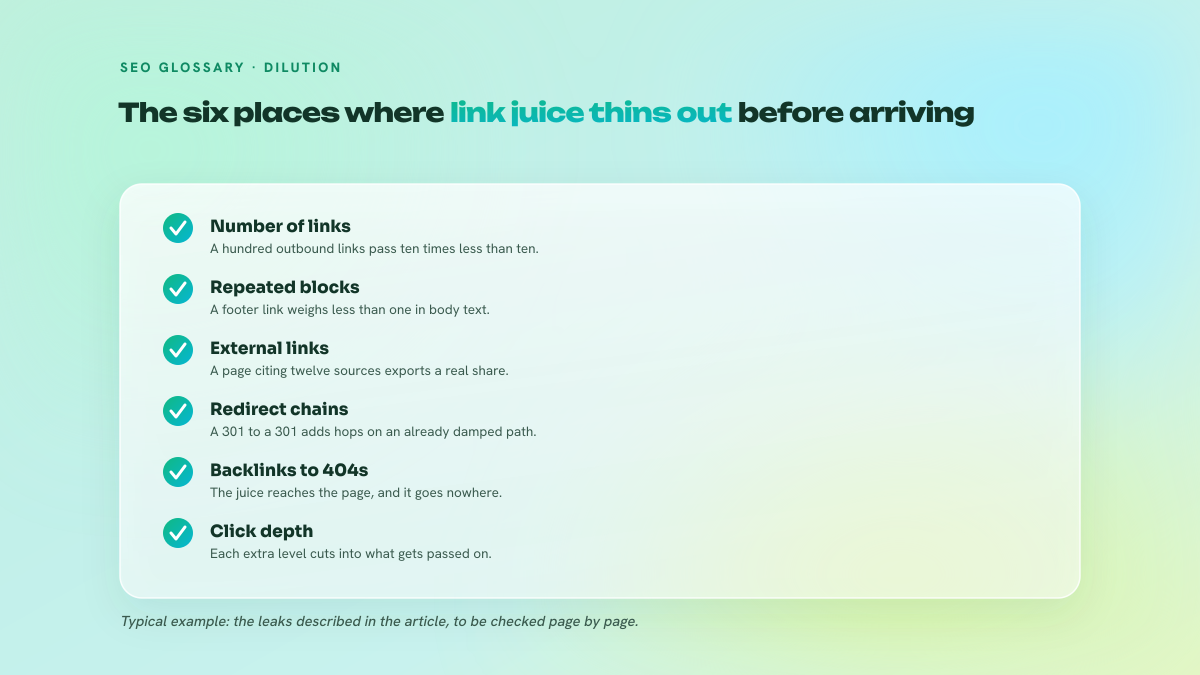
- →Dilution is arithmetic, not folklore. A page emitting eighty links passes a fraction per link of what the same page passes emitting five, which is why a contextual in-body link on a tight article beats a footer slot on a stronger domain.
- →Link spam updates devalue retroactively and Google states that once spammy links are neutralised the ranking benefit cannot be regained: budget for links that survive the next update, not for links that pass this quarter.
- →AI Overviews raised the price of not ranking: Search Engine Land reported in 2025 that 99.5% of sources cited in AI Overviews already sit in the top 10 organic for the query, so link equity now also gates AI citation.
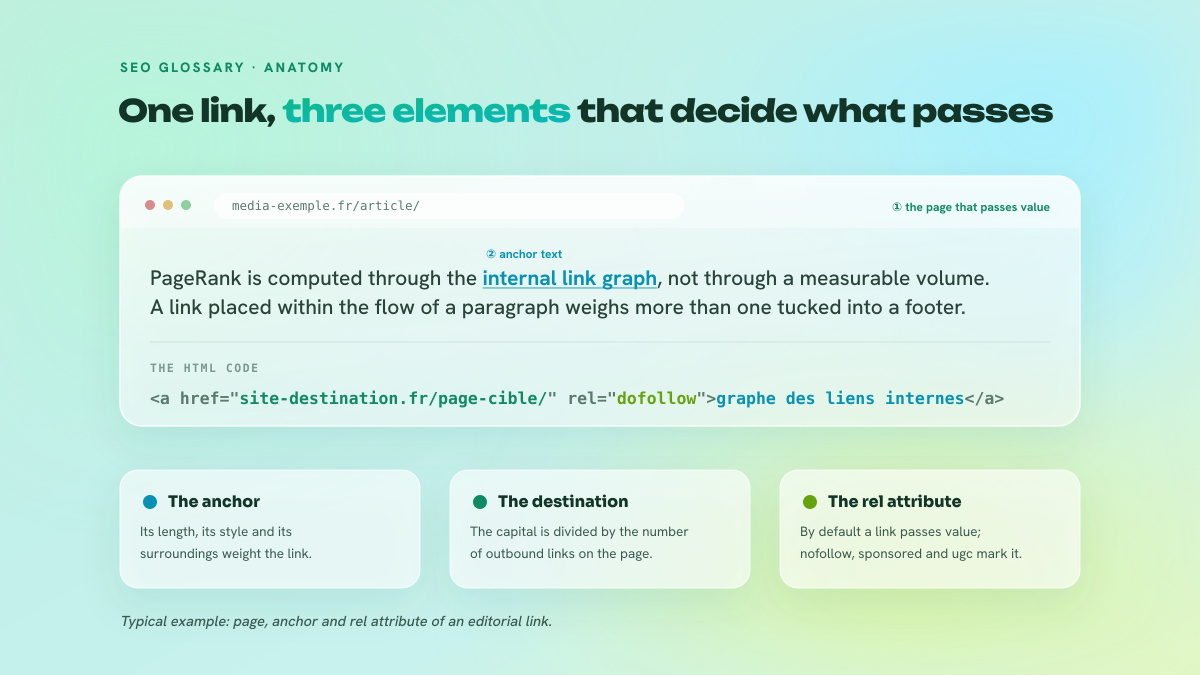
What link juice actually is, past the plumbing metaphor
Link juice is operator slang for link equity: the ranking value a page transmits to the pages it points at. The plumbing image is imprecise and still the fastest way to name the real object, which is PageRank, a recursive probability score computed over the link graph where a page's value derives from the value of the pages linking to it, divided by how many links those pages emit. None of that is news. What changed recently is that we argue from documentation instead of inference.
The Google Content Warehouse documentation published by accident between late March and early May 2024, and reported on 27 May 2024, exposed roughly 2,596 internal modules and around 14,000 attributes. Among them sat several live PageRank variants, including rawPagerank, pagerank2 and a nearest-seed formulation, alongside a domain-level signal named siteAuthority described as a modernised, link-driven authority score. That inventory contradicts a decade of « PageRank is mostly deprecated » messaging. The public toolbar number died in 2016. The computation never did.
The operational reading for 2026: link juice is not folk vocabulary standing in for nothing. It is the closest available name for the internal quantity that decides which URLs are eligible to compete at all. A page can be perfectly written, correctly structured and semantically on target, and still never surface, because nothing points at it with enough weight to lift it into the candidate set. Every argument below follows from that.
How the transfer works, and what sits on top of it
The mechanic has not moved since the original 1998 Brin and Page paper: a page distributes its score across its outbound links, moderated by a damping factor (0.85 in the original formulation) that models the probability a random surfer keeps clicking rather than jumping elsewhere. A page emitting five links passes a far larger share per link than the same page emitting eighty. That division is the entire reason dilution exists as a concept, and it explains why a sidebar link on a link-farm directory is a rounding error next to an in-body link on an article that points at three destinations.
A short visual primer before we get into the factors that modulate the transfer:
What changed is the layer sitting above the graph. DOJ testimony in 2023 and the 2024 leak both surfaced NavBoost, a click-based re-ranking system fed by goodClicks, badClicks and lastLongestClicks. The practical model is now two-stage: link equity largely determines which URLs enter the consideration set for a query, then behavioural signals reorder pages that are similarly linked. This is why two URLs with comparable referring-domain profiles can sit three positions apart and stay there for months. Throwing more links at that gap is the wrong lever, and we watch agencies pull it every quarter because links are the only lever they sell.
What decides how much actually passes
Four variables do most of the work. First, the authority of the source page, not the source domain: a freshly published URL on a strong site carries almost nothing until it has received internal links itself, which is why a link placed in a brand-new article on a well-known publication underperforms what the domain metric promised. Second, topical proximity between source and target, which has been part of the model since the nearest-seed logic and remains the single best predictor we have of whether a link moves anything. Third, placement: main content transmits, boilerplate does not, and a link embedded in the running text of a relevant paragraph is worth several footer slots. Fourth, the number of competing outbound links on that page.
Then the rel attributes. Dofollow is not an attribute, it is the absence of one: a plain anchor transmits by default. rel="nofollow" arrived in 2005 against comment spam and stopped being a directive in March 2020, when Google reclassified it as a hint, alongside rel="ugc" and rel="sponsored" introduced in September 2019. Hint means Google decides, case by case, with no way for you to observe the outcome. In practice a link flagged as nofollow from a major publication is probably not worth exactly zero, but you cannot model it, so price it at zero and treat any residual as a bonus. Anyone selling nofollowed placements at followed prices is arbitraging your uncertainty.
PageRank sculpting, the practice of nofollowing internal links to funnel more equity into money pages, has been dead since Google clarified in 2009 that the blocked share evaporates rather than redistributing to the remaining links. It still surfaces in audits in 2026, usually as a legacy plugin setting nobody revisited. If you want a page to receive more equity, delete the links that compete with it or add links that point at it. Do not try to crimp the pipe.
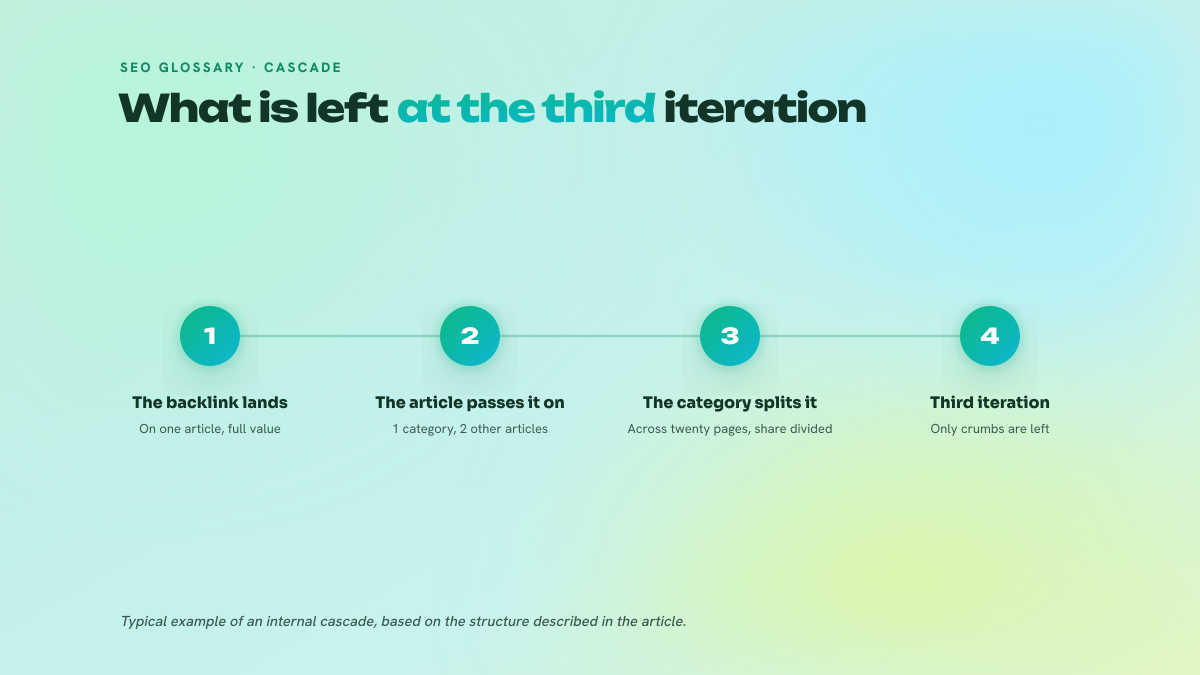
Dilution, and why internal linking beats hoarding
Dilution is arithmetic, not superstition. Every additional outbound link on a page reduces the share carried by the others. A homepage with 180 links in a mega-menu spreads its accumulated equity so thinly that its most valuable child pages receive almost nothing distinguishable from the least valuable ones. That is the most common structural defect we find, and it costs nothing to fix beyond an argument with whoever owns the navigation.
Internal linking is where most sites have unclaimed value, because it is the only part of the graph you fully control. Three rules cover the bulk of it. Keep the number of links on high-equity templates low enough that the distribution stays meaningful. Point from your strongest earning pages, usually the ones that attracted external links, towards the pages you actually need to rank, not towards generic hubs. Kill orphan pages, since a URL reachable only from the sitemap receives no equity at all and behaves, in ranking terms, like a page that does not exist.
The silo discipline that competitors describe at length is a means, not an end. What matters is that the paths carrying equity go where commercial value is, and that the click depth from a linked page to a target page stays short. We audit this by crawling the site, computing an internal PageRank on the crawl graph, and comparing the ranking against the list of pages that are supposed to earn money. When the two lists disagree, the fix is a linking pass, not a link purchase.
What we see go wrong in audits
The dominant error is treating link equity as a stock you accumulate rather than a flow you can lose. Link spam updates devalue retroactively: the August 2025 spam update rolled out globally from 26 August to 22 September 2025, the longest in recent memory, and analyses of affected local sites showed pages propped up by exact-match anchor spam losing visibility even when the offending links were five years old. Google's own guidance, restated in coverage of the June 2026 spam update, is blunt: once spammy links are neutralised, any ranking benefit they generated cannot be regained. Cleaning up afterwards restores nothing. It only stops the bleeding.
Second error: buying on domain-level metrics alone. Domain Rating and its equivalents are third-party approximations computed from crawls that Google does not use. They correlate loosely with the thing you want and are trivially inflated. A DR 60 domain whose article pages receive no internal links transmits less than a DR 30 site with a tight structure and genuine topical overlap.
Third: over-disavowing. Every quarter someone hands us a disavow file containing legitimate referring domains, uploaded on the theory that pruning weak links concentrates the rest. It does not work that way. Disavowal removes equity, it does not redistribute it, and Google has spent years telling people the tool is for manual actions and genuine self-inflicted spam.
Fourth: measuring the wrong thing. Referring domain counts move fast and mean little. What we track instead is whether target pages gained impressions on non-branded queries in Search Console within eight to twelve weeks of a link going live, on symmetric before and after windows. If nothing moved on impressions, the equity did not land, whatever the metric on the invoice said.
Earning and buying link equity without wasting it
The value of link equity went up in 2026, not down, because the cost of not ranking went up. Search Engine Land reported in 2025 a study finding that 99.5% of sources cited in AI Overviews already sit within the top 10 organic results for that query, and SE Ranking's end-2024 analysis put at over 92% the share of AI Overviews citing at least one top-10 organic result. Meanwhile Ahrefs measured in December 2025 a 58% drop in click-through rate for position one on queries where an AI Overview appears, with Seer Interactive's longitudinal study over 3,119 informational queries finding organic CTR falling 61%, from 1.76% to 0.61%. Fewer clicks per ranking, and ranking is now the entry ticket for being cited at all. Marginal equity buys less traffic and more eligibility.
Practically, that argues for fewer and better placements. Editorial links inside genuinely relevant articles, on pages that are themselves linked from within their host site, at a pace consistent with the site's history. Reclaiming unlinked brand mentions and fixing 404s that still receive backlinks is unglamorous and remains the highest return per hour on most audits, because the equity already exists and is simply being dropped on the floor. When you do pay, know what the host page looks like before the invoice: you can browse the media catalogue without creating an account, and it is worth comparing what a link actually costs when nobody takes a cut in the middle against what a marketplace quotes for the same slot.
Across the French editorial media we operate in-house, the internal rules are identical on every site: articles carry a small number of outbound links, placements sit in the body, and no page is published without internal links pointing at it, because a host page with no equity of its own transmits none to you. That is also why buying from a network that runs its own titles differs from buying through an intermediary reselling access: you can place a link directly with the publisher and see the page it lands on before it goes live. The transfer of equity is decided by that page, not by the transaction.
Nautilinks operates an owned network of editorial media. In-house written articles, transparency disclosures respected, anchor mix calibrated.
Frequently asked questions
Is PageRank still running, or is link juice a legacy concept?
Still running. The 2024 Content Warehouse documentation listed several live PageRank attributes, including rawPagerank, pagerank2 and a nearest-seed variant, plus a link-driven siteAuthority signal. What disappeared in 2016 was the public toolbar number, not the computation. The realistic change is relative weight: link equity now determines eligibility, then behavioural re-ranking systems reorder pages with similar link profiles. So the concept is current, but it explains less of the final position than it did in 2015.
Is buying links illegal, and does bought equity actually pass?
Not illegal anywhere we operate. It violates Google's link spam policy, which is a commercial risk, not a legal one. Paid links do pass equity until they are detected, and detection targets patterns: exact-match anchors at scale, sites with no audience, footprints across host networks. The relevant question for a buyer is not legality but durability. Link spam updates devalue retroactively, and Google states the benefit from neutralised links cannot be recovered, so cheap volume is a lease, not a purchase.
Does a nofollow link transmit anything since it became a hint in 2020?
Possibly, and you cannot measure it. Reclassifying nofollow as a hint means Google may choose to use the link for crawling and ranking, with no signal back to you about whether it did. Our position: price nofollow placements at zero and count any lift as a bonus. Where they genuinely earn their place is in reference and discovery, a nofollowed mention on a large publication still drives traffic and often triggers followed citations elsewhere. Paying followed-link rates for them is not defensible.
How do you actually measure whether a link passed equity?
Not with referring domain counts. We compare Search Console impressions on non-branded queries for the target URL over symmetric windows, typically eight to twelve weeks before and after the link goes live, and check whether the page moved into new query clusters rather than just gaining a position. On internal linking, crawl the site and compute an internal PageRank on the crawl graph, then compare that ranking against your commercially important pages. Disagreement between the two lists is the actionable finding.
Should I nofollow internal links to concentrate equity on money pages?
No. That approach died with Google's 2009 clarification that the share allocated to a nofollowed internal link evaporates instead of redistributing to the remaining links. You end up with less total equity in circulation, not a better distribution. The working alternatives are structural: reduce the number of links on high-equity templates, point earning pages at target pages directly, cut click depth, and remove orphan URLs. We still find sculpting configurations left over in plugin settings during 2026 audits.
Do backlinks still matter if AI Overviews are absorbing the clicks?
They matter more per click and less per impression. Search Engine Land reported in 2025 that 99.5% of sources cited in AI Overviews already rank in the top 10 organic for the query, so link equity is now the gate for AI citation as well as for classic ranking. At the same time Ahrefs measured a 58% CTR drop for position one on AI Overview queries in December 2025. Ranking buys visibility and citation, but converts fewer visits than it used to.
Test your knowledge
Quiz: Link juice
1/3What did the 2024 Google Content Warehouse documentation reveal about PageRank?