- →Link bait is not a content genre, it is a job: being the thing a third party needs to finish their own argument. If the asset is not useful to a journalist or a specialist independently of your SEO goal, it will not be cited.
- →The base rate is a power law, not a bell curve. Backlinko’s analysis of 912 million posts (run with BuzzSumo) found 94% of pages earned no external backlinks and only 2.2% earned links from more than one site, so plan one strong asset per quarter rather than twelve competent ones.
- →Data-led and expert-led formats dominate because they match what editors actually need: a 2025 digital PR benchmark put data-led content at 94.8% and expert commentary at 92.5% of practitioner output, while Cision’s 2026 survey of over 1,800 journalists found 86% reject pitches misaligned with their beat.
- →Reporting only links now understates the asset. Ahrefs’ study of 75,000 brands found branded web mentions correlated with AI Overview presence at 0.664, ahead of backlinks or domain rating, and Google AI Overviews linked to a mentioned brand only 10.7% of the time versus 51.6% for Perplexity.
- →Your money pages are almost never the asset. The reference page earns the links, internal linking moves the equity to the page that sells, and confusing the two is the most common reason a campaign produces nothing.
- →A great asset can still be devalued by the pattern around it: exact-match anchors at scale, scaled guest posting or a velocity spike will read as manipulation regardless of how good the piece is.
What link bait actually is, past the definition
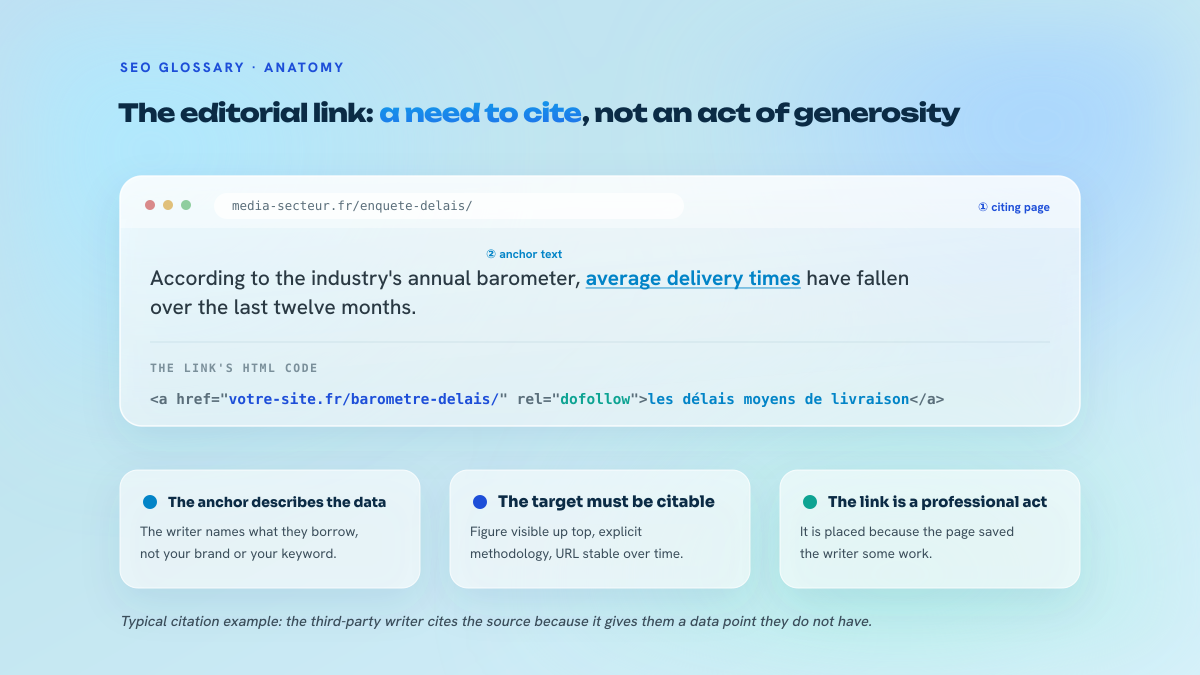
Every link you did not have to ask for exists because an editor, a journalist or a blogger decided that pointing at your page made their own page better. Link bait is the deliberate engineering of that decision: an asset whose usefulness to a third party is so obvious that citing it becomes the path of least resistance. The bait is not a trick, the bait is the utility.
The confusion with clickbait is worth killing on the first paragraph, because the two optimise for opposite audiences. Clickbait optimises for a click from a passive reader and structurally under-delivers on its headline. Link bait optimises for a citation from someone who publishes, and it has to over-deliver, because the person linking is putting their own credibility behind you. Linkbaiting is just the process noun: the campaign that turns an idea into an asset and puts it in front of the people who can cite it. A piece can be strong link bait and weak clickbait, and that is usually a good sign about the piece.
If you want the definition framed in a minute before we get operational:
The second distinction matters more in practice: a linkable asset is not a good article, and it is almost never your commercial page. A page that ranks and converts is built for a buyer. A page that gets cited is built for a publisher. They are different documents with different success criteria, and the asset does not need to sell anything. It earns the referring domains, then your internal linking carries the equity toward the pages that make money. Teams that skip that second step end up with a well-linked study and a product page that still sits on page three.
Why it works, and why most of it does not
The base rate is where every link bait plan should start. The Backlinko analysis of 912 million blog posts, produced with BuzzSumo, found that 94% of pages received no external backlinks at all, and the same research is commonly summarised as showing only 2.2% earning links from more than one website. That study predates the current cycle, so read it as a structural fact about the web rather than a 2026 measurement: link acquisition is a power law and the median page sits at zero. Producing more average content does not move you along that curve, it just adds mass to the zero bucket.
Length correlates with links without causing them. The same dataset found content over 3,000 words earned 77.2% more backlinks than pieces under 1,000 words, which mostly reflects the fact that long pieces tend to contain more citable units: a table, a methodology, a chart, a definitive number. What actually triggers a link is a writer stuck mid-sentence. They need a figure to prove a point, a tool so they do not have to explain a calculation, or a position to argue with. Those are the three reflexes worth engineering against, and they are the reason a 600-word post with an original dataset outperforms a 4,000-word guide that synthesises what everyone already published.
The psychology is not mysterious either. People cite what makes them look informed and what costs them nothing to verify. That is why methodology sections and downloadable raw data punch above their weight: they lower the reviewer’s risk. And it is why a viral spike on social platforms is a weak proxy. Social distribution reaches readers, links come from publishers, and the overlap is thinner than most campaign decks assume.
The formats that still earn links in 2026
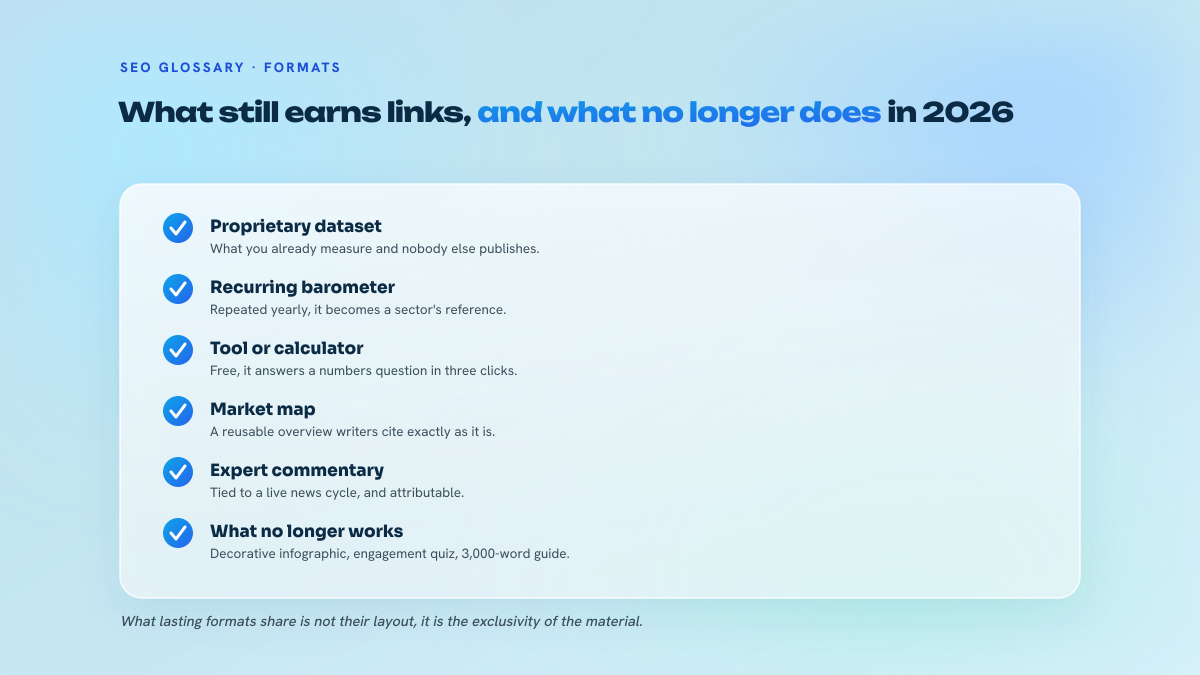
The market has narrowed. Generic ultimate guides and decorative infographics are commoditised: anyone can produce them in an afternoon now, and editors know it. What still earns editorial coverage is proprietary data, working tools and a named point of view. A 2025 digital PR benchmark reported 94.8% of practitioners using data-led content and 92.5% using expert commentary, which tells you both what works and how crowded the lane has become. Doing data-led content is table stakes, doing it on a dataset nobody else holds is the differentiator.
Original research is the strongest genre because it creates a citation dependency: once your figure becomes the reference number in a niche, every future article on the topic has to route through you. Semrush’s recurring most-visited-websites study is the textbook case, a dataset republished every year that accumulates references passively. You do not need that scale. A survey of 200 practitioners in your vertical, or an analysis of data your product already logs, produces the same mechanic at a fraction of the cost.
Interactive tools and calculators are the second reliable genre, and they age better than any article: a working calculator keeps earning references for years while a guide decays. Expert commentary sits third, and it is the fastest to ship when a news cycle opens. Contrarian positions do work, but treat them as a limited-use instrument. A defensible stance backed by data earns links from people who disagree with you; a hollow provocation earns a week of attention and a lasting credibility cost, and it is the one format where the difference between link bait and clickbait collapses fastest.
Building the asset and putting it in front of people who cite
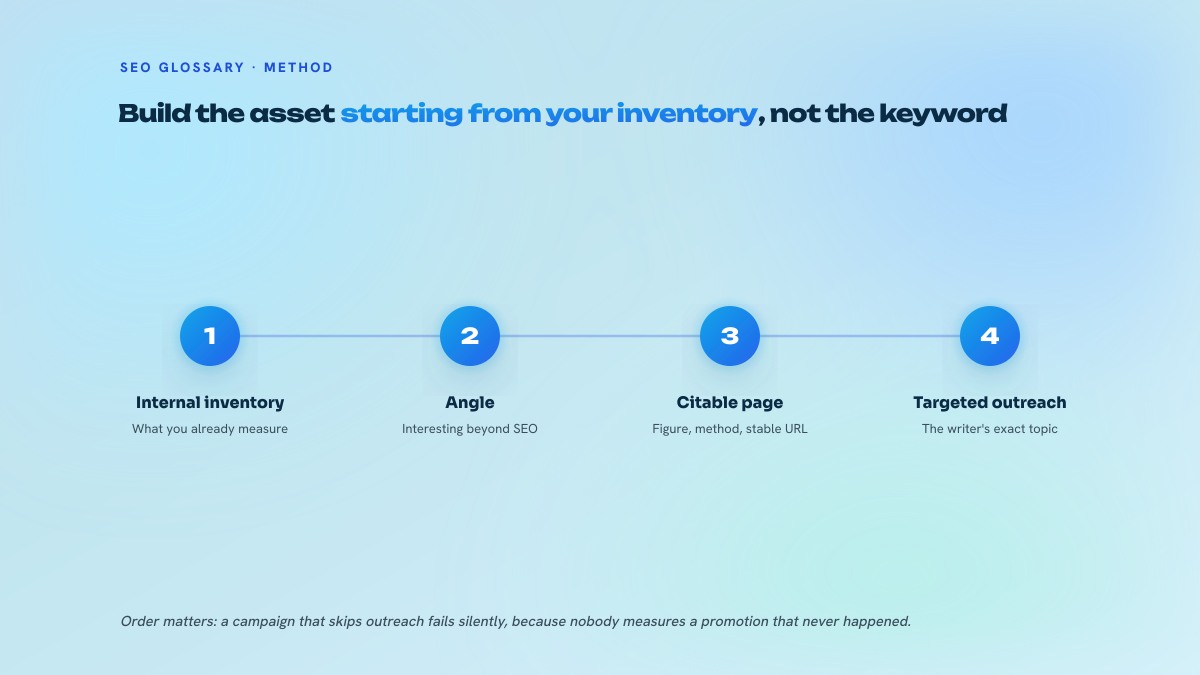
The sequence that works runs backwards from the citation. Decide which sentence, in which type of article, you want to be the source for. Identify the fifty or so publications that write that sentence regularly. Then pick the format that answers their recurring need, and only then build. Teams that reverse this order build something they find interesting and discover afterwards that nobody in their space has a reason to reference it.
This walkthrough of the build process covers the same ground from the practitioner side:
Promotion is where most budgets are wasted, and the data on the receiving end is unambiguous. Cision’s 2026 research, surveying more than 1,800 journalists, found 86% reject pitches misaligned with their beat or audience, 47% want compelling data and 45% want embargoed or early-access material. Read those three numbers as a pitch specification: relevance is a hard filter, data is the currency, and exclusivity is the lever you still control. Twenty pitches written for a specific desk beat four hundred sent to a scraped list, and the failure mode is not tone, it is targeting.
The honest limitation of link bait: it is unpredictable and it does not scale on a calendar. One asset in four lands, and the ones that land do so on someone else’s news cycle. That is why serious operations run it alongside a predictable base rather than instead of one. On our side that base is a network of owned French editorial media where placement is a decision, not a hope, and where you pick the host media yourself, one placement at a time. Earned assets build the reference layer and the brand signal, the owned layer keeps the profile growing while you wait for the next asset to hit. Anyone selling you either one as a complete strategy is selling you their inventory.
Measuring it past the link count
Reporting a link bait campaign as a number of referring domains is now the fastest way to under-report your own work. Google shipped Search Generative AI performance reports in Search Console on 3 June 2026, exposing impressions from AI Overviews, AI Mode and generative Discover features while keeping that data inside the overall performance report. That is the first usable window into a surface where your asset can be the source of an answer without anyone clicking anything.
The volume on that surface moved fast. Ahrefs, analysing 25 million AI Overviews, reported that the number of Overviews grew 116% between 12 March and 6 May 2026, following Google’s March core update. The citation economics are lopsided: in a separate Ahrefs analysis of more than 31,000 brand mentions across a database of 150 million AI prompts, Google AI Overviews linked to the mentioned brand only 10.7% of the time, against 51.6% for Perplexity. Your dataset can be feeding answers all quarter while your backlink profile shows almost nothing.
Which is why the unlinked mention of your brand without a hyperlink deserves its own line in the report. Ahrefs’ study of 75,000 brands found branded web mentions correlated with AI Overview presence at 0.664, more strongly than backlinks or domain rating. Practitioners have already adjusted: BuzzStream’s 2026 State of Digital PR survey of 150 respondents found 55.4% now tracking AI-citation mentions as a success metric, while the share reporting increased organic traffic or rankings fell from 78% in 2025 to 63.5% in 2026. Read that drop as reporting catching up with reality, not as digital PR stopping to work.
Monitoring that second surface is not free, and it deserves an explicit line in the campaign budget. Ahrefs’ Brand Radar is reported at $199 per month per AI index, or $699 per month for all-platform access, generally on top of a paid plan whose Standard tier is reported at $249 per month in 2026. Semrush One, which bundles classic SEO with AI Visibility, is reported to start at $199 per month. Before committing that to tooling, put it next to what the same spend buys in actual placements: what a placement costs on our side is public, which makes the arbitrage a five-minute calculation rather than a debate.
What we see go wrong
The first failure is the swap: a team commits to link bait, ships clickbait, and gets traffic with zero citations. The tell is in the asset itself. If a journalist cannot extract a fact, a number or a tool from it, there is nothing to link to and the headline was the whole product.
The second is treating the campaign as a launch instead of an asset. One round of outreach, no follow-up, no refresh, and the piece dies in six months while its early links rot. Datasets should be re-run and re-pitched, calculators should be maintained, and broken references to your own asset are worth reclaiming.
The third is the pattern around the asset rather than the asset itself. When a page that sat at zero suddenly collects fifty links in a fortnight, the shape of the acquisition curve over time becomes a signal in its own right, independent of the quality of what earned them. Add exact-match anchors at scale or a wave of guest posts published around the launch, and you have manufactured a footprint on top of a legitimate asset. Google’s enforcement direction over the last year is consistent on this: the August 2025 spam update rolled out from 26 August to 22 September 2025, taking roughly 26 to 27 days, and the June 2026 spam update ran from 24 to 26 June per Google’s own status record. Neither targets link bait as a category. Both make scaled, manufactured acquisition patterns more expensive to run.
This retrospective on abandoning linkbait as a primary tactic is worth the ten minutes, particularly on the ethics question:
On the paid question, we are the last people who will pretend the line is clean: we sell placements on media we own and we label them as such. BuzzStream’s 2026 survey found roughly 80% of respondents saying they never buy links, which is a statement about self-reporting as much as about practice. The operational truth is narrower than the moral debate. What gets a profile devalued is not the existence of a transaction, it is a pattern that looks engineered: identical anchors, identical publication rhythm, hosts with no audience. A campaign calibrated over several months by someone who watches the curve and mixes earned assets with paid placements on real editorial sites is a different risk profile from a hundred links bought in the week your study went live.
The last mistake is quieter and costs the most: building the asset for Google. If the piece only makes sense as an SEO play, editors feel it immediately and the pitch dies in the inbox. The test is simple. Would a specialist in your field use this if search engines did not exist? If the answer is no, no amount of outreach will fix it.
Nautilinks operates an owned network of editorial media. In-house written articles, transparency disclosures respected, anchor mix calibrated.
Frequently asked questions
Is link bait exposed under Google’s current spam policies?
The asset is not the problem, the acquisition pattern is. Google’s spam policies target paid links passing ranking signals, excessive exchanges, scaled guest posting with optimised anchors and other attempts to manipulate PageRank. Original research, tools and genuinely newsworthy stories sit outside that. The risk appears when you wrap a legitimate asset in manufactured amplification: identical anchors, a burst of paid posts timed to the launch, hosts with no real audience. That combination reads as manipulation even when the underlying piece is excellent.
How do you tell link bait from clickbait when both engineer attention?
By who you are optimising for and what happens after the click. Clickbait targets a reader and delivers less than the headline promised, which is why it converts attention into nothing durable. Link bait targets a publisher and has to over-deliver, because that person stakes their credibility on the reference. Practical test: can someone extract a citable unit from the page, a figure, a method, a working tool? If the headline was the entire product, you built clickbait and no outreach list will save it.
What is a realistic link target for a single asset?
Set the target on referring domains, not links, and expect a power-law outcome rather than an average. The Backlinko and BuzzSumo analysis of 912 million posts is the reference point: 94% of pages earn no external backlinks and only 2.2% earn links from more than one site. In practice one asset in three or four lands meaningfully. Budget for one serious asset per quarter with real promotion behind it instead of monthly pieces that each get a token outreach round.
Does link bait still pay off if AI Overviews rarely link out?
It pays off differently, and you have to change the report to see it. Ahrefs found Google AI Overviews linked to a mentioned brand only 10.7% of the time versus 51.6% for Perplexity, so a lot of value arrives as unlinked mentions and impressions. Their study of 75,000 brands also found branded mentions correlating with AI Overview presence at 0.664, above backlinks or domain rating. Track mentions and the Search Console generative reports Google shipped on 3 June 2026 alongside referring domains.
How long should you promote an asset before writing it off?
Two to three weeks of active pitching answers whether the angle works, and the signal is reply rate rather than link count. If beat-relevant journalists are not replying, the problem is targeting or the angle, not persistence. Cision’s 2026 survey of over 1,800 journalists found 86% reject pitches misaligned with their beat. After that window, shift the asset to passive accumulation: internal linking, updating the data, and re-pitching on the next relevant news cycle rather than sending more cold emails.
Do you need original data, or can a well-made guide still work?
A guide can rank, but it rarely gets cited any more because it contains nothing a writer cannot source elsewhere. Citations require ownership of something: a dataset, a survey, a working tool, a named position. A 2025 digital PR benchmark put data-led content at 94.8% of practitioner output, which is exactly why undifferentiated synthesis no longer earns coverage. If you have no proprietary data, the cheapest entry point is a survey of a few hundred people in your vertical or an analysis of what your own product already logs.
Test your knowledge
Quiz: Link bait
1/3According to the Backlinko and BuzzSumo analysis of 912 million blog posts, what share of pages earned no external backlinks?