- →Intent belongs to the query as Google resolves it, not to the keyword string: if the top 10 are guides and the page you plan is a product page, the intent argument is already lost.
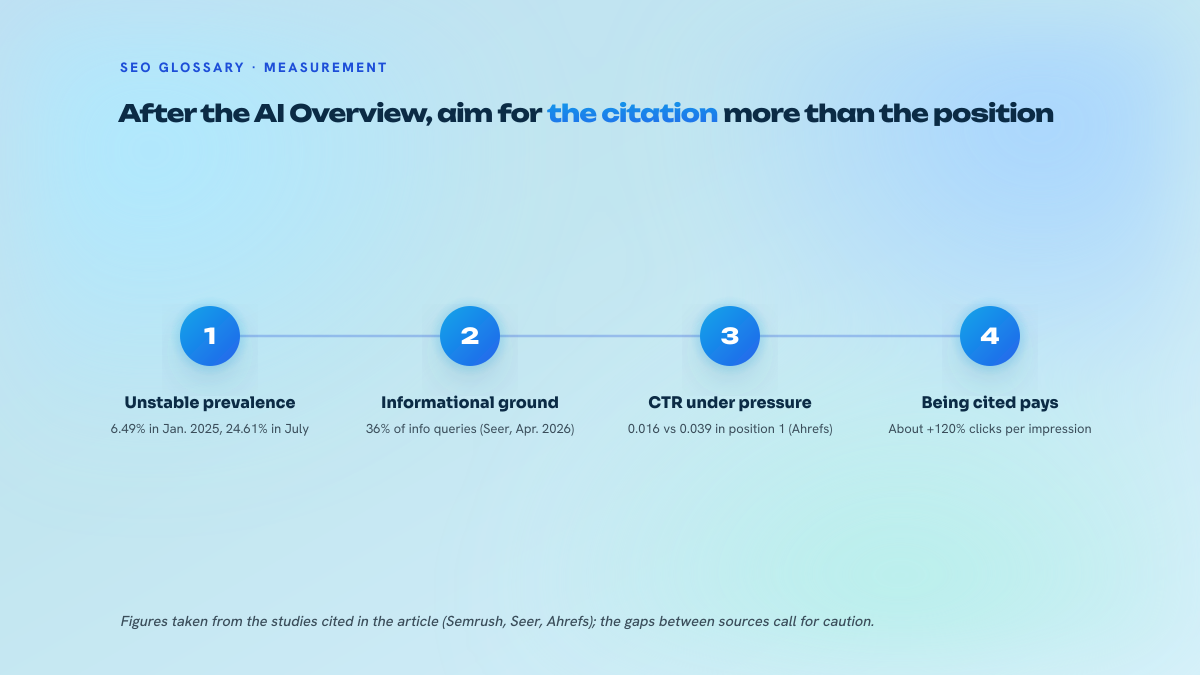
- →Informational is the largest bucket and the most eroded one: SE Ranking's 2025 split put around 53% of queries in it, and Ahrefs' December 2025 study on 300k keywords measured a ~58% drop in position-1 CTR on keywords that trigger an AI Overview.
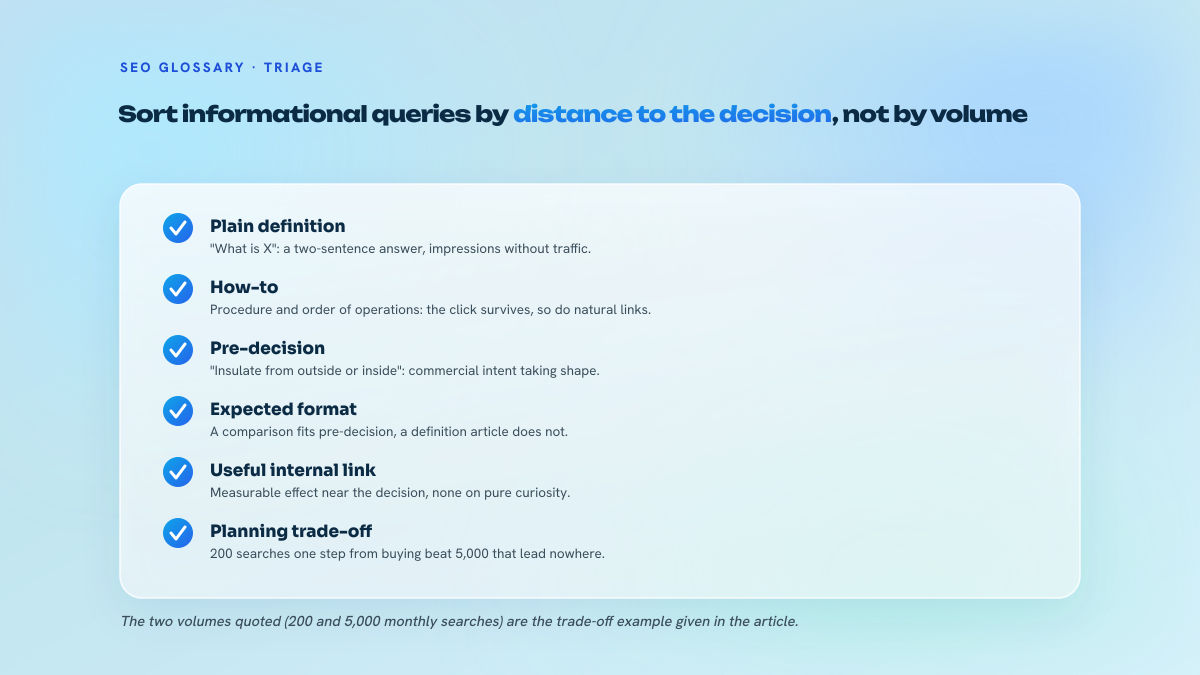
- →Simple « what is X » explainers are no longer a traffic asset in 2026. They are a citation asset, a topical-coverage asset and a link-magnet asset, and they should be budgeted as such.
- →Heroic Rankings' 2026 analysis found 40% of AI Overview sources ranked only in positions 11 to 20, which means being cited is a partly separate game from ranking, and depth of verifiable fact is what buys the citation.
- →In a netlinking operation, informational pages are what makes a host credible and what gives an editorial link somewhere natural to sit. Commercial pages rarely earn links on their own.
- →Tool intent labels from Semrush or Ahrefs are model guesses on the keyword, not observations of the SERP. Use them to sort ten thousand keywords, never to arbitrate the twenty that carry your budget.
What informational intent actually covers
Someone types « why do backlinks lose value over time » and nothing in that query says buy. It says explain. That is informational intent in its raw form, and the operational consequence is immediate: no amount of link equity will push a commercial page onto that SERP, because Google has already calibrated the result set around a different definition of a helpful answer. Intent is not a soft marketing notion here, it is the hard constraint that decides whether the page you are about to commission has any chance at all.
The bucket is bigger than most keyword exports suggest. SE Ranking's 2025 query split put roughly 53% of searches in the informational category, against 32% navigational, 15% commercial and under 1% transactional. Most of what people search for is not a purchase, it is a question, a definition, a how-to, a comparison of concepts rather than of products. For anyone building content at scale, that is where the volume lives and where the competition for attention is now hardest.
The part practitioners get wrong is attribution. Intent does not live in the keyword string, it lives in the query as Google resolves it, and the same words can carry different intent depending on context, market and season. « Netlinking » on google.fr returns agency pages and definitions in the same SERP because Google refuses to arbitrate between a reader who wants to understand the practice and one who wants to buy it. When a SERP hedges like that, it is telling you the intent is mixed, and a page that picks a single side loses half the addressable clicks.
The four intent types, and where the boundaries blur
The standard taxonomy splits queries into informational, navigational, commercial investigation and transactional. Informational means the searcher wants knowledge. Navigational means they want a specific website and typed its name instead of a URL. Commercial investigation means they are comparing before buying, the classic « best X », « X vs Y », « X reviews » family. Transactional means the wallet is already out.
This short overview of the four types is a useful reset before we get into the operational detail:
Nautilinks operates an owned network of editorial media. In-house written articles, transparency disclosures respected, anchor mix calibrated.
Frequently asked questions
If informational traffic is collapsing, is there still a case for publishing explainers?
Yes, but for different returns. Explainers are what makes a domain look like a real publication, what earns editorial links, and what gets pulled into generative answers. Seer's 2026 data shows brands cited in AI Overviews earn around 120% more organic clicks per impression than uncited ones on the same query. Budget them as authority and citation assets with a multi-quarter payback, and hold them to a coverage and citation target rather than a sessions target.
How do you tell an informational query from a commercial investigation one when the SERP mixes both?
Count the result types in the top ten. A SERP that mixes guides with comparison pages and vendor sites is Google refusing to arbitrate, which means the query serves two audiences. The right response is one page that teaches properly and then names concrete options, not two pages competing for the same term. Check the ratio again every quarter: mixed SERPs drift faster than stable ones, especially since Overviews started expanding into commercial territory during 2025.
Are the intent labels in Semrush and Ahrefs reliable enough to plan from?
They are reliable enough to sort a ten thousand keyword export into rough piles, and not reliable enough to arbitrate the twenty terms carrying your budget. Those labels are classifier outputs computed on the keyword string, not observations of the live SERP in your target country. Head terms with mixed intent are the systematic failure case, and they are usually the highest-value terms in the list. Sort with the tool, decide with the SERP.
Does informational content actually help a netlinking campaign, or is it just filler?
It carries the campaign. Commercial pages almost never earn editorial citations on their own merit, so equity has to enter through explainers, studies and reference pages and then flow inward. On the host side the same logic applies: a media property with genuine informational depth places a sponsored article credibly, one without it does not. Judging a host on its informational coverage predicts durability better than any third-party authority score.
What makes a page get cited inside an AI Overview rather than just ranked?
Extractable factual density, mostly. Position Digital's 2026 compilation reports that cited articles contain roughly 62% more distinct factual statements than uncited ones. Heroic Rankings found 40% of Overview sources ranked only in positions 11 to 20, so citation is not a simple function of rank. Write statements a machine can lift without ambiguity, name entities explicitly, source your numbers, and keep delivery fast.
Should informational pages target Featured Snippets in 2026?
Snippet formatting still costs nothing and occasionally wins, but it is no longer the objective. On queries that trigger an Overview, the snippet inherits a fraction of the clicks it did two years ago: Ahrefs measured a ~58% cut in position-1 CTR on those keywords in December 2025. Optimise the page to be the source the summary leans on. The formatting habits overlap anyway, so you get the snippet as a side effect rather than as a goal.
Test your knowledge
Quiz: Informational intent
1/3According to Heroic Rankings' 2026 analysis, what share of AI Overview sources ranked only in organic positions 11 to 20?