- →HARO, Connectively and Featured are three distinct products with distinct inboxes. Featured's own terms of service separate HARO from Connectively, so any vendor selling « HARO access » has to name the product before you pay.
- →The channel's value moved from link acquisition to citation supply: Muck Rack's May 2026 study of over 25 million AI links found 84 % of citations came from earned media and 0.3 % from paid or advertorial content.
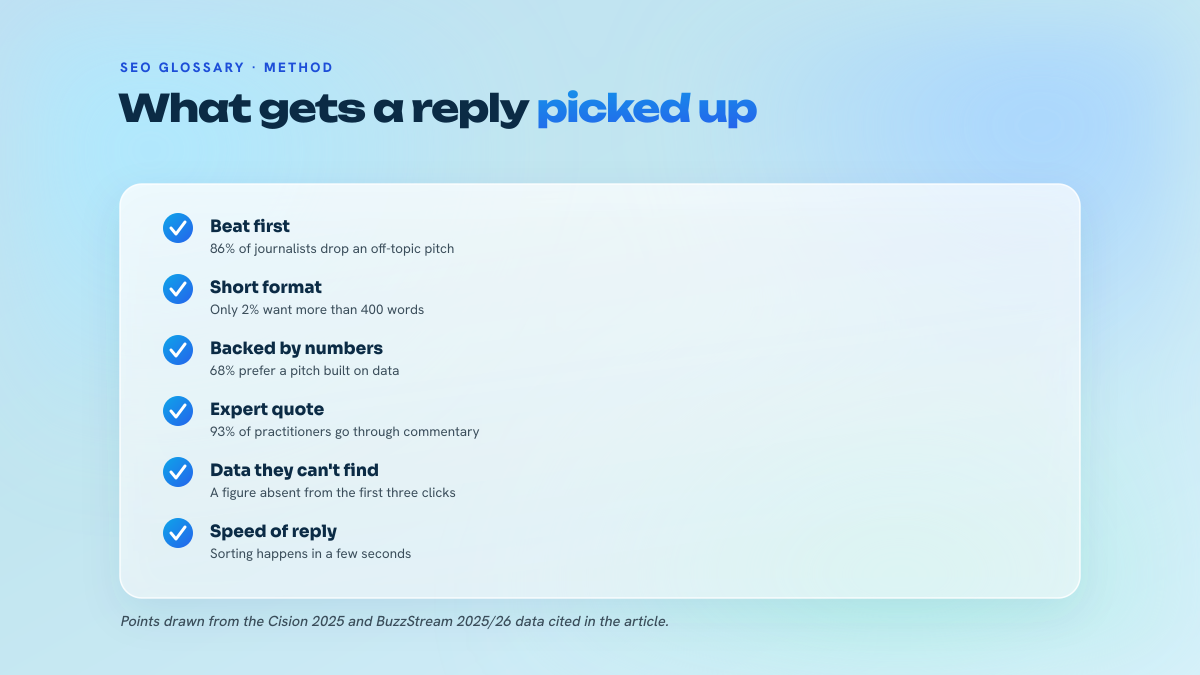
- →Beat relevance is the binding constraint, not pitch quality. Cision's 2025 survey of 3,000 journalists across 19 markets found 86 % immediately reject anything outside their beat, and only 2 % wanted pitches over 400 words.
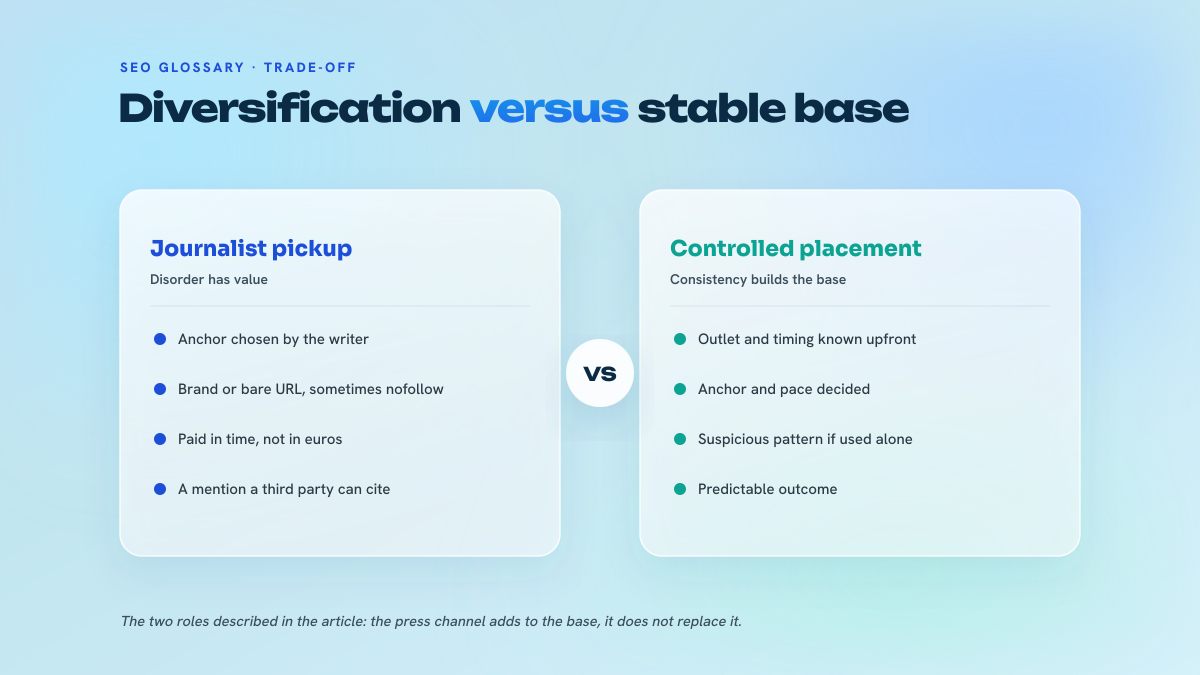
- →HARO is unforecastable by design. Treat it as opportunistic volume layered on top of a planned, contractual base of placements, never as the base itself.
- →The policy risk is not in HARO, it is in what surrounds it: Google's spam policies now name scaled content abuse and site reputation abuse explicitly, and syndicated round-up junk carrying your quote falls squarely in that zone.
- →Measure unlinked brand mentions and AI citations, not just referring domains. A quote that never returns a dofollow link can still feed the entity graph that decides whether a model names you.
What HARO became after the Connectively shutdown
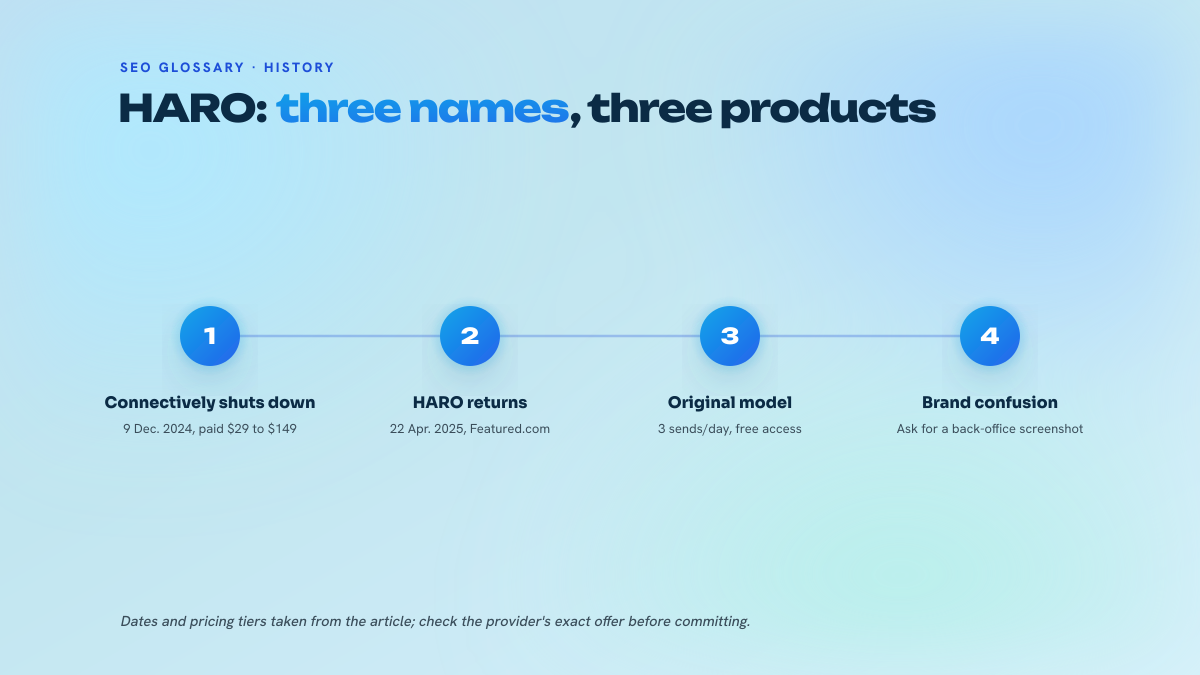
The acronym survived three ownership changes and now points to at least three different products, which is the first practical thing to know about it. Cision shut Connectively down on 9 December 2024, ending the paid tiers reported at $29 to $149 per month that had replaced the original free digest. Four months later, on 22 April 2025, Featured.com relaunched HARO on something close to its original model: free for journalists and free for sources, three query emails a day, monetised through newsletter sponsorship rather than subscription.
The naming situation is genuinely confusing and it matters the moment money changes hands. Featured's own terms of service state that HARO and Connectively are separate properties, while industry reporting says Featured later revived a Connectively-branded paid product. If an agency sells you « HARO access », ask which product, which inbox, and what daily query volume you actually receive. Treat the three names as distinct until a contract says otherwise. Alternatives sit at a different price point: comparison reporting in 2026 cites Qwoted Pro at roughly $149 per month for 35 pitches, while Source of Sources positions itself as the free HARO-style option. Those figures come from vendor comparison articles rather than published rate cards, so recheck them before procurement.
What has not changed is the mechanic. A journalist writing a piece needs a quote from someone with credentials, broadcasts a query, and picks from the replies. You are not buying placement, you are competing for an editorial slot on the strength of what you can say. That single distinction separates HARO from every transactional tactic in the glossary. A contributed article on a host site or a link added inside an existing published page are both negotiated: you know the URL, the anchor, the date, the price. With HARO you know none of those things in advance and you never will. Anyone promising you a guaranteed HARO placement is either buying it through a side channel or lying.
The 2026 numbers, and what they actually say
The strongest recent argument for journalist sourcing has nothing to do with backlinks. Muck Rack's May 2026 study « What Is AI Reading? » analysed more than 25 million links surfaced by ChatGPT, Claude and Gemini across 17 industries. It found 84 % of AI citations came from earned media, journalism alone accounted for 27 %, and paid or advertorial content represented 0.3 %. Across the three editions published since July 2025 those figures held steady: earned media between 82 % and 89 %, journalism between 25 % and 27 %. That stability across a year of model churn is the interesting part. It is not a spike, it is a structural preference.
Set that against how the market behaves. BuzzStream's 2026 State of Digital PR survey of 150 practitioners found 83.1 % thought digital PR had become more important because of AI, while only around 40 % reported having a repeatable process for earning AI citations. The belief is nearly universal, the execution is not. A 2026 survey of 500 SEO professionals put digital PR as the best-performing link building method for 34 % of respondents, HARO-style journalist sourcing for 21 %, and guest posts for 18 %. Combined, PR-oriented methods were named best-performing by 55 %.
Read those two datasets together and the picture is unambiguous. Journalist sourcing outperforms contributed content on self-reported effectiveness, and it feeds the exact content type that generative engines quote. Google's expansion of AI Mode on 7 January 2026, with follow-up questions and reasoning over linked web content, only increases the premium on being the source a model names rather than the tenth blue link. Measurement caught up too: Ahrefs launched Brand Radar in beta in March 2025 and by July 2025 said it operated across five prompt indexes, each holding roughly 10 million to over 100 million prompts, with the actual links appearing in AI answers exposed. There is no longer an excuse for running PR blind on the citation side.
One caution on interpretation. None of these studies says a HARO link outranks a well-placed contextual link on a topically aligned site. They say earned editorial pages are what models cite. Those are different claims and conflating them is how agencies end up selling HARO retainers as a ranking product.
Where journalist sourcing fits in a link portfolio
HARO is opportunistic volume. It cannot be scheduled, cannot be forecast, and cannot be assigned a delivery date, which makes it structurally unfit to carry a campaign on its own. Anyone who has tried to hit a quarterly referring-domain target with journalist sourcing alone has watched three good weeks followed by a month of silence because no reporter in the vertical happened to be writing. The correct architecture is a planned, contractual base with HARO layered on top, and the base is what you actually control.
That base is where owned and negotiated inventory earns its keep. At Nautilinks we operate our own French editorial media in-house, which means placement dates, topics and anchors are decided rather than hoped for. That is not a substitute for earned press and we do not pretend it is: the two do different jobs. The owned side gives a campaign its floor and its predictability, the earned side gives it the third-party editorial signal no network can manufacture. If you are building the predictable half, the catalogue of media with their metrics visible before you commit is the honest starting point, because you can see what you are getting.
Where HARO genuinely shines is on the two things bought links handle badly. First, brand and entity reinforcement: a quote attributed to a named person with a named title on a real publication builds the association between a person, a company and a topic in a way a contextual link inside a sponsored article does not. Second, tier-one publications that will never sell you anything. National press, trade titles with real editorial control, industry newsletters. Those sites have no rate card, and a journalist query is one of the few legitimate doors in.
The complementarity works in the other direction as well. A quote in a respected trade title makes the next outreach easier, and it gives an operator running the campaign end to end something concrete to point at when calibrating the mix between earned and contracted placements over a quarter.
What we see go wrong
The most common failure is volume spraying, and the data is brutal on it. Cision's 2025 research covering 3,000 journalists across 19 markets found 86 % immediately reject pitches unrelated to their beat, and only 2 % wanted anything longer than 400 words. Every reply you send outside a reporter's beat is not neutral, it is a small deposit into the reason journalists stopped reading source platforms in the first place. The teams pitching forty queries a week get worse results than the teams pitching six, because the six were read.
The second failure is generic AI-written answers. Reporters can spot them at a glance now, and they select against them. BuzzStream's 2025/26 data reports 68 % of reporters prefer pitches supported by data or original research, while expert commentary was used by 93 % of digital PR practitioners. Commentary is table stakes, therefore commentary alone does not differentiate. A number nobody else has, drawn from your own operations, does. If you run a business with proprietary data, that data is your pitch and everything else is packaging.
The third failure is the policy one, and it is worth being precise because HARO itself is not the risk. Google's documented spam policies now explicitly cover scaled content abuse, site reputation abuse and expired domain abuse, and enforcement has been active: the August 2025 spam update rolled globally from 26 August to 22 September 2025, a 27-day rollout and the first confirmed spam update since December 2024, followed by a short spam update from 24 to 26 June 2026. What gets caught is the ecosystem around a legitimate quote: the low-grade syndication sites that scrape a round-up and republish it, the « guaranteed placement » vendors reselling access to publications whose contributor sections were sold off, the arrangements that look editorial and are not. A quote on a genuinely edited publication is safe. A quote on a page that exists only because someone monetised a domain's reputation is not, whatever the referring domain metric says.
The fourth failure is accounting. Teams report HARO in referring domains only, so an unlinked mention in a national title scores zero and a dofollow from a syndication farm scores well. That is exactly backwards given what Muck Rack measured.
Running it properly: cadence, thresholds, measurement
Cadence first. One person, thirty to forty-five minutes a day on the three query emails, filtering hard for beat fit and answering three to eight queries a week is a workable steady state. Response speed matters more than polish because reporters close queries early. If you cannot answer within a few hours of the digest arriving, you are competing for the leftovers.
Content of the reply: under 250 words, a usable quote the journalist can paste unedited, one concrete number or observation from your own work, and the credential line that justifies why you are the one saying it. No pitch, no links to your site, no offer to write the article. The 2 % figure from Cision on pitch length is not a style preference, it is a filter.
On measurement, track four things separately: placements published, of which linked, of which dofollow, and unlinked brand mentions. Then track AI citations independently, through Brand Radar or an equivalent prompt-index tool, because that is where the 84 % earned-media share from the Muck Rack study actually shows up. Expect a low hit rate. A team converting one placement per eight to twelve well-targeted replies is doing fine, and the ones claiming much better are usually counting syndication copies as distinct wins.
On cost, be honest with yourself about the arithmetic. The platform may be free but the labour is not: three hours a week of a senior person who can actually speak with authority is the real line item, and it is rarely cheaper per acquired link than a contracted placement. That is the calculation to run before committing a quarter to it, and it is why comparing it against what a placement costs outright is a fair exercise rather than a heretical one. The answer is usually that you want both, weighted toward the predictable side, with journalist sourcing running as a low-cost background process that occasionally lands something no budget could buy. Read alongside the broader earned-media discipline it belongs to, HARO is one input channel, not a strategy.
Nautilinks operates an owned network of editorial media. In-house written articles, transparency disclosures respected, anchor mix calibrated.
Frequently asked questions
Is HARO still worth running now that everyone knows about it?
Yes, but not as a volume channel. The saturation is real, which is why the win rate sits low. What justifies keeping it is what it reaches: publications with genuine editorial control that will never sell a placement. A 2026 survey of 500 SEO professionals put HARO-style sourcing as best-performing for 21 % of respondents. Budget it as a few hours a week, not as a retainer line with a referring-domain target attached.
HARO, Connectively or Featured: which one do I actually sign up for?
HARO relaunched on 22 April 2025 under Featured.com with the free three-emails-a-day model, and that is the default entry point. Connectively was shut down by Cision on 9 December 2024; Featured's terms of service treat HARO and Connectively as separate properties, and reporting suggests a Connectively-branded paid product resurfaced later. Confirm which inbox and which query volume any paid tier gives you before subscribing.
Do HARO links carry real ranking weight, or is this an AI-citation play now?
Both, unevenly. A dofollow from a strong editorial publication carries ordinary link value, but hit rates are too low to move rankings on their own. The stronger argument is citation supply: Muck Rack's May 2026 study of over 25 million AI links found 84 % of citations came from earned media against 0.3 % from paid or advertorial content. Treat rankings as the secondary effect.
Can a HARO placement expose me to a spam penalty?
The quote itself, no. The surrounding ecosystem, sometimes. Google's spam policies explicitly name scaled content abuse and site reputation abuse, and enforcement has been active with the August 2025 update running 26 August to 22 September 2025 and a further spam update from 24 to 26 June 2026. The risk sits in syndication farms republishing round-ups and in vendors reselling access to publications that no longer have real editorial control.
How do I measure HARO when most placements come back unlinked?
Split the funnel: placements published, of which linked, of which dofollow, plus unlinked brand mentions tracked separately. Then track AI citations with a prompt-index tool. Ahrefs launched Brand Radar in beta in March 2025 and said by July 2025 it ran five prompt indexes holding roughly 10 million to over 100 million prompts each, exposing the actual links appearing in AI answers. Counting referring domains alone undervalues the channel and overvalues junk.
What actually separates a reply that gets used from one that gets ignored?
Beat fit, then speed, then a number nobody else has. Cision's 2025 research across 3,000 journalists in 19 markets found 86 % immediately reject off-beat pitches and only 2 % wanted anything over 400 words. BuzzStream reports 68 % of reporters prefer data-backed pitches while 93 % of practitioners send expert commentary, so commentary is the baseline and proprietary data is the differentiator.
Test your knowledge
Quiz: HARO
1/3According to Muck Rack's May 2026 study of over 25 million AI links, what share of citations came from paid or advertorial content?