- →A footer link is one template decision replicated across every URL: tools report it as N backlinks, Google consolidates the repeated pattern at domain level, so collapse it to a single line before reporting.
- →Google has never shipped a footer-specific update, including through the August 2025, March 2026 and June 2026 spam updates; what applies is the ordinary paid-link policy, and a contractual credit is a paid link whatever the invoice says.
- →Ahrefs' own filtering guidance tells users to isolate in-content links specifically to strip footer and comment noise, which tells you what a serious backlink dataset thinks a template placement is worth.
- →Internally, keep the footer under roughly 25 to 40 destinations: a page linked from every URL and a page linked from three relevant URLs stop looking different to a crawler once the block gets fat.
- →A broken relative path in a footer produces a site-wide 404 pattern; sort internal pages by inlink count in a crawl and the footer reveals itself in ten seconds.
- →For AI surfaces, a footer credit generates no editorial text about you: Ahrefs' 2025 study across 75,000 brands found web mentions correlating 0.664 with AI Overview visibility against 0.218 for backlinks.
What a footer link actually is
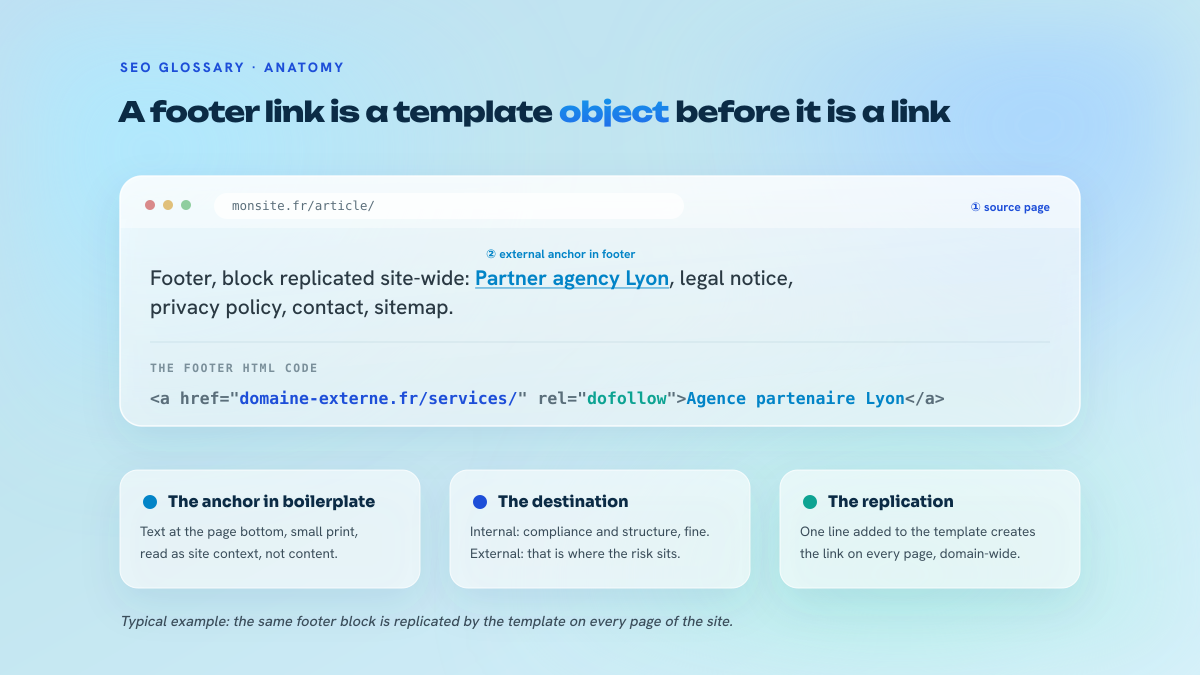
Every page of a website ends with the same block: contact, legal pages, a sitemap reference, social icons, sometimes a line naming the agency that built the site. That block is the footer, and any anchor inside it is a footer link. The definition is trivial. The structural consequence is not: a link placed there is not one link, it is one template decision replicated across every URL the website publishes.
This is why the term belongs in a backlinks glossary rather than in a front-end tutorial. The moment a link lives in a template, it stops behaving like an editorial recommendation and starts behaving like a site-level property. Third-party crawlers see the multiplication and report it faithfully: a single footer anchor on a 500-page site surfaces as 500 backlinks in most tools. Ranking systems have had two decades to learn that this multiplication carries no additional information, and analysis of links repeated across an entire template converges on the same reading, that the pattern is consolidated at domain level rather than counted once per page. No Google document publishes a numerical rule here, so treat that as a working model, not as doctrine.
Two families share the name and behave nothing alike. Internal footer links point at your own pages: contact, help, category hubs, legal, locations, accessibility statement. They are pure architecture, and they are the reason the element exists. External footer links point off-site: the « designed by » credit, a partner, a supplier, an SEO provider's name. Those carry the risk profile, and those are the ones people buy and sell. Conflating the two is the single most common reason a footer discussion goes nowhere.
How Google treats footer links in 2026
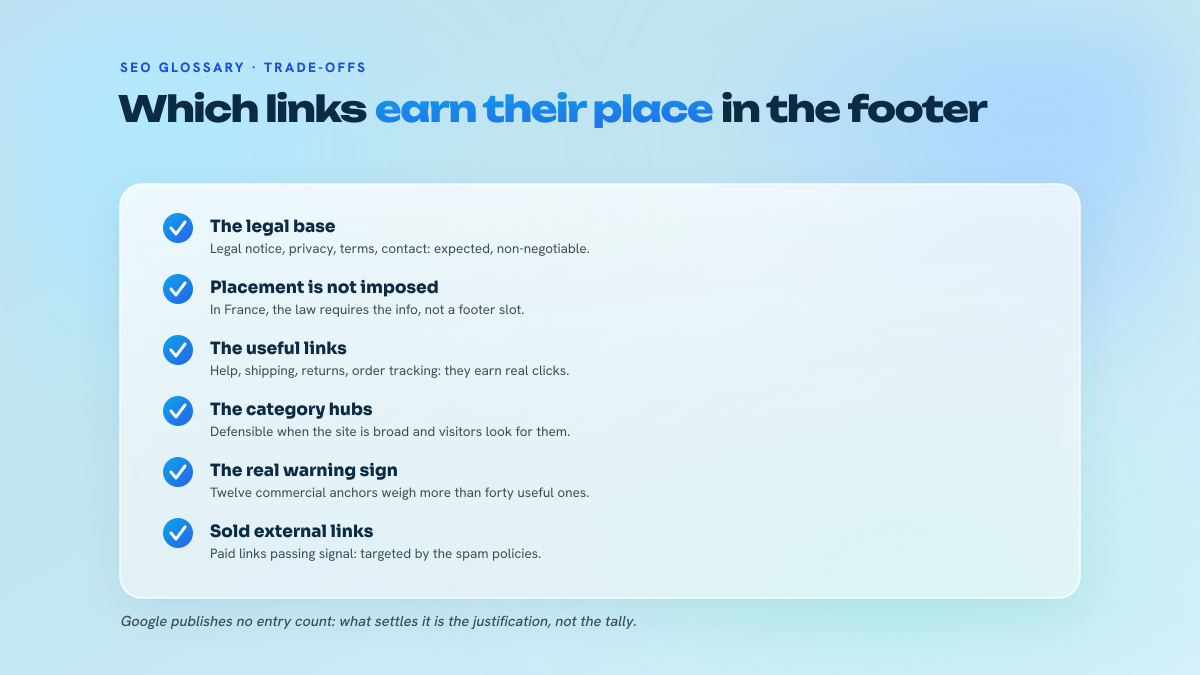
No footer-specific algorithm update has ever shipped, and none shipped in the last twelve months either. What shipped is enforcement. A global spam update ran from 26 August to 22 September 2025, roughly 27 days. A second started on 24 March 2026 at 12:18 PDT and completed in under 24 hours, applied globally and across all languages. A third ran from 24 to 26 June 2026, logged on the Google Search Status Dashboard as a ranking incident. None of them named footers. All of them enforce the same spam policies, which cover paid links intended to pass ranking credit, excessive exchanges and manipulative sitewide placements.
The operative documentation is duller and more useful than any update note. Google Search Central's guidance on qualifying outbound links says a link created as part of a paid arrangement should carry rel="sponsored", and that untrusted user-generated links can take ugc or nofollow. That is the entire footer policy: it turns on whether the link was earned or transacted, not on where it sits in the DOM. A footer credit negotiated as part of a build contract is a paid link, whatever line item it appears under.
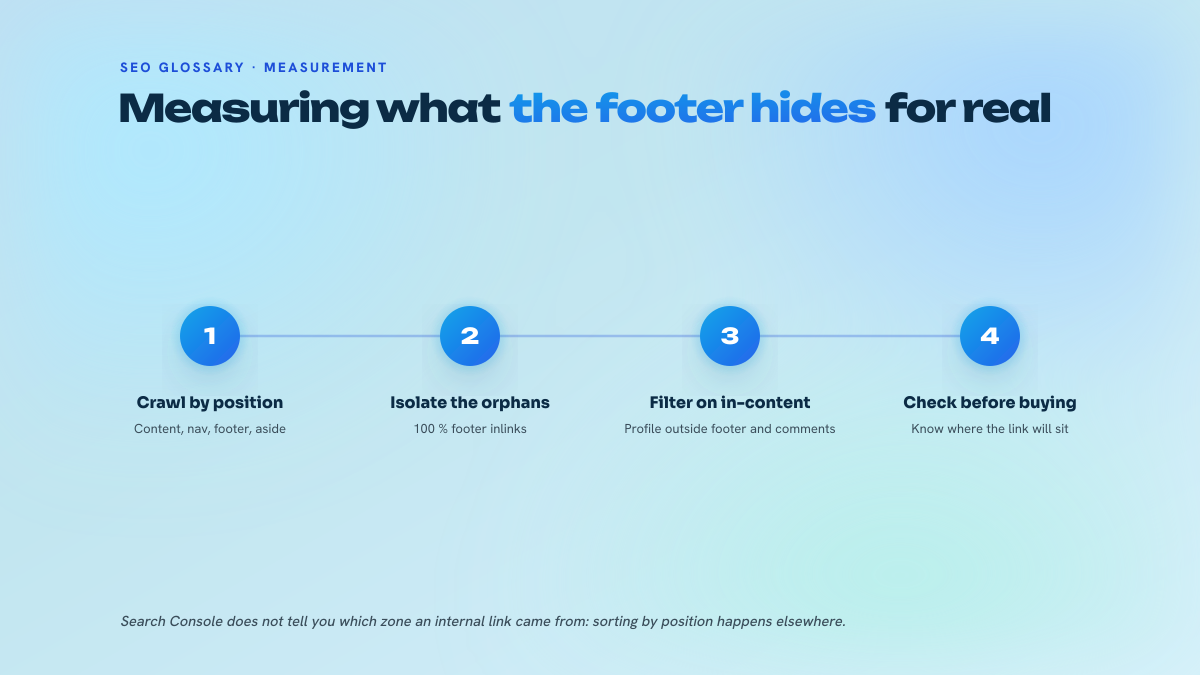
Measurement follows the same logic. Ahrefs' current guidance on link filtering explicitly tells users to isolate in-content links in order to strip out spurious footer and comment-section results, which tells you what a serious backlink dataset thinks a template placement is worth. When you audit a profile, sort referring domains by link count and look at the anchor and target distribution: any source contributing hundreds of links with one anchor pointing at one page is a template, and it should collapse to a single line in your report before you draw any conclusion. Counting it otherwise inflates the profile, flatters the growth curve, and hides the real rate at which you acquire distinct referring domains, which is the only number worth pacing a campaign against.
Where footer links fit in a netlinking operation
Internal first, because that is where the value is and almost nobody writes about it. The footer is the only navigation element guaranteed to appear on every page, which makes it the cheapest way to hand a small set of pages a link from the entire website. Used with restraint that is legitimate architecture: contact, the main category hubs, the accessibility page, the sitemap reference, locations for a multi-site business. Used without restraint it becomes a keyword-link block that flattens your hierarchy, because a page linked from every URL and a page linked from three genuinely relevant URLs stop looking different to a crawler.
The threshold we work with in audits sits somewhere between 25 and 40 distinct internal destinations across all columns, and never more than the main navigation carries. Above that you are not opening crawl paths, you are spreading the same site-level distribution across so many targets that none of them gains anything measurable. If a page matters enough to justify a permanent sitewide slot, it usually deserves a place in the header navigation instead, where users actually look for it.
External footer links are a different trade entirely. As a buyer they are the weakest asset available: one anchor, one target, one context, duplicated. As a seller they are the fastest way to make a site read as transactional to anyone who opens the source. Across the French editorial media we run at Nautilinks, external links live inside articles and never in the template, and that is not a purity stance: a placement inside a relevant paragraph is the only kind that keeps meaning when the host page evolves. If you are deciding where a budget goes, an anchor sitting inside a paragraph that actually discusses your subject beats a sitewide credit at equal price, every time, which is the whole argument for putting the money inside an article rather than in a template. The market broadly agrees on the input side: in Editorial.link's survey of 518 SEO professionals, 48.6% named digital PR the most effective link-building tactic against 16% for guest posting and 12% for linkable assets, and no leading answer involves template placements.
Adding footer links without breaking the architecture
The mechanics are trivial in every stack, which is precisely why they get done badly. In raw HTML you add anchors inside a <footer> element, grouped in a <nav> with an accessible name so a screen reader can announce or skip the block, and styled with CSS rather than with nested tables inherited from a 2014 theme. Headers and footers are the two regions a keyboard user traverses most often, so link order in the source matters as much as visual column order.
In WordPress the work happens in the menus screen: create a menu, select the footer display location the theme exposes, add the pages you want. Social icons usually come from a widget or block rather than the menu itself. This walkthrough shows the quick method:
Shopify puts the same operation under navigation settings: open the footer menu, add a menu item, fill the name field and the link field. A visual pass through the settings tab, if you prefer watching it done:
Hosted builders such as Hostinger follow the same pattern: select the footer element, edit the link field on the selected item, publish. The interface changes, the decision does not.
Whatever the CMS, three rules survive the platform. Anchor text is the page name, not a keyword variant, because a keyword repeated on every URL of the site is the clearest manipulation pattern a footer can display. Every destination appears once, not twice under two labels. And relative paths get tested after publication, not assumed, because the footer is the one place where a single typo replicates itself across the entire website.
What goes wrong with footer links
Broken paths lead the list. A missing leading slash in a footer reference turns one link into a site-wide 404 pattern, and because nobody reads their own footer, it survives for months. Any crawler that reports internal inlink counts finds it in seconds: the offending URL sits at the top of the list with an inlink count equal to your page count.
The commercial credit is the second failure. « SEO services in [city] » repeated across every page of every client site, from an agency's whole portfolio, is textbook manipulation and reads that way to a reviewer. If the credit is contractual, it is branded, it is marked sponsored, and it points at a real company page. That costs nothing and removes the entire exposure.
Third, buying footer placements as a product. Practitioners in the 518-person Editorial.link survey reported an average acceptable price of roughly $508.95 for a quality backlink, a market benchmark rather than a ranking value, and nothing about a template credit belongs in that bracket. Anyone offering sitewide footer links priced against contextual placements is selling you a multiplication artefact, which is worth comparing against what a single editorial placement actually costs before signing.
Then the smaller ones that still cost traffic. Multi-language footers where the language switcher sends every visitor to the home page instead of the equivalent page, which wastes the one hreflang-adjacent signal users actually click. Footers that collapse on mobile via display rules that also remove the links from the DOM. Author and attribution links on portfolio or project sites pointing at dead profiles years later. None of these are ranking catastrophes on their own, and all of them are free to fix.
Tactical takeaways for a working SEO
Crawl your own site once a quarter and sort internal pages by inlink count. Everything at the top with a count matching your page total is in the footer or the header. If a page in that list is not one you would defend as strategically important in a meeting, take it out. The exercise runs in ten minutes and usually removes four or five links nobody remembers adding.
On acquisition, treat footer placements as something you accept only when the relationship justifies it, never as a line item you pay for. On reporting, deduplicate template sources before you show a client a referring-domain curve, or you will be explaining later why the number dropped when a single partner redesigned their site.
On AI surfaces, the arithmetic is unforgiving. Ahrefs' 2025 study across 75,000 brands found web mentions correlating 0.664 with AI Overview visibility against 0.218 for backlinks. Correlation is not causation and the study does not segment by link position, but the direction is clear enough: a template credit produces no editorial text about you, no context, no sentence a language model can lift and cite. That is the practical case for campaigns calibrated over several months rather than bought by the batch, and the reason the footer stays what it was designed to be: navigation, contact, legal, and nothing you would be embarrassed to explain.
Nautilinks operates an owned network of editorial media. In-house written articles, transparency disclosures respected, anchor mix calibrated.
Frequently asked questions
Does a sitewide footer link from a high-authority domain beat one contextual link from a weaker site?
Almost never, once you account for consolidation. The sitewide placement gives you one anchor, one target and one context repeated, and the repetition adds no information a ranking system can use. The weaker contextual link gives you a relevant surrounding paragraph, a page that can itself rank, and an anchor that fits a sentence. Ahrefs' own filtering guidance treats footer results as noise to be excluded, which is a fair proxy for their analytical weight.
Should I disavow footer links pointing at my site?
Rarely. Disavow is for links you caused or bought that you cannot get removed, not for every template placement in your profile. A former client keeping your credit in their footer is not a liability. What warrants action is a portfolio of paid sitewide credits with keyword anchors, and the correct first move there is asking for rel="sponsored" or removal at the source. Disavow only when the source will not cooperate.
How should an agency handle its own « designed by » credits across client sites?
Branded anchor, company name only, pointing at a real page, and marked sponsored or nofollow when the credit is part of the contract. Google's outbound-link documentation is explicit that links resulting from a paid arrangement should be qualified. A keyword anchor repeated across dozens of client footers is one of the oldest patterns reviewers look for, and it puts the clients at risk more than the agency.
How many links should a footer carry before it becomes a problem?
There is no published threshold, so use a functional one. Keep the footer under roughly 25 to 40 distinct destinations and never above what the main navigation carries. Past that, you are handing site-wide prominence to so many pages that the distinction between important and incidental disappears. If you cannot justify each destination as something a visitor genuinely looks for at the bottom of a page, it does not belong there.
Do rel attributes on footer links change how tools count them?
They change the qualification, not the count. A nofollowed or sponsored footer link still appears in crawler datasets, still multiplies across pages, and still shows in your referring-domain totals. Ahrefs' 2026 statistics page reports that 10.6% of backlinks to the top 110,000 sites were nofollow, so the attribute is common enough that filtering by it alone will not clean your profile. Filter by link position, then by attribute.
Are footer links useful for visibility in AI answers?
Not meaningfully. AI surfaces cite passages, and a footer credit contains no passage: no sentence about what you do, no context, nothing quotable. Ahrefs' 2025 study across 75,000 brands measured web mentions correlating 0.664 with AI Overview visibility against 0.218 for backlinks. Editorial coverage that names and describes you feeds that mechanism. A repeated template anchor does not, whatever its follow status.
Test your knowledge
Quiz: Footer link
1/3A footer link sits on a 500-page site. How should it appear in a serious backlink report?