- →ClaudeBot, Claude-SearchBot and Claude-User are three separate user-agents with three separate purposes; a single blanket rule against ClaudeBot only opts you out of training collection.
- →Cloudflare measured ClaudeBot at roughly 38,065 crawled pages per referral in July 2025, and a Cloudflare Radar analysis put it at 23,951:1 for 1 January to 16 March 2026 against about 5:1 for Google. Treat it as bandwidth spend, not as a traffic source.
- →ClaudeBot's share of AI-bot traffic swings hard month to month: 11.69% in April 2026, 9.73% in May, close to 20% in June after a reported 66% jump, 16.28% in July. Budget for the peak, not the average.
- →Blocking is now selective rather than blanket: in a June 2026 snapshot of 107 prominent sites, 35.5% blocked ClaudeBot specifically while only 8.4% used a wildcard disallow.
- →robots.txt is a request, not an access control. If the content must not be taken, the control belongs at the server or the contract, not in a text file.
- →Your own robots policy governs your own domain only. Editorial mentions and links sitting on third-party media get crawled under those publishers' rules, which is where network-level posture matters.
Three user-agents, one brand, three separate decisions
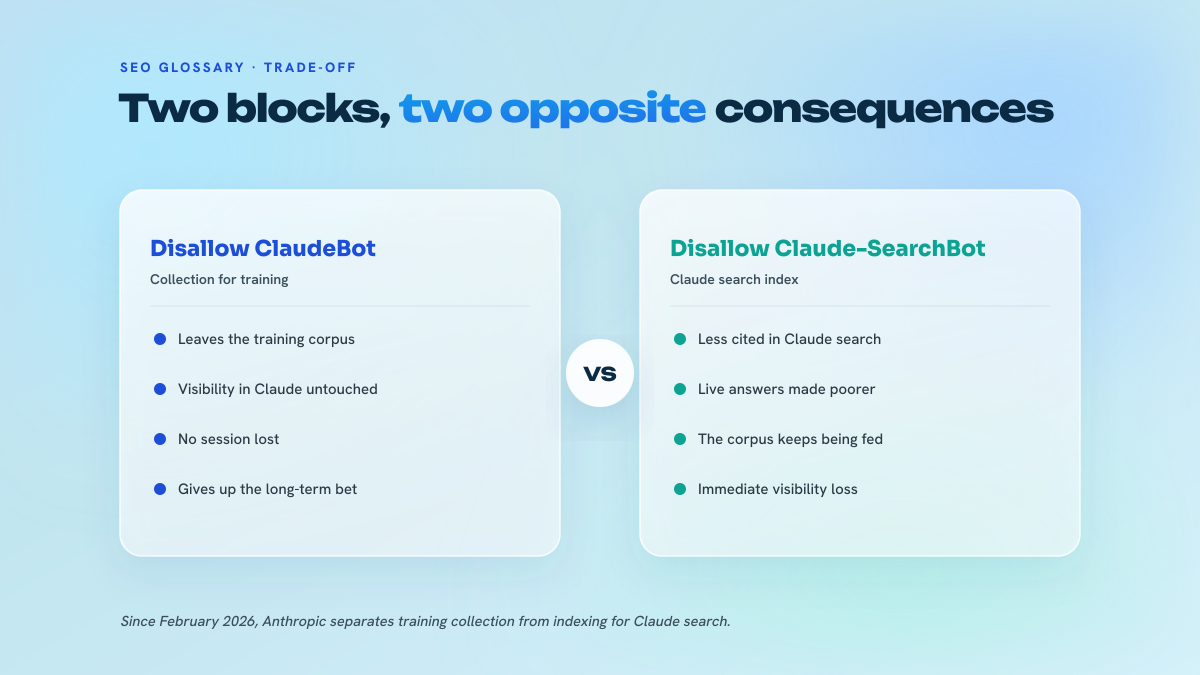
The most expensive misunderstanding about ClaudeBot is treating it as «the Claude bot». It isn't. Anthropic runs a small fleet, and on 25 February 2026 it clarified the split in its own crawler documentation, as reported by Search Engine Land. ClaudeBot collects public web content that may be used for model training. Claude-User fetches a page in real time because a user asked Claude something that requires it. Claude-SearchBot indexes content for Claude's search results. Three names, three purposes, three separate lines in your robots file.
That split is the whole subject. A publisher who added a Disallow for ClaudeBot in 2024 and considered the matter closed did not remove themselves from Claude's answers. They removed themselves from a training corpus, which is a copyright and licensing position, and left retrieval-time visibility entirely untouched. The reverse mistake is worse: a wildcard disallow aimed at «AI bots» takes out Claude-SearchBot and Claude-User too, which is the one part of the fleet that can actually surface your brand inside an answer a prospect is reading. Anyone maintaining directives aimed at AI crawlers should be able to name which of the three they are targeting and why.
Anthropic's 2026 model system cards keep describing ClaudeBot as a general-purpose crawler for training data that follows site robots.txt instructions. Worth reading that sentence precisely: it follows the file, it is not bound by it. Compliance with robots.txt is a stated policy of the operator, enforced by nobody. That is not a Claude-specific caveat, it has been true of the exclusion protocol since its inception, but it matters more when the content being collected has commercial value to the collector.
What ClaudeBot actually does on your server
Volume first, because it drives every infrastructure argument you will have with a hosting provider. Cloudflare's July 2025 comparison found ClaudeBot's share of AI-crawler traffic rising from about 6% in July 2024 to nearly 10% in July 2025, while GPTBot went from 4.7% to 11.7% and Bytespider collapsed from 14.1% to 2.4%. Through 2026 the readings are far less stable: 11.69% in April 2026 against GPTBot's 9.84%, then 9.73% in May, then roughly 19.8 to 20% in June after a reported 66% month-over-month surge that made ClaudeBot the second-largest individual AI crawler behind Googlebot, then 16.28% in July. Anyone quoting a single share figure for ClaudeBot is quoting a snapshot with a two-fold error bar.
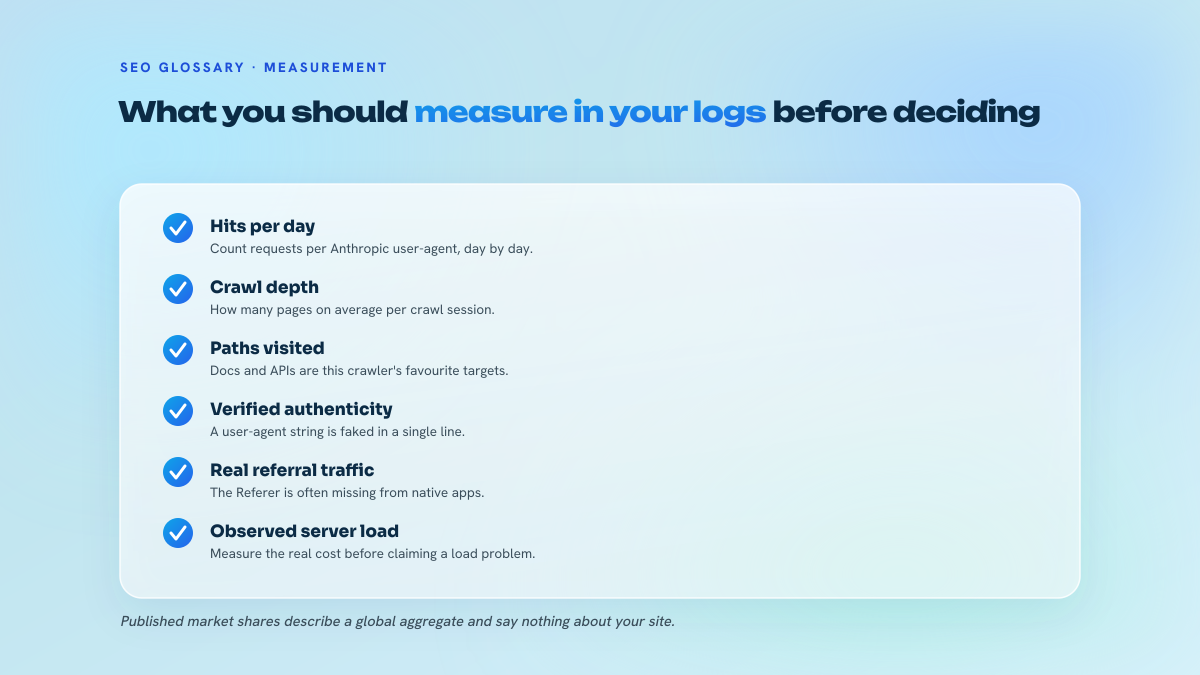
On shape rather than volume, a 30-day server-log study of 12 production sites published on 26 April 2026 measured around 1,800 ClaudeBot hits per site per day against 4,200 for GPTBot and 980 for PerplexityBot, and found ClaudeBot crawling deeper, an average of 5.2 pages versus 3.8 for GPTBot, with a preference for documentation and API paths. Twelve sites is a directional sample, not an industry benchmark, and the authors say so. Still, the depth signal matches what we see in logs on our own properties: this crawler follows internal paths further than the average AI bot, so a site with weak internal architecture will hand it a lot of low-value pages and pay for the transfer.
Practically, ClaudeBot consumes your server capacity, not Google's crawl budget. The two are unrelated, and conflating them produces bad panic decisions. Identify it in logs by user-agent string, then segment: hits from ClaudeBot tell you about training collection, hits from Claude-User tell you a human asked Claude a question your page was retrieved for, and that second number is the one worth watching week over week.
Crawl-to-refer: a cost line, not an acquisition channel
The ratio that settles the debate is crawl-to-refer, the number of pages a bot takes for every visitor it sends back. Cloudflare's analysis put ClaudeBot at roughly 38,065 crawled pages per referral in July 2025, an improvement on the 286,930:1 measured six months earlier and still an order of magnitude away from anything a publisher would call an exchange. A later analysis of Cloudflare Radar data covering 1 January to 16 March 2026 measured 23,951:1 for ClaudeBot, against 1,276:1 for GPTBot, about 111:1 for Perplexity and about 5:1 for Google. The authors are explicit that these ratios move with the time window, the site sample and the referral attribution method, and that traffic arriving through a native app often carries no Referer header at all, which inflates every AI ratio to some degree.
Even with generous error bars, the conclusion holds: ClaudeBot is a content-acquisition cost, and arguing about it in traffic terms is a category error. Cloudflare's broader July 2025 work found 79% of AI crawling served training, 17% search and 3.2% user-action retrieval, which is the same story from the supply side. If the objective is to be named and linked inside generated answers, the levers are Claude-SearchBot access, retrievable page structure, and the volume of third-party editorial mentions a model can find when it fans a query out across sources. That last one is not a robots.txt setting, it is an off-site programme, and it is what we deliver when a client asks us to make a brand quotable inside AI answers rather than merely crawlable. The mechanics of getting picked up are covered in our entry on how models choose which sources to cite.
Writing a robots policy that matches your actual goal
For most commercial sites, the defensible position in 2026 is asymmetric: decline the training collection, keep the retrieval paths open.
User-agent: ClaudeBot
Disallow: /

User-agent: Claude-SearchBot
Allow: /

User-agent: Claude-User
Allow: /
That file opts out of future training while preserving inclusion in Claude search results and real-time answers, subject to Anthropic honouring its own documented behaviour. It is a stance, and it is the one we would defend for a publisher whose content is the product. For a B2B site whose content exists to generate leads, the calculus flips: the training corpus is where a model learns that your brand is associated with your category, and cutting that off to save bandwidth is a poor trade.
The market has already moved from blanket refusal to targeting. A June 2026 snapshot of 107 prominent sites found 38 of them, 35.5%, explicitly blocking ClaudeBot, 36.4% blocking at least one Anthropic crawler and 44.9% blocking at least one major AI crawler, while only 9 sites, 8.4%, used a blanket wildcard disallow. Cloudflare reported in January 2026 that between July 2025 and January 2026, sites blocking crawlers like ClaudeBot and GPTBot were nearly seven times as numerous as sites blocking Googlebot and Bingbot. The economic evidence is genuinely unsettled: a Rutgers and Wharton publisher study found the top 30 publishers blocking AI crawlers saw a 23% decline in total traffic and 14% in human traffic, then a later revision reportedly produced a much smaller weekly decline of around 7%, and the authors warn throughout that correlation is not causation. Nobody should be quoting that study as proof in either direction.
What we see go wrong
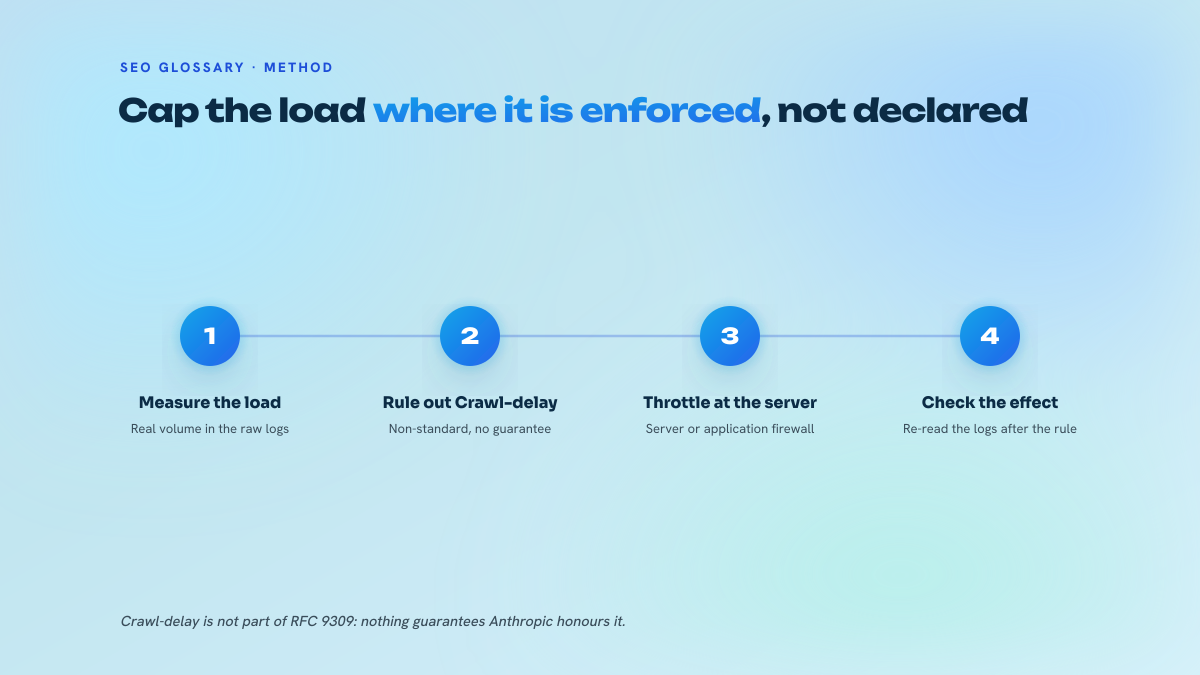
The wildcard disallow written in a hurry is the classic. It usually appears after a bandwidth alert, it blocks the retrieval agents alongside the training crawler, and six months later somebody notices the brand has stopped appearing in AI answers and blames the content team. Second on the list is crawl-delay: it never made it into the original exclusion standard, and support across AI crawlers is inconsistent. If a bot is genuinely hurting your origin, rate-limit it at the edge where the rule is enforced, and keep robots.txt for stating intent.
Third, log trust. Any client can send a ClaudeBot user-agent string, and scrapers do exactly that to inherit a well-behaved reputation. Before you build a policy on log volume, verify a sample against Anthropic's published crawler information rather than taking the header at face value. Fourth, name confusion, which the SERP for this term reflects: assistants and community tools that borrow the Claude name, the ones circulating as Clawd or OpenClaw, are not Anthropic crawlers and blocking a string that resembles them accomplishes nothing.
The last one is structural. Your robots file governs your domain and nothing else. Every mention of your brand sitting on a third-party media property is crawled under that publisher's rules, which is why an off-site programme is more robust to any single site's blocking decision than your own pages are. Across the French editorial media we run in-house, the AI crawler posture is set once at network level and applied uniformly, so a client's mentions do not sit behind a wall somebody put up during a bandwidth incident. If you would rather inspect that before committing, the catalogue of media is public and filterable without an account, and teams who prefer someone else to sequence the whole programme can have us calibrate the campaign over several months instead.
One last operational note: Google Search Console added dedicated generative-AI performance reporting on 3 June 2026, with separate visibility views for AI Overviews, AI Mode and generative features in Discover. That data covers Google surfaces only. Nothing in Search Console will ever tell you what Claude did with your content, so ClaudeBot measurement stays a server-log and edge-analytics job.
Nautilinks operates an owned network of editorial media. In-house written articles, transparency disclosures respected, anchor mix calibrated.
Frequently asked questions
If I block ClaudeBot, do I disappear from Claude's answers?
No. Since Anthropic's February 2026 documentation update, ClaudeBot handles training collection only. Inclusion in Claude search results depends on Claude-SearchBot, and real-time retrieval for a user's question depends on Claude-User. Blocking ClaudeBot alone leaves both intact. The mistake that actually costs visibility is the wildcard disallow that catches all three user-agents at once, usually written during a bandwidth incident and never revisited.
Are Clawd and OpenClaw the same thing as ClaudeBot, or a rename?
Neither. ClaudeBot has not been renamed. It remains Anthropic's official web crawler and it identifies itself with that user-agent string. The similarly named assistants and community tools circulating under other spellings are separate projects, not Anthropic crawler traffic, and writing robots rules against those strings does nothing. If you see them in logs, treat them as ordinary unidentified clients and handle them at the edge.
Does ClaudeBot respect crawl-delay?
Support for crawl-delay is inconsistent across AI crawlers, and it was never part of the original exclusion standard. Relying on it to protect an origin server is optimistic. If ClaudeBot volume is genuinely hurting you, rate-limit or challenge at the CDN or reverse proxy, where the rule is actually enforced rather than merely requested, and keep robots.txt for stating intent.
How do I confirm a ClaudeBot hit in my logs is genuine?
You don't, from the user-agent string alone. Anything can send it, and scrapers do precisely that to inherit a compliant crawler's reputation. Verify a sample against Anthropic's published crawler and IP information before building policy on the numbers. This matters most when you are about to justify infrastructure spend or a blocking decision on volume that may be substantially forged traffic wearing a respectable header.
Is there any measurable traffic return from letting ClaudeBot crawl?
Not directly. Cloudflare measured roughly 38,065 crawled pages per referral in July 2025, and a Radar analysis covering 1 January to 16 March 2026 put it at 23,951:1 against about 5:1 for Google. The return, if any, is indirect: brand association learned during training, surfacing later in generated answers. Evaluate ClaudeBot as content licensing policy and bandwidth cost, never as an acquisition channel.
Will Search Console show me AI crawler activity?
Only Google's. The generative-AI performance reporting added on 3 June 2026 covers AI Overviews, AI Mode and generative features in Discover, all Google surfaces, with the data still included in the overall Search performance report. Anthropic exposes no equivalent console. ClaudeBot and Claude-User measurement stays a server-log and edge-analytics exercise, which is one more reason to keep raw log access rather than relying on sampled analytics.
Test your knowledge
Quiz: ClaudeBot
1/3Which Anthropic user-agent governs whether your pages can be retrieved in real time to answer a user's question?