- →The branded / non-branded line is not lexical, it separates demand that existed before the search from demand your ranking captured. Report them as one blob of organic and you can no longer tell which one moved.
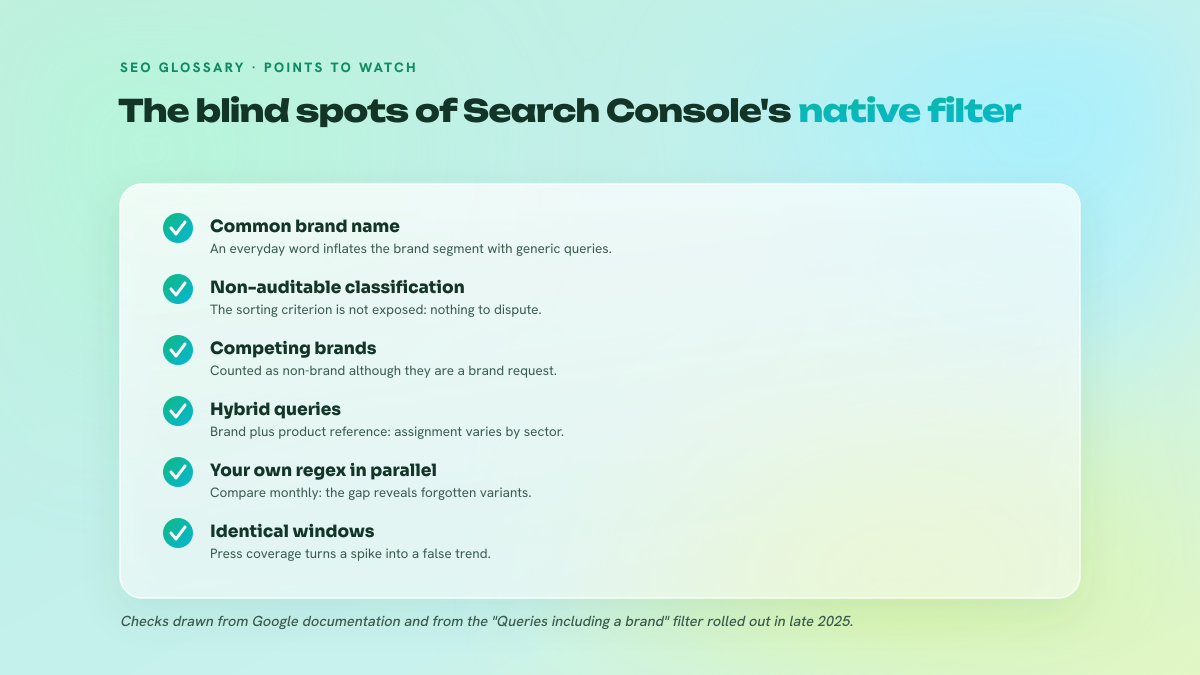
- →Google's native branded queries filter, announced 20 November 2025 and rolled out through December (Search Engine Land), replaces the regex hack but does not replace your own brand-variation list: keep both and compare them on a fixed window.
- →Non-branded is where the risk sits in 2026. Ahrefs data shows AI Overviews are about 1.9× more frequent on non-branded keywords than on branded ones, and organic CTR on AIO queries fell from 1.76% in June 2024 to 0.61% in September 2025.
- →Branded signals now feed AI visibility directly: in an Ahrefs study of 75,000 brands (August 2025), web mentions, branded anchor text and branded search volume correlated with AI Overview presence better than classic link metrics.
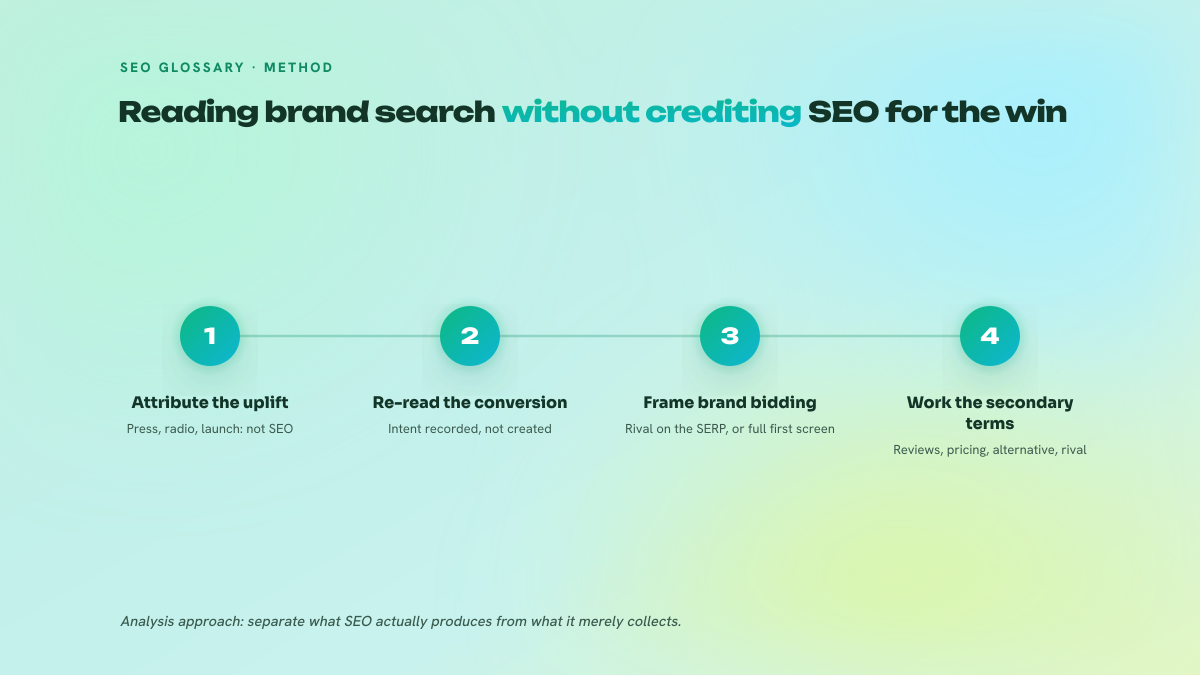
- →A branded share that climbs while total organic is flat is not good news, it is non-branded decline hidden by brand demand. Segment before you celebrate, especially after a PR spike.
- →Anchor profiles follow the same logic as query mix: branded anchors are the default weight, exact-match keyword anchors above roughly 10 to 15% of a page's inbound links are where practitioner datasets start seeing algorithmic trouble.
What the split actually measures
A branded query carries your brand name or something Google reads as your brand: the exact name, a typo, the name plus a product line, the name plus « reviews » or « pricing ». Google draws the line the same way in its own Search Console documentation, folding brand variations, misspellings and brand-related products or services into the branded bucket. Non-branded queries are the remainder: category-level demand where the searcher has not yet decided who they are buying from.
The interesting part is not lexical, it is about who created the demand. A branded query means the intent existed before the search happened: someone saw an ad, read a comparison, got a recommendation, remembered a name three weeks later. The SERP is a routing step, and most of that traffic would have arrived through a bookmark anyway. A non-branded query means the demand is unassigned and the ranking decides who captures it. That is the whole diagnostic value of the split: it separates the traffic your SEO earned from the traffic your marketing, your PR or your existing customer base handed to your SEO.
Volume-wise, branded search is not a rounding error. Ahrefs data published in 2025 puts roughly 45.7% of all Google searches in the branded category, so almost half the query space is navigational rather than discovery. On the other side, BrightEdge data for 2025 has organic search driving about 53.3% of all website traffic, and the bulk of that pool is non-branded. Discovery-first platforms skew harder still: Pinterest reported in 2025 that 96% of its top searches are unbranded. The two buckets are not competing theories about your traffic, they are two different economies sitting inside the same report.
Intent maps onto the split unevenly, and this is where most competing guides stop too early. Branded queries are overwhelmingly navigational, with a transactional tail (name plus « pricing », name plus « discount ») and a thin informational tail (name plus « reviews », name plus « alternative »). Non-branded queries span the full informational to transactional range, which is why they carry the content strategy: they are where a gap between what you publish and what the category actually asks becomes measurable. Merging both buckets destroys that resolution, and no amount of dashboard polish gets it back.
Measuring it without lying to yourself
Until late 2025 the split was a manual job. You wrote a custom query filter in the Search Console performance report, maintained a brand-variation list by hand, pushed it into Looker Studio, and hoped nobody searched a typo you had not anticipated. Google announced a native branded queries filter on 20 November 2025, rolled out through December, as reported by Search Engine Land. It classifies queries with an AI model, applies across web, image, video and news, and surfaces the percentage split directly in the performance report. The gain is consistency: the classification no longer depends on how careful a given analyst was.
A short visual recap of the distinction before getting into the mechanics:
That is not a reason to delete your regex. Two failure modes survive the automation. The first is brands whose name is a common noun: a retailer named after a trade, a tool named after an animal, an agency named after a colour. The classifier has to guess whether the generic use of the word points at you, and on a domain with weak brand volume it guesses conservatively. The second is adjacent-brand queries. « Alternative to X » is non-branded for you and branded for X, and depending on how your product line is named, half your comparison content sits in a bucket the filter assigns differently from the way your commercial team thinks about it.
Run both definitions in parallel for a quarter. Keep your regex as the audit trail, use Google's filter as the default view, and compare the two over an identical window with an identical set of filters. A divergence of a couple of points is noise. A divergence above ten points means your brand token is ambiguous, and you should trust your own list for anything that ends up in a board deck.
Outside Search Console, the segmentation is coarser but still worth wiring. GA4 lets you build a landing-page and source segment that approximates the split when your brand pages are cleanly separated from your category pages, though it cannot see the query itself. Semrush Organic Research gives you the same view on competitors, which is the only practical way to benchmark your ratio against the people you actually compete with. One caveat worth stating plainly: Search Console anonymises rare queries, so the long tail of non-branded demand is systematically under-reported. Your non-branded clicks are real, your non-branded query count is a floor.
Where it lands in a netlinking operation
The query split and the anchor profile obey the same logic, and treating them as separate disciplines is one of the clearer markers of a junior operation. If almost half of real search behaviour is branded, then a link profile where the brand name barely appears as an anchor is describing a site nobody names. Practitioner datasets circulating through 2026 link-building guides converge on a working distribution of roughly 40 to 60% branded anchors, with exact-match keyword anchors kept under about 10 to 15% of a page's inbound links. Above that band is where algorithmic filtering starts showing up in case studies. The threshold is not published by Google, it is an empirical ceiling, and it maps almost exactly onto what a natural query mix looks like.
The strategic link between brand strength and generic ranking is worth hearing stated directly:
What changed in 2026 is that branded signals stopped being only a safety mechanism and became a visibility input. An Ahrefs study of 75,000 brands published in August 2025 found that web mentions, branded anchor text and branded search volume were the factors correlating most strongly with presence in Google AI Overviews, ahead of traditional link metrics. Brands in the top quartile for web mentions averaged 169 AI Overview appearances against 14 for the next quartile. A follow-up correlation study in December 2025 put branded web mentions at 0.664 against AI Overview visibility and 0.709 against AI Mode, with branded anchor text at 0.527 and 0.628 respectively. Correlation is not the mechanism, but the direction is consistent enough to plan around.
The operational consequence: campaigns that only chase generic anchors on category pages are optimising for the half of the query space that is losing clicks fastest, while starving the half that feeds AI surfaces. When we plan placements across the owned French editorial media we run in-house, the brand-mention side of an article matters as much as the anchor: an article that names the client in prose and links once, naturally feeds both the branded query curve and the mention graph, where a bare exact-match anchor feeds neither. The same reasoning applies when you filter media before buying: pick publishers whose audience could plausibly search your brand afterwards, which is a different filter from the one you apply on a catalogue you browse by metric and by theme.
What we see go wrong
The most common mistake is not a measurement error, it is a reporting choice: showing total organic sessions and nothing else. A branded share that rises while total organic stays flat is non-branded decline wearing a disguise. Post-PR periods make this brutal: after a press feature, branded queries can account for close to 80% of a brand's organic clicks, which means the blended line goes up while the discovery engine is stalling. Anyone reporting the blended number in that window is, without meaning to, showing the client someone else's work.
The second mistake is reading branded conversion rates as a performance signal. Benchmarks summarised in 2025 and 2026 put branded queries at roughly 2 to 3× the conversion rate of non-branded ones, which surprises nobody: people searching your name have already decided. Optimising toward that number means optimising toward an audience you already own. Worse, the gap is now partly an artefact. A GA4 study by Visibility Labs across 94 ecommerce brands over January to December 2025 compared 9.46 million non-branded organic sessions against 135,000 ChatGPT sessions, and found non-branded organic converting at 1.39% against 1.81% for ChatGPT referrals. Many AI-assisted journeys end in a branded search, so the assistant does the discovery and the branded bucket books the conversion.
The third mistake is having no target ratio at all. A 2026 SaaS benchmarking guide considers a healthy split to sit around 20 to 25% branded against 75 to 80% non-branded, and flags heavier branded reliance as a sign of limited top-funnel reach. The exact numbers vary by sector, an established retailer legitimately runs far more branded than a two-year-old B2B tool, but having no number means you cannot say whether a five-point move is a win or a warning.
The fourth one is quieter: assuming non-branded volume will behave like it did in 2021. It will not. Ahrefs data shows AI Overviews appearing on 16% of US searches and 21% of all keywords in 2025, and roughly 1.9× more often on non-branded keywords than on branded ones. Measured organic CTR on queries carrying an AI Overview fell from 1.76% in June 2024 to 0.61% in September 2025. Flat non-branded clicks against rising non-branded impressions is now the normal shape of a healthy site, not evidence of a problem.
Operating the split week to week
Set the ratio as a tracked metric with a target band, reviewed monthly, on a rolling 28-day window compared year over year rather than month over month. Seasonality moves branded demand more than it moves generic demand, and a March against February comparison will tell you a story that does not exist. Watch the direction of both curves independently: total up with branded up and non-branded flat is a brand win and an SEO stall, and those deserve different responses.
On the content side, the two buckets need different formats. Non-branded demand is served by category depth, by the internal architecture that gives you real coverage over a subject rather than scattered posts, and by pages that answer a question before mentioning who you are. Branded demand is served by pages you would rather not write: comparison pages, pricing pages, alternatives pages, review pages. Those rank easily because nobody outranks you on your own name, and they convert. They also do nothing for discovery, which is exactly why they should never be counted as SEO growth.
On the acquisition side, keep the anchor mix aligned with the query mix you want to exist in eighteen months. If you plan to be a brand people type, the profile should already look like one. That is the framing we use when scoping work with clients who want a campaign calibrated over several months rather than a batch of links: the branded portion of the anchor plan is not a safety tax, it is the part that compounds. And when reporting, publish the split every single time. It is the one number that stops a client from thanking you for a spike their PR agency bought.
Nautilinks operates an owned network of editorial media. In-house written articles, transparency disclosures respected, anchor mix calibrated.
Frequently asked questions
How do I handle a brand name that is also a common word when filtering?
Run two definitions in parallel. Google's native filter classifies with a model and will misfile generic uses of an ambiguous token in both directions. Keep a hand-maintained regex covering your name, its typos, your product lines and your domain string, and compare both views on identical date ranges and filters. If they diverge by more than about ten points, trust your list and document the definition you used in every report.
Is a rising branded share a good sign?
Only if non-branded clicks are rising too. A branded share climbing against flat total organic almost always means non-branded erosion masked by brand demand, which is exactly what happens in the weeks after a press feature, where branded can reach close to 80% of organic clicks. Read the two absolute curves before you read the ratio. The ratio is a summary, and summaries hide the case you most need to catch.
Should non-branded keywords still be the priority given AI Overviews?
Yes, with adjusted expectations. Ahrefs data puts AI Overviews at about 1.9× more frequent on non-branded keywords, and measured organic CTR on AIO queries dropped from 1.76% in June 2024 to 0.61% in September 2025. Non-branded remains the only demand pool you can win from strangers. What changes is the KPI: track impressions and share of the category alongside clicks, and expect flat clicks on rising impressions to be normal rather than broken.
Does the split change how I plan anchor text?
It should. Practitioner datasets converge on branded anchors carrying roughly 40 to 60% of a healthy profile, with exact-match keyword anchors kept under about 10 to 15% of a page's inbound links. Beyond that band, case studies start showing algorithmic filtering. Since branded search volume, branded anchors and web mentions were the top-correlating factors with AI Overview presence in Ahrefs' August 2025 study of 75,000 brands, the branded portion is now doing two jobs instead of one.
What ratio should I be aiming for?
There is no universal figure, only a sector-relative one. A 2026 SaaS benchmarking guide treats 20 to 25% branded against 75 to 80% non-branded as healthy, and heavier branded reliance as a sign of thin top-funnel reach. An established consumer retailer legitimately runs far more branded than that. Set your band by benchmarking three direct competitors in Semrush Organic Research, then track your own movement inside it rather than chasing someone else's number.
Why do branded queries convert so much better, and does that mean anything?
Benchmarks summarised through 2025 and 2026 put branded conversion at roughly 2 to 3× non-branded, which is mostly definitional: the decision preceded the search. Part of the gap is now an attribution artefact too. A Visibility Labs GA4 study across 94 ecommerce brands in 2025 found ChatGPT referrals converting at 1.81% against 1.39% for non-branded organic, and many assistant-led journeys finish with a branded search that collects the credit. Optimising toward branded CVR means optimising toward demand you already own.
Test your knowledge
Quiz: Branded vs non-branded queries
1/3Google shipped a native branded queries filter in Search Console. When was it announced, and what does it cover?