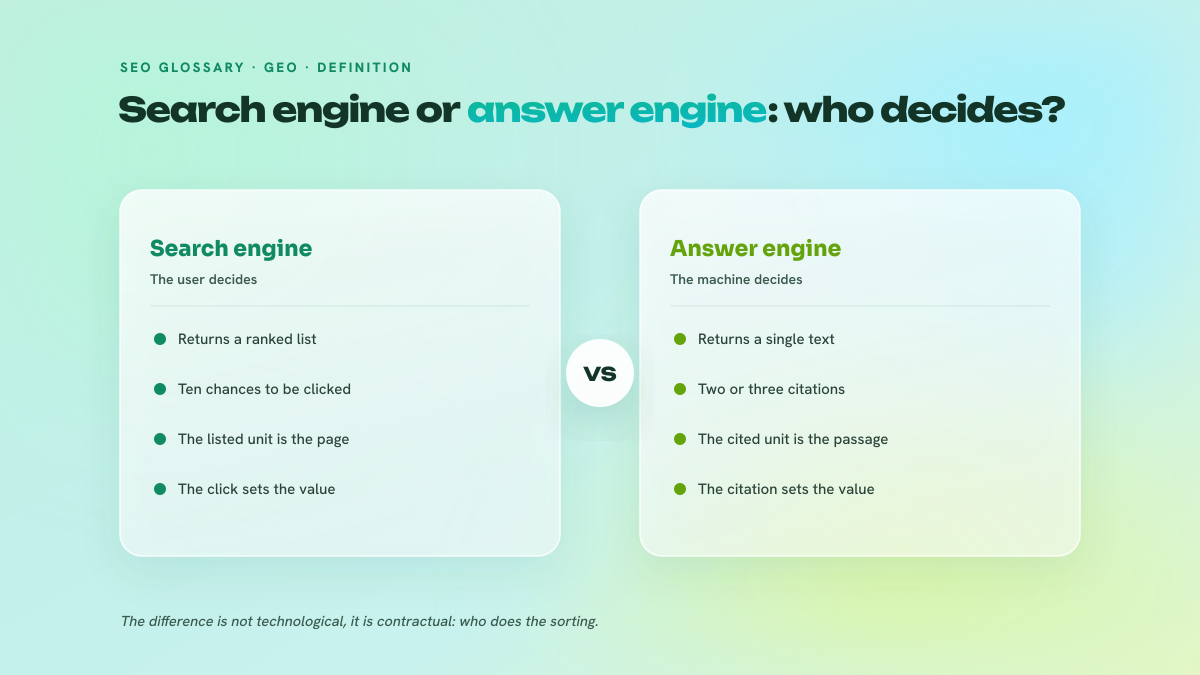
- →An answer engine is not a search engine with a chat skin: it performs the relevance judgment itself and cites afterwards, so the deliverable you optimize for is a citation, not a rank.
- →Google grounds answers on its own index, Perplexity on a live crawl plus partner data, ChatGPT on training weights with an optional search call. Auditing them as one surface produces useless recommendations.
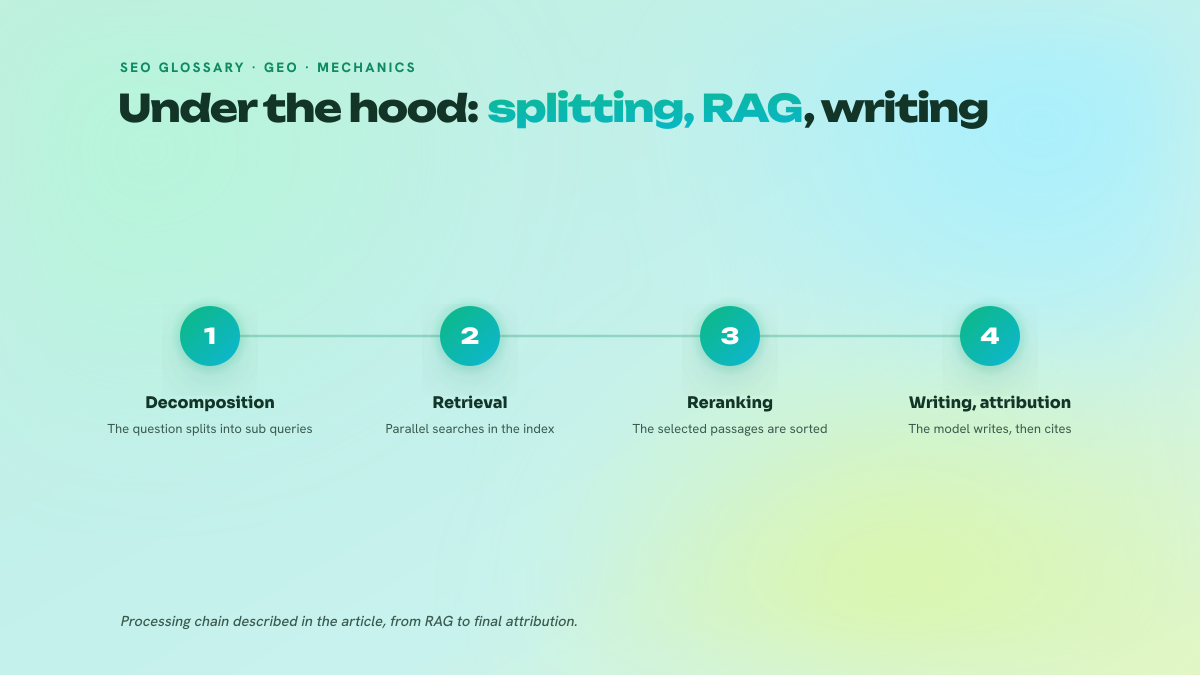
- →Ranking top 10 is still close to a prerequisite inside Google (Mersel AI, 2026: 93.67% of AI Overviews citations point to at least one top-10 result) but a weak predictor of which domain gets picked.
- →Off-Google engines pull from a different corpus: SEOScaleUp reports 8 to 28% citation overlap with Google top-10 for ChatGPT, Perplexity and Claude, and Reddit alone made up around 24% of Perplexity citations in January 2026 (Tinuiti via QuickSEO).
- →Schema markup helps entity resolution and rich results. No engine documents it as a citation factor, and FAQ markup sprayed across a site buys nothing in an answer.
- →Measure with a fixed prompt set run repeatedly across engines, never with a single pass: these systems are non-deterministic and a ten-prompt sample tells you nothing.
What an answer engine really is
A search engine returns candidates and leaves the judgment to you. An answer engine makes the judgment first and shows its sources afterwards, sometimes not at all. That single inversion carries everything else: the unit of visibility stops being a position in a ranked list of documents and becomes a citation inside a synthesized response. Every tactic filed under answer engine optimization descends from that shift, and most of the confusion in the field comes from people who have not internalised it.
The category is older than the current wave. Featured snippets, knowledge panels and voice assistants were already answer engines, just with a narrow answer surface: one source, one extracted passage, no synthesis. What changed between 2024 and 2026 is that the answer layer now blends several documents into prose that nobody wrote. Google AI Overviews, launched in May 2024, sit above the organic results and are read by users as the primary answer rather than as a widget. Google AI Mode, ChatGPT Search, Perplexity and Microsoft Copilot do the same job with different plumbing underneath.
Those differences matter more than the shared label, because the engines fail in different ways. Google grounds its answers on its own index, so the retrieval pool is essentially the web as Google already ranks it. Perplexity runs retrieval against a smaller live crawl plus partner data, which makes it quicker to surface fresh content and far more erratic about what counts as an authoritative source. ChatGPT mixes parametric knowledge from training with an optional search call, which means it can answer a question about your category without retrieving anything: your brand either exists in the weights or it does not. Treating these three as one surface called « AI search » is the first mistake I see in audits, and it is the reason so many AEO reports read as generic.
How the answer actually gets assembled
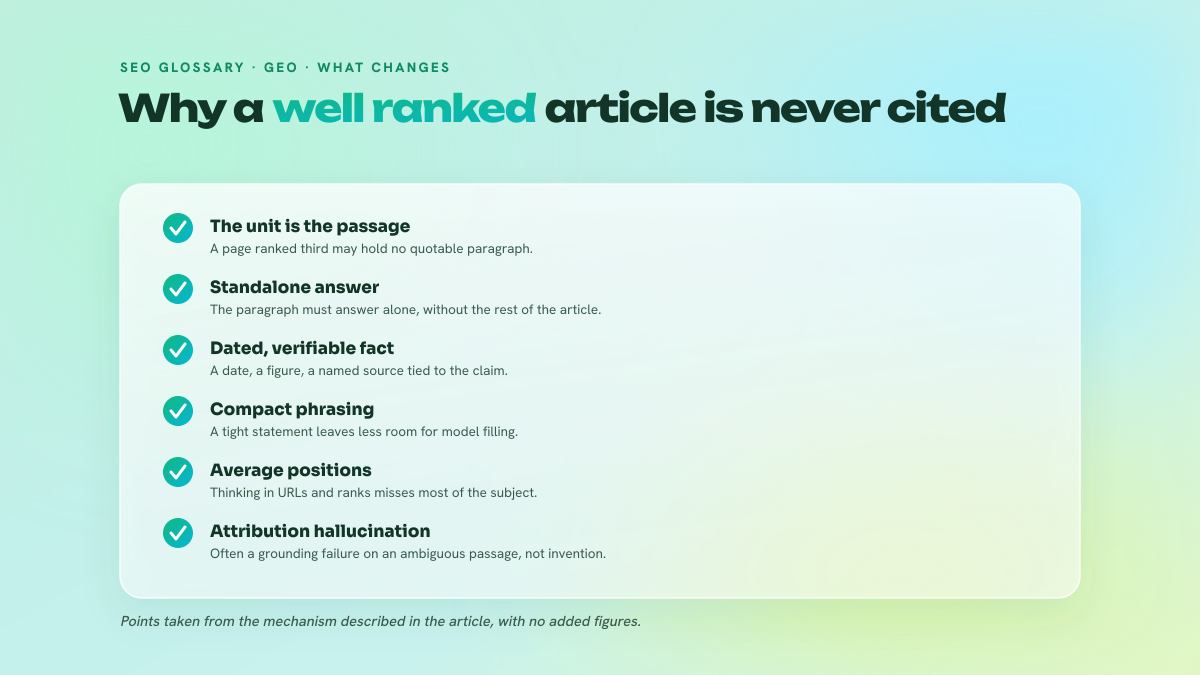
The pipeline is consistent even when implementations differ. The user question is decomposed into several machine queries, retrieval runs on each of them, passages are extracted, a model synthesizes a response, and citations are attached to the output. That decomposition step, the fan-out that turns one question into a dozen sub-queries, is where most of the visibility is actually decided. You are not competing on the phrase the user typed, you are competing on sub-queries you never see and cannot look up in a keyword tool.
This short explainer frames the shift from a ranked list to a generated answer, which is the mental model to hold before going further:
The surface is no longer marginal. BrightEdge tracked Google queries from February 2025 to February 2026 and measured AI Overviews presence rising from around 31% to 48% of tracked queries, a 58% year-on-year increase, with coverage crossing 40% by June 2025. Distribution is uneven by vertical: by February 2026 BrightEdge reports an AI Overview on 88% of healthcare queries, 83% in education and 82% in B2B tech, against roughly 37% in entertainment. On the usage side, figures disclosed by Sundar Pichai in Q2 2025 and compiled by QuickSEO put AI Overviews at around 2 billion monthly users across 200+ countries, with AI Mode passing 100 million monthly active users in mid-2025 and exceeding 1 billion monthly queries by December 2025.
One mechanical detail changes how you read your own data. In several implementations the citation is attached after synthesis, matched back to the generated text rather than emitted by the retrieval step. A cited URL is therefore not proof that the sentence beside it came from that page. Reverse-engineering an answer by reading its source list is a comfortable exercise that produces confident, wrong conclusions.
AEO versus SEO, and what actually differs
Most AEO checklists circulating in 2026 are featured-snippet advice from 2019 with the vocabulary swapped: answer the question in the first forty words, use clear headings, add schema. None of that is wrong, and none of it is new. Selling it as a separate discipline with a separate budget line is where the marketing starts. The honest position is that answer engine optimization is largely classic SEO applied at passage level, plus a genuinely new part worth working on.
This primer covers the vocabulary if you want the baseline framing before the operational part:
The new part is the widening gap between ranking and being cited. Inside Google the two are still coupled: Mersel AI found in 2026 that 93.67% of citations inside AI Overviews point to at least one top-10 organic result, so classic ranking remains close to a prerequisite. But the overlap between the specific domains cited and the specific top-10 domains fell from around 76% in mid-2025 to somewhere between 17% and 38% in 2026 data depending on query type, per BrightEdge and Demand Local figures compiled in current GEO reporting. Being eligible and being chosen have become two different problems. Off Google the coupling nearly disappears: SEOScaleUp reports 8 to 28% citation overlap with Google top-10 for ChatGPT, Perplexity and Claude, and QuickSEO measured Perplexity overlap at 33 to 60% overall, swinging from 82% in healthcare to 27% for restaurants.
On structured data, take the stance and hold it: schema markup helps entity resolution, disambiguation and rich results, and no answer engine documents it as a citation factor. Adding FAQPage markup to every template is a cargo cult that produces validation-tool green checks and nothing else. What does move the needle is prose that survives extraction out of context: a clean self-contained claim, a named source, a date, a number. If a paragraph only makes sense after reading the two above it, it will not be retrieved as an answer.
What it changes for a netlinking operation
Answer engines have not made links irrelevant, they have split what a link buys into two distinct returns. The first is unchanged: authority that helps the target page rank, which inside Google is still the entry ticket to the citation pool. The second is newer and less discussed: an editorial article on a third-party site is a retrievable document that associates your brand with the category vocabulary. When an engine fans a question out into sub-queries, those documents are candidates too, and a brand mentioned in ten independent editorial contexts is a stronger entity than a brand mentioned once on its own site.
Corpus composition is where platform-specific work stops being theory. Tinuiti data relayed by QuickSEO shows Reddit accounted for around 24% of all Perplexity citations in January 2026, against roughly 2.2% inside Google AI Overviews. Same brand, same content, radically different retrieval pools. A campaign built only on editorial placements will underperform on Perplexity, and a campaign built only on forum presence will not exist inside Google. The reasonable answer is a mix sized by where your buyers actually ask questions, which you can only know by sampling. If you want the sampling done on your own prompt set rather than a generic one, that is exactly what our check on where your brand surfaces inside AI answers is built for.
On the acquisition side, the practical constraint is the same as before: you need publishable, indexable articles on media that are themselves retrieved. We run our own French editorial media in-house at Nautilinks, which is why we can say plainly that the editorial quality of the host page matters more for citation than any metric on a media kit. You can browse the full catalogue of media without creating an account and check the pricing yourself, or have the whole sequencing handled for you if you would rather delegate the calibration of a campaign over several months.
Measuring answer engine visibility without fooling yourself
Traditional metrics degrade quietly here. Search Console does not separate clicks that came through an AI Overview from ordinary organic clicks, so a page can lose most of its visibility inside the answer layer while its impression count holds. Seer Interactive, working on a dataset of 25 million impressions, measured organic click-through rate falling from 1.62% to 0.61% when an AI Overview is present, roughly a 61% drop, with Ahrefs reporting in December 2025 a comparable 58% CTR reduction on position 1. Zero-click behaviour compounds it: Similarweb and SparkToro data for US and EU searches puts 58.5 to 59.7% of Google searches ending without an external click, and Digital Applied cites a 93% zero-click rate inside Google AI Mode.
This interview covers the tactical side of optimizing for answer engines, and is worth watching for the framing even where you disagree with the conclusions:
The measurement that works is unglamorous: build a fixed set of 100 to 300 prompts that mirror how buyers actually phrase their questions, run them across the engines that matter for your vertical, repeat the run on a schedule, and track citation share and brand mention share over time rather than a single snapshot. These systems are non-deterministic, so a single pass is noise. Pair that with referral data: traffic arriving from chatgpt.com or perplexity.ai is small in volume, ChatGPT alone reached around 900 million weekly active users in February 2026 and about 2.5 billion prompts per day per OpenAI and Similarweb figures compiled by QuickSEO, while Perplexity handles roughly 50 million weekly queries per Digital Applied, but that traffic tends to arrive further down the decision path. Judge it on conversion, not on sessions.
What we see go wrong
The failure we meet most often is scope: a team decides to optimize for every answer engine at once, spreads effort thin, and ends up measurably present nowhere. Pick the one or two engines where your buyers actually are, usually Google plus one, and go deep. Second failure, content mutilated in the name of extractability: pages rewritten into stacks of forty-word answers that no longer hold an argument, which lose their organic rankings and therefore their eligibility for the citation pool they were chasing. Third, llms.txt treated as a lever. No major engine has committed to honouring it. Publishing one costs nothing, expecting anything from it is superstition.
Two more worth naming. Sampling theatre: a ten-prompt check run once, screenshotted, presented as a visibility report. And the assumption that a citation converts like a click. Being cited inside an answer that fully satisfies the user is brand exposure, not traffic, and it should be valued as such in the reporting rather than quietly counted as a win. The teams doing this well in 2026 treat answer engines as a distribution channel with its own economics, keep classic SEO fundamentals intact underneath because retrieval still runs on the index, and accept that the search box is now one interface among several rather than the whole market.
Nautilinks operates an owned network of editorial media. In-house written articles, transparency disclosures respected, anchor mix calibrated.
Frequently asked questions
Is an answer engine just a search engine with a chat interface on top?
No, and the difference is architectural rather than cosmetic. A search engine ranks documents and hands the relevance judgment to the user. An answer engine decomposes the question, retrieves passages, synthesizes a single response and attaches citations afterwards. The user is shown a conclusion instead of a list of options. That changes what you optimize: a passage that survives extraction out of context, not a page that wins a position.
Does ChatGPT count as an answer engine when it replies without searching?
Yes, and that is precisely what makes it the hardest surface to work on. ChatGPT mixes parametric knowledge from training with an optional search call, so a query about your category can be answered entirely from the weights with no retrieval and no citation. In that mode your visibility depends on how present your brand was in the training corpus, which you influence over years through published mentions, not through on-page tweaks made last week.
Is there a real distinction between AEO and GEO or is it just vocabulary?
There is a narrow one. AEO covers being the source of a direct answer, including pre-LLM surfaces like featured snippets and voice results. GEO covers being cited inside a generated, multi-source response. In daily practice the two workstreams overlap almost entirely, and agencies selling them as separate retainers are selling vocabulary. Judge a proposal on whether it names the engines, the prompt set and the measurement method.
If I already rank top 3, am I automatically cited in AI Overviews?
No. Mersel AI found in 2026 that 93.67% of AI Overviews citations point to at least one top-10 organic result, so ranking is close to a prerequisite. But the overlap between the domains actually cited and the domains ranking top-10 fell from around 76% in mid-2025 to between 17% and 38% in 2026 depending on query type. Eligibility and selection are two separate filters.
Does adding schema markup get my content cited more often?
Not directly. Schema helps engines resolve entities, disambiguate your brand and qualify for rich results, all of which is worth doing. No answer engine documents structured data as a citation factor, and blanket FAQPage markup across a site produces validator green checks and nothing measurable. Effort is better spent on self-contained paragraphs carrying a named source, a date and a figure, since that is what extraction actually keeps.
How big does a prompt set need to be to measure answer engine visibility seriously?
Plan on 100 to 300 prompts reflecting how buyers phrase questions in your vertical, run across the two or three engines that matter to you, repeated on a fixed schedule. These systems are non-deterministic, so a single pass on a handful of prompts measures noise. Track citation share and brand mention share as trends over weeks, and cross-check against referral conversions rather than referral sessions.
Test your knowledge
Quiz: Answer engine
1/3According to Mersel AI 2026 data, what share of AI Overviews citations link to at least one top-10 organic result?