- →AlsoAsked's value is the recursion, not the questions: a second-level node tells you what Google thinks comes after the first answer, which is a page-structure signal a flat keyword export cannot produce.
- →Pricing is credit-based and Deep Search eats credits fast: Basic is $12/month for 100 credits, Pro $47/month for 1,000, with 20 % off annual billing (AlsoAsked pricing page, 2026). Deep Search returns around 150 questions per query, so an agency on Basic runs dry in a week.
- →Search-history retention is 24 hours on Basic and one year on Pro. If you do not export the CSV the same day, on the entry plan your research is gone and PAA has already rotated.
- →Question intent is exactly where AI Overviews concentrate: Seer Interactive found Overviews on roughly 86 % of question searches and 95 % of comparison searches (Search Engine Land, 2026). That makes question mapping more useful and clicks scarcer at the same time.
- →Google's 15 May 2026 guidance states that generative features run on the same Search systems and that no llms.txt, AI-only markup or Markdown is required. PAA data helps you structure an answer, it is not an AI-ranking shortcut.
- →Use it as a brief-building tool for editorial placements, not as a keyword tool. The question tree tells a host publisher's writer what sub-question to actually answer instead of paraphrasing the client's own page.
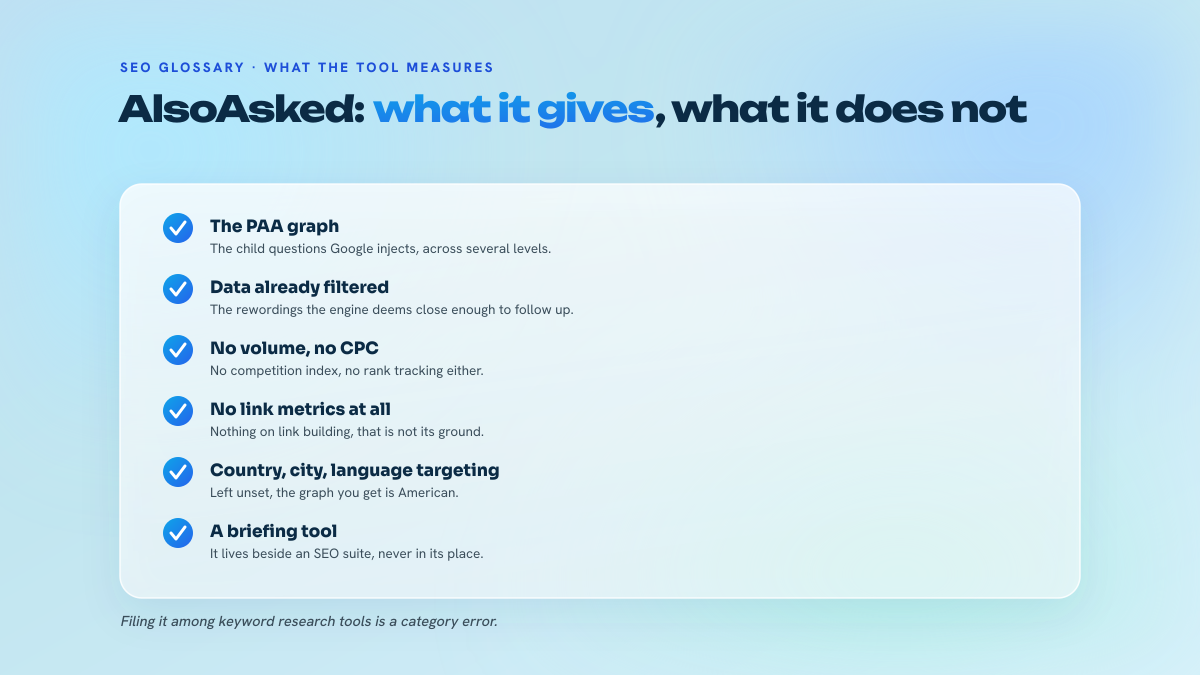
What AlsoAsked actually gives you
Type a seed query into AlsoAsked and you get a tree, not a list. Each People Also Ask question Google surfaces for that seed becomes a node, and every node expands into the questions Google shows once that node is opened. The recursion is the entire product. A flat keyword export tells you what people type. The question tree tells you the order in which Google expects curiosity to unfold, which is a different and more useful thing when you are structuring a page rather than counting demand.
That distinction matters more than the tool's marketing does. The second level of the tree is Google's own model of what a user still does not understand after reading the first answer. When you see that « how long does it take » sits under « is it worth it » rather than the reverse, you have learned something about the reader's decision path that no volume column will ever tell you. This is why AlsoAsked survives in a stack that already contains heavier machinery.
The tool sits in a deliberately narrow slot. Comparison coverage in 2026 puts it less kindly: AlsoAsked ships no search volume, no CPC, no competition score, no rank tracking and no backlink metrics. That is not a gap waiting to be filled, it is the design. You keep your usual backlink and volume platform for sizing and for link analysis, and you use AlsoAsked for the one signal those platforms flatten. Anyone selling it as an all-in-one keyword suite has not used it seriously.
Worth being precise about what the data is. the PAA block itself is volatile, partly personalised, and rotates on a timescale of days. AlsoAsked queries it live rather than serving a cached index, which is its main advantage over the older question-scraping tools and also its main constraint: two runs a week apart on the same seed will not match, and neither run is wrong. Treat every export as a dated snapshot, not as a stable list.
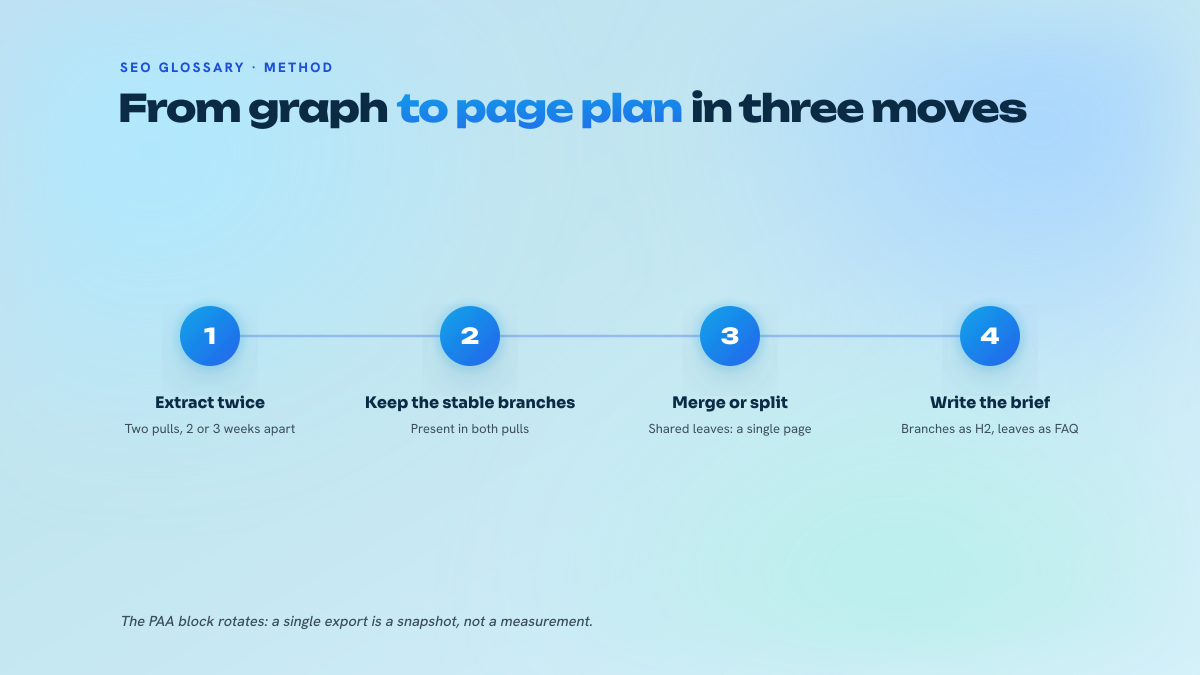
How the question graph is built, and what it costs
Mechanically, one search consumes one credit and returns the tree for one seed in one location and one language. Deep Search widens the crawl considerably: AlsoAsked reports an average of 150 questions per query on that mode. Country, city and language targeting are available on all paid tiers, which is the feature most people underuse, and bulk upload plus an asynchronous API with webhooks handle volume.
The pricing page, as of 2026, lists Basic at $12/month for 100 credits, Lite at $23/month for 300 credits and Pro at $47/month for 1,000 credits, tax excluded, with annual billing discounted by 20 % ($144, $276 and $564). Free access is positioned as monthly credits for non-registered users. Third-party 2026 reviews report the practical allowance as three searches per day, but the official page does not state a number, so treat that figure as independently reported rather than confirmed.
Two details in that table decide whether the tool works for an agency. First, credit burn: a single content brief in three cities plus two languages is five credits before you have looked at a competitor, and a Deep Search run on a broad seed is a credit that returns 150 questions you then have to triage. On Basic, one hundred credits disappear inside a week of real work. Second, retention. Search history is kept 24 hours on Basic, one month on Lite and one year on Pro. On the entry plan, research you did not export the same day is simply gone, and since PAA rotates you cannot reproduce it. Export the CSV immediately or buy the retention.
The company reports 14,000+ registered users and 2.5m+ searches on its homepage. Those are self-reported product figures, not audited market share, and they say nothing about data quality. What actually differentiates the tool is that the API is asynchronous with webhooks, which means intent monitoring can be scheduled rather than manual: run the same seed set monthly, diff the trees, and you have a drift signal on how Google is reframing a topic. That is a genuinely useful artefact and almost nobody builds it.
Where question data earns its keep in a netlinking operation
Most SEOs file AlsoAsked under content research and stop there. In a netlinking operation it is more useful one step earlier, at the briefing stage, because the recurring failure of a placed article is not the link, it is that the article restates what the client's page already says. A host publisher's writer given a question tree writes something that answers a sub-question the target page does not cover, which makes the contextual link a genuine next step for the reader rather than an inserted anchor.
That is how we brief on the French editorial media we run in-house at Nautilinks: the placement's angle is picked from a second or third-level node, and the link points to the page that answers the parent node. The internal logic is the same one Google is modelling in the PAA block, so the resulting link sits where a reader would want it. You can look at how those media are actually operated and what each one covers before deciding which one fits a given question cluster.
Question data also settles a recurring argument about which host to pick. If a media outlet already ranks on the parent question of your tree, a link from it carries topical adjacency you cannot buy with metrics alone. Filtering a catalogue on Trust Flow tells you about the host's link graph. Cross-referencing the host's existing coverage against your question tree tells you whether the placement will be read. Both matter, and the second is the one people skip, which is why we made the full media catalogue browsable without an account instead of hiding it behind a sales call.
The commercial case for caring about questions strengthened before AI even entered the picture. A November 2025 Search Engine Land guide reported that People Also Ask visibility in the US rose 34.7 % between February 2024 and January 2025, and that 63 % of PAA interactions happen on mobile. Those figures predate the current window but explain the trajectory: question surfaces took SERP real estate from classic blue links, and the sites that structured for them absorbed the difference.
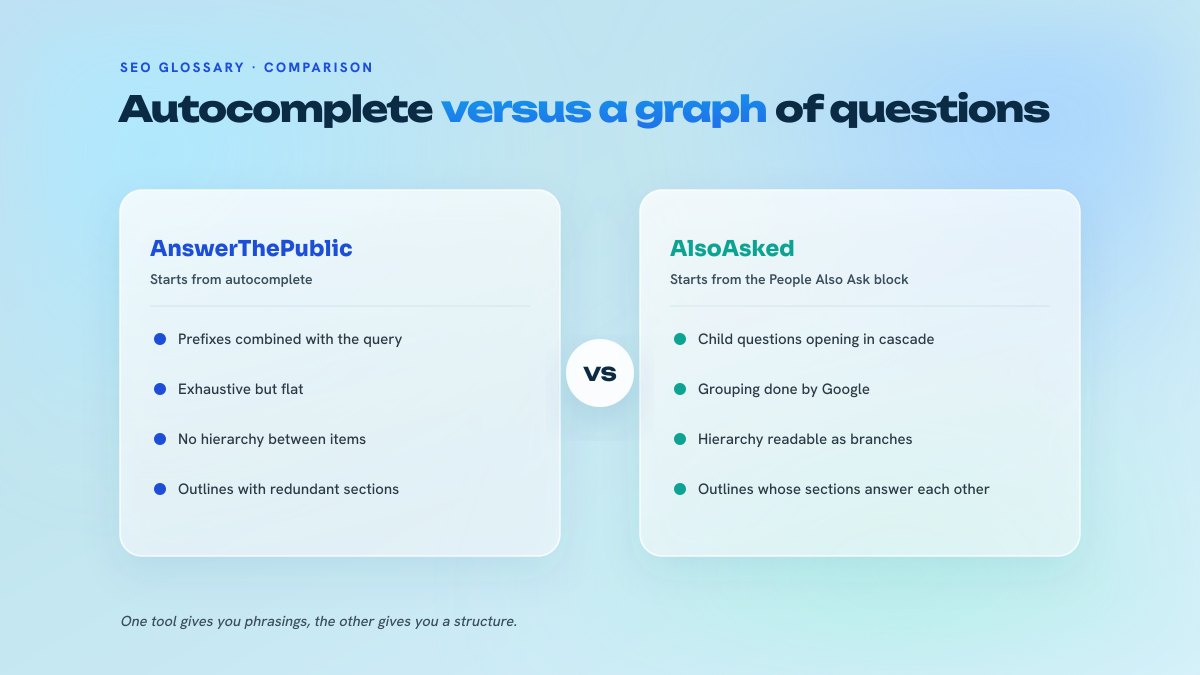
2026 reality: AI Overviews changed the payoff, not the method
The honest read on question research in 2026 is that it became more valuable and less profitable at the same time. Seer Interactive, in a study covering 53 brands, 5.47 million queries and 2.43 billion impressions reported by Search Engine Land, found that organic CTR on searches carrying an AI Overview fell to 1.3 % in December 2025 and recovered to 2.4 % by February 2026, an 85 % rise off the floor. On the same SERPs, CTR was approximately 3.3 % with no Overview, 2.1 % when the page was cited inside it and 0.9 % when it was not. Searches without an Overview went the other way, from 2.8 % in early 2025 to 3.8 % in February 2026.
The distribution is what makes this an AlsoAsked problem specifically. In Seer's data, Overviews triggered on roughly 36 % of informational, 5 % of transactional, 95 % of comparison and 86 % of question searches. Question intent, the exact terrain this tool maps, is where Overviews are near-universal. Prevalence estimates vary widely by panel: a Semrush-based study reported Overviews on 6.49 % of queries in January 2025, peaking at 24.61 % in July 2025 and settling at 15.69 % in November 2025, and those numbers are not directly comparable to Seer's because the query mixes differ. The direction is not in dispute.
So the objective moves from ranking to ranking plus being cited, since a cited page on an Overview SERP roughly doubles the CTR of an uncited one in that dataset. What does not move is the method. Google published guidance on generative-search optimisation on 15 May 2026 stating plainly that AEO and GEO are still SEO, that generative features run on the same fundamental Search systems, and that sites need no llms.txt file, no AI-only markup and no Markdown to appear in them. It also notes that third-party tools have no access to Google's internal ranking data.
Read that against AlsoAsked's own homepage, which now markets question trees as an AI-visibility instrument on the grounds that they map follow-up conversational intent. The claim is defensible as far as it goes: query fan-out in AI Mode does decompose a prompt into sub-questions, and a page built around a coherent question tree covers more of that decomposition. It is not evidence that PAA data predicts citation. Anyone selling PAA exports as an AI-ranking input is selling a correlation as a mechanism.
What we see go wrong, and the setup that avoids it
The most common failure is transcription. An agency exports the tree, promotes every node to an H2, and ships a 2,500-word page that answers forty questions at a depth of two sentences each. That page is a PAA harvesting machine with no argument in it, and since December 2025 it is precisely the shape that an Overview replaces outright. The tree is an outline hypothesis, not a heading structure. Most branches should be answered inside a paragraph or dropped.
Second failure: ignoring geography. The city and language targeting exists because PAA differs by market, and a French tree pulled on a US locale is a different document. If you operate across markets, run the seed per market and diff, because the gap between the trees is often the actual editorial insight, particularly on regulated verticals where local framing dominates the block.
Third: no baseline. Exporting questions without knowing what your site already covers produces briefs that duplicate existing pages, and the duplication then competes with itself. Crawl first, map current coverage per URL, and only then decide which nodes are genuinely uncovered. The integration path here is well worn and barely documented: AlsoAsked states its API integrates with tools including Screaming Frog and ChatGPT, so the crawl-then-diff loop can be automated rather than done in a spreadsheet once a quarter.
Fourth, and the one that costs money: treating question count as a content target. Deep Search hands you 150 questions and a junior fills them all, which inflates page count and dilutes the internal linking budget across pages nobody will ever link to. Coverage decisions should be made against what a page can plausibly rank for and what it can convert, then the authority budget gets allocated to the survivors. If you are sizing that budget, the arithmetic between how many pages you plan to support and what a placement actually costs per media is the constraint that should decide how many nodes you keep, not the export length.
The setup that works is unglamorous. One Pro seat for the retention, seeds run per market, Deep Search reserved for pillar topics rather than every brief, CSV exported and versioned in the repository the same day, a monthly re-run on the same seed set to catch reframing, and the diff feeding the editorial calendar. Total cost is $564 a year on annual billing. Compared with what a single misbriefed placement costs, it is not the line item to optimise.
Nautilinks operates an owned network of editorial media. In-house written articles, transparency disclosures respected, anchor mix calibrated.
Frequently asked questions
Is AlsoAsked still worth paying for now that AI Overviews absorb question queries?
Yes, but for a different reason than in 2023. Seer Interactive data reported by Search Engine Land shows Overviews on roughly 86 % of question searches, so ranking alone no longer pays there. What pays is being cited, and structured question coverage is one of the inputs. You buy the tool to build better-organised answers, not to harvest PAA snippets. If your model still assumes a click per ranking on question intent, fix the model before renewing the subscription.
Which plan makes sense for an agency, and is Basic ever enough?
Basic at $12/month for 100 credits is a solo consultant's plan and it keeps history for only 24 hours, so anything you forget to export is unrecoverable once PAA rotates. For an agency, Pro at $47/month buys 1,000 credits and one year of retention, which turns your search history into a longitudinal record of how Google reframes a topic. Annual billing takes Pro to $564. Credit burn on Deep Search is the real constraint, not the monthly price.
How does AlsoAsked differ from pulling PAA from a rank tracker or a SERP API?
A rank tracker gives you the PAA block for a query, flat. AlsoAsked recurses: it clicks each question and captures what Google surfaces next, several levels deep. That parent-child relationship is the whole value, because it encodes sequence rather than presence. A SERP API can replicate it if you build the crawl and the deduplication yourself, and some teams do. Most find that rebuilding it costs more engineering time per year than the Pro subscription.
Can the question tree be used to predict AI Mode fan-out?
Partially, and it should not be sold as more than that. Query fan-out decomposes a prompt into sub-queries, and a page that covers a coherent question cluster naturally covers more of that decomposition. But Google's 15 May 2026 guidance says generative features run on the same Search systems and that third-party tools have no access to internal ranking data. PAA is an observable proxy for topic decomposition, not a view into the fan-out itself.
What is the fastest way to plug it into an existing content workflow?
Crawl the site first and map current coverage per URL, then run seeds per market, then diff. Without that baseline you write briefs that duplicate pages you already have. AlsoAsked states its API integrates with tools including Screaming Frog, and the API is asynchronous with webhooks, so the crawl-and-diff loop can run monthly on a schedule. The output that matters is the delta between two runs, not the raw export.
Does question research help when choosing which media to buy a link from?
It helps more than most metric filters. If a host publisher already covers the parent question of your tree, a contextual link from it lands in a passage a reader is genuinely working through, which is the difference between a link that sends traffic and one that only sits in a backlink report. Filter on host metrics to exclude the obviously bad, then cross-reference the host's real editorial coverage against your question cluster.
Test your knowledge
Quiz: AlsoAsked
1/3What does AlsoAsked provide that a flat keyword export cannot?