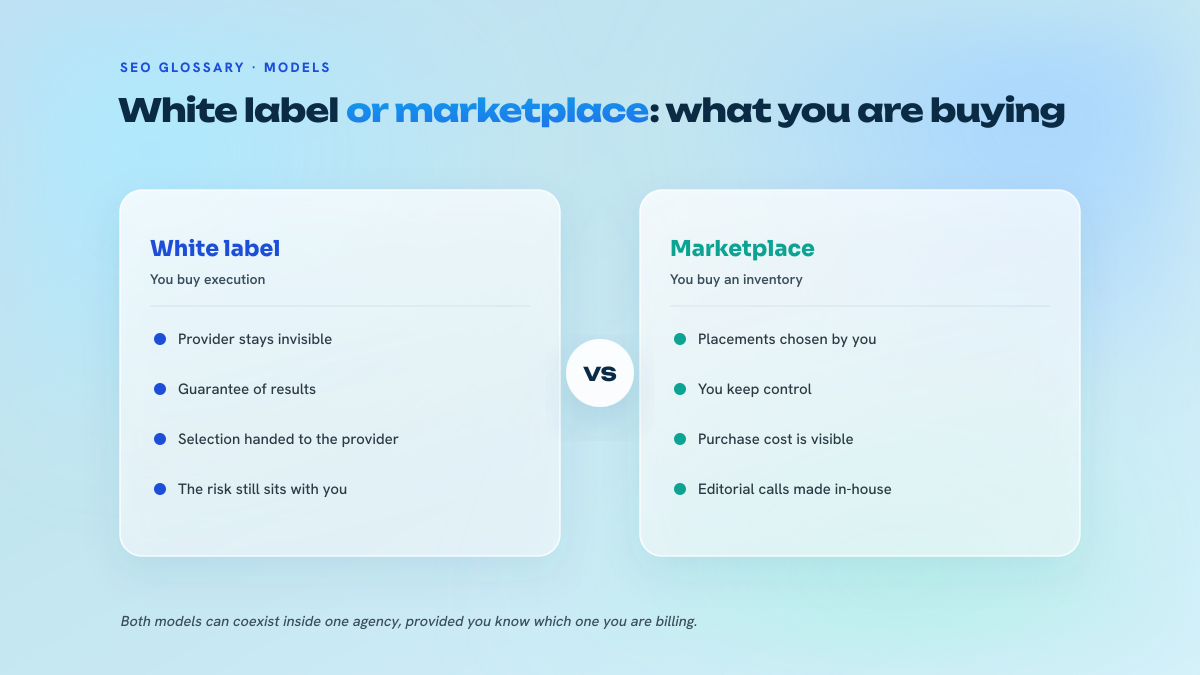
- →White label is a capacity decision, not a competence decision: the agencies that win outsource execution and keep diagnosis, prioritisation and the client relationship in-house.
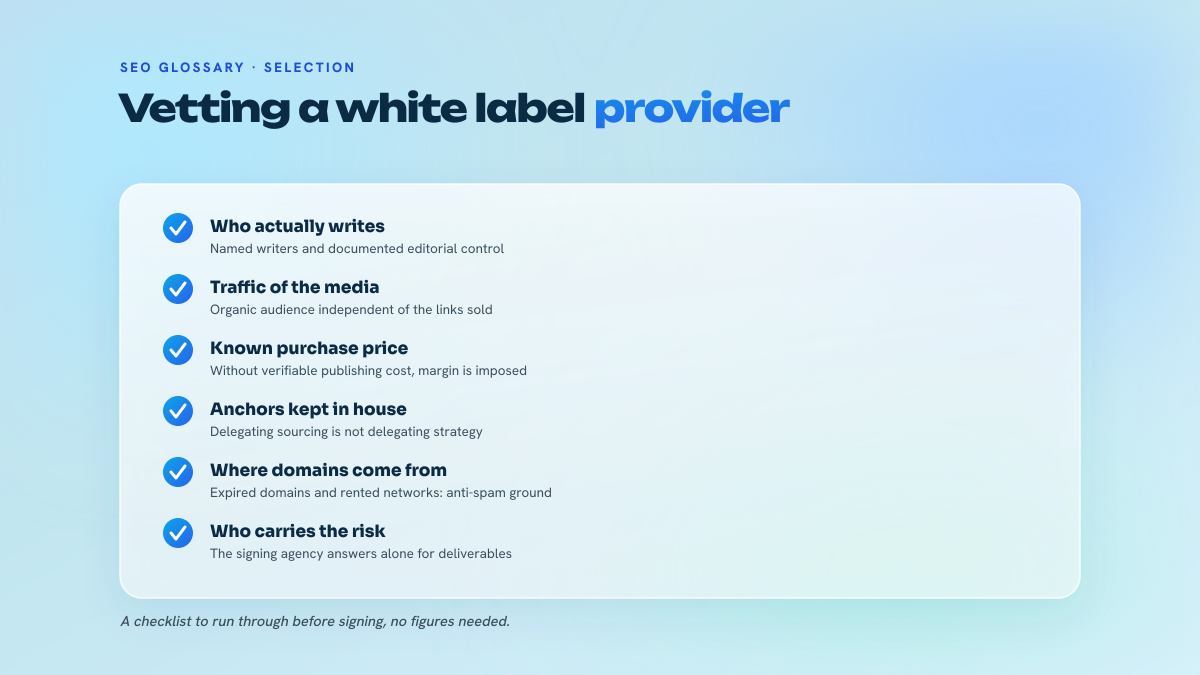
- →The supplier's inventory is the only thing that matters in link fulfilment. Ask who owns the publishing site, who writes the article and whether the placement can be removed, before any DR or Trust Flow filter.
- →Google's August 2025 spam update ran roughly 27 days across all languages and explicitly targeted expired-domain abuse, scaled content abuse and site-reputation abuse (Search Engine Land, 2025 updates review), which are precisely the three shortcuts cheap white label fulfilment relies on.
- →Editorial.link's 2025 survey of 518 SEO professionals found 56 % outsourced at least part of link building and that respondents priced one high-quality backlink at $508.95 on average, with 80.9 % expecting costs to rise: sub-100 € placements are not a bargain, they are a different product.
- →Rank-position reporting is no longer sufficient. Since Google shipped generative-AI performance reports in Search Console on 3 June 2026, a white label report that ignores AI impressions and citations is hiding the part of the funnel that moved.
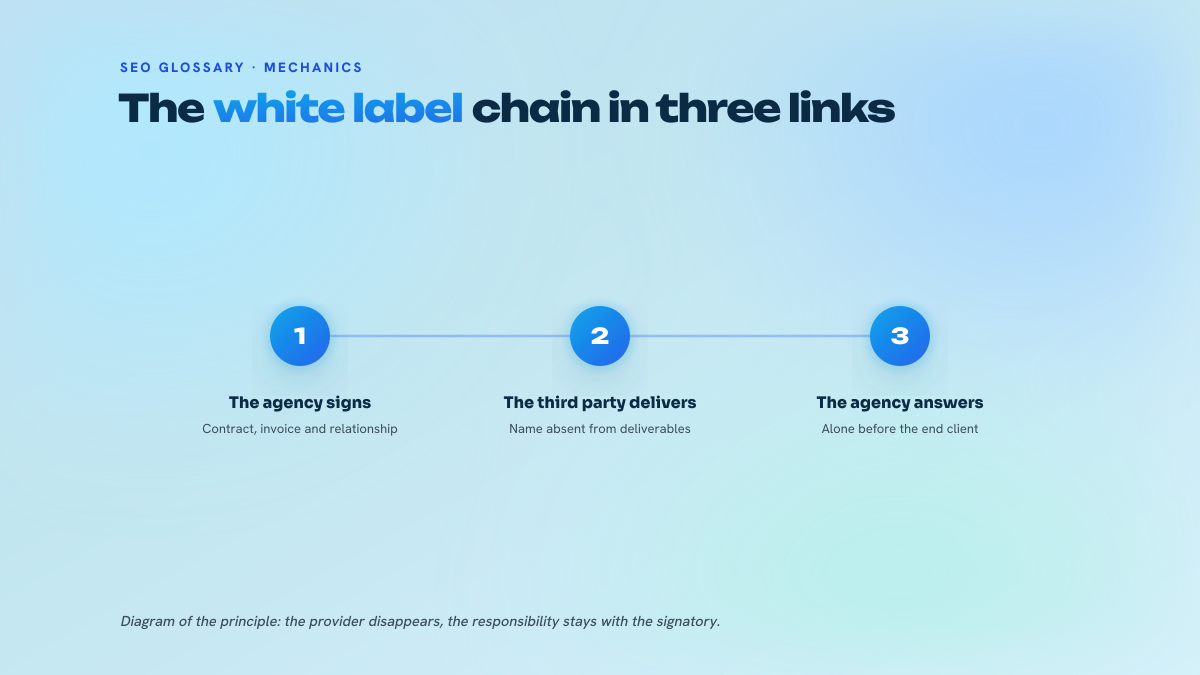
- →Anonymity cuts both ways: the reseller carries the penalty, the client's manual action and the refund, while the supplier keeps the margin and the deniability. Price that asymmetry into the contract or into the supplier choice.
What the white label model actually sells
An agency signing a white label deal is not buying SEO knowledge. It is buying capacity it can resell under its own name: audits without a logo, content without a byline, link placements without a supplier reference, dashboards it can rebrand. The commercial promise is that a four-person agency can service accounts sized for twelve people, and that the client never learns where the work came from.
That framing matters because it tells you which failures are structural. When white label goes wrong, it is almost never because the supplier lacked skill. It is because the reseller sold a scope it could not specify, the supplier optimised for the deliverable rather than the outcome, and nobody in the chain owned the client's actual ranking problem. The reseller sees a monthly report. The supplier sees a ticket. The client sees a bill.
The useful distinction is between the layers you can safely detach and the ones you cannot. Diagnosis, prioritisation and the argument you make to a client about why their category page is losing to a marketplace: those live with whoever holds the relationship. Execution travels well. Technical crawls, on-page rewrites, schema deployment, translation, reporting, link acquisition, all of these are legitimately outsourced by senior teams every day and have been for fifteen years. The industry's discomfort with the term comes from resellers who detached the wrong layer, sold strategy they never produced, and discovered that the supplier's judgment was now their brand.
How the model works in 2026
Three shapes dominate. The first is capacity-on-demand: the reseller sends a scoped brief, the supplier returns a deliverable, pricing is per unit. The second is a dedicated pod, where the reseller effectively rents named practitioners at a monthly rate and treats them as staff who invoice from elsewhere. The third, and the one most people mean when they say white label SEO, is productised fulfilment: fixed packages, fixed monthly output, a portal, a rebrandable report.
Productised fulfilment is where the model is under the most pressure. It only works if the deliverable is standardisable, and the parts of SEO that still move rankings in 2026 have become less standardisable, not more. A generic 2 000-word article and four contextual links no longer describe a strategy, they describe a shipping manifest. What has held up is the fulfilment of things that genuinely benefit from scale and infrastructure: crawling, localisation, structured data rollouts, and publisher-side link inventory, where owning or negotiating access to real media is a capital and relationship problem rather than a skill problem.
Link fulfilment deserves its own paragraph because it is where most white label margin is made and most white label risk is created. Between a reseller and a published link there can be four intermediaries: the reseller, a fulfilment agency, a broker who aggregates supply, and the site owner. Each layer takes a cut and each layer removes information. By the time the placement goes live, the reseller usually cannot answer the only three questions that matter: who owns that site, who wrote that article, and what happens if the client wants it removed in eighteen months. That opacity is the actual product being sold in a lot of the market, and it is the reason we run our own French editorial media in-house rather than reselling inventory we would have to describe second hand.
The fulfilment risk nobody prices
Google spent the last twelve months making cheap fulfilment more expensive. The August 2025 spam update rolled out from 26 August to 22 September 2025, covered all languages, and was the first spam update since December 2024 according to Search Engine Land's review of the 2025 updates. Its stated targets read like an inventory of white label shortcuts: expired-domain abuse, scaled content abuse, site-reputation abuse and link schemes, all of which Google now documents explicitly as spam policies. The December 2025 core update followed, running eighteen days from 11 to 29 December 2025, and Google's status dashboard records a further spam update over 24 to 26 June 2026.
The operational consequence is that supplier due diligence has to move upstream of the metrics. Filtering a media list by Domain Rating or by Trust Flow above an arbitrary threshold tells you nothing about whether the host is a rented subfolder, a rebuilt expired domain, or a site whose editorial team exists. Those three cases have identical third-party metrics and radically different survival curves. What actually predicts survival is whether the placement sits inside real editorial output with real traffic, whether anchor governance is applied across the client's whole profile rather than per order, and whether the supplier has a removal and replacement procedure that does not require a support ticket war.
There is a second asymmetry that white label contracts rarely address. If a placement triggers a manual action against the client, the supplier loses one order. The reseller loses the account, refunds the retainer, and spends three months on a disavow and reconsideration cycle it did not cause. Any agency reselling link fulfilment should be reading the supplier's failure modes as its own liability, because commercially they are.
Reporting after AI search broke the rank-only report
The standard white label report, a rank table plus a traffic curve plus a link log, described the business accurately until roughly 2024. It does not anymore. Pew Research's July 2025 analysis of 68 879 Google searches from 900 US adults found that a traditional result was clicked on 8 % of visits when an AI summary was present, against 15 % when it was not, and that only 1 % of visits produced a click on a link inside the summary. Seer Interactive's 2025 study of 3 119 informational queries reported organic click-through falling from 1.76 % to 0.61 % when AI Overviews appeared, a 61 % decline.
Google has since given the industry the instrumentation. On 3 June 2026 it launched dedicated generative-AI performance reports in Search Console, covering AI Overviews, AI Mode and generative-AI features in Discover, with impression views available while click and CTR reporting stays limited. Google's own May 2026 guidance is blunt about the discipline question: optimising for generative features is still fundamentally SEO, not a separate practice, and its spam policies now formally apply to AI Overviews and AI Mode, which closes the idea that generative surfaces are a policy-free playground.
For a reseller this is a positioning opportunity more than a technical one. A report that separates classic rankings, impressions inside AI answers, referral sessions from LLM sources, assisted conversions and branded search demand tells a client something their previous agency's report structurally could not. A supplier that cannot produce those lines is selling a 2023 deliverable at 2026 prices.
The real cost structure, and where the margin hides
Almost nobody publishes numbers on this, which is convenient for the parts of the market that depend on the client not doing arithmetic. Editorial.link's 2025 survey of 518 SEO professionals found that 56 % outsourced at least part of their link building and that agencies allocated an average 32.1 % of SEO budgets to it. The same research put the average acceptable price of one high-quality backlink at $508.95, reported 80.9 % of respondents expecting link costs to rise over the following two to three years, and gave an average minimum monthly budget of $8 406 for highly competitive niches. A separate 2026 survey of 500 professionals found 58 % increasing link budgets against 14 % cutting them, which is survey evidence rather than audited market data but points the same way.
Set that against a productised white label offer selling ten links a month for a four-figure retainer and the maths resolves in one direction: the inventory is not the same inventory. That is not a moral point, it is a supply point. A placement on a site with genuine editorial output and audience has a floor price set by the publisher's opportunity cost. A placement with no such floor is coming from somewhere the publisher does not value the page, which is exactly the profile Google's expired-domain and site-reputation policies describe. Agencies that want the margin without the exposure generally end up buying fewer, better-sourced placements and being explicit with the client about it, which is why we publish what each media costs before anyone signs anything rather than quoting a package.
The other structural cost is coordination. Every white label chain adds brief-writing, quality review, revision cycles and the internal time spent explaining to a client why month two looks like month one. Resellers routinely price the deliverable and forget the coordination, then discover their effective margin is half the spreadsheet figure. Buying from a supplier whose catalogue and turnaround you can inspect directly, rather than through an account manager, removes a surprising share of that overhead: it is the practical difference between a market where inventory is aggregated and resold and one where you deal with the publisher.
Vetting a supplier without a checklist
Three questions separate suppliers faster than any audit template. Ask who physically owns the sites where links will be placed, and treat any answer that routes through a partner network as an unknown rather than a yes. Ask to see an article the supplier wrote for a client in your vertical, unedited, and read it as a peer: if it reads like it was assembled from the SERP it will perform like it. Ask what happens on a failure, meaning removal, replacement, refund, and how long each takes in practice.
Then test the reporting before the fulfilment. Request a sample report and check whether it distinguishes branded from non-branded queries, whether it shows AI surface impressions at all, and whether the link log records the publishing URL rather than just the domain. A supplier that reports at domain level is a supplier that expects some URLs to move.
Finally, keep one thing structurally in-house whatever else you outsource: the decision about what to work on next. Agencies that outsource execution and keep diagnosis stay agencies. Agencies that outsource diagnosis become a billing layer, and a billing layer is the easiest thing in this market for a client to remove. If the volume problem is specifically link inventory, the honest version is to buy from a source you can inspect, on a catalogue you can browse without an account or a sales call, and keep the strategy where the client relationship already is.
Nautilinks operates an owned network of editorial media. In-house written articles, transparency disclosures respected, anchor mix calibrated.
Frequently asked questions
Is white label SEO worth it when AI search is compressing organic clicks?
The click compression is real: Pew Research's July 2025 study found traditional results clicked on 8 % of visits with an AI summary present versus 15 % without. But SEO is not being retired, it is being re-instrumented. Google's May 2026 guidance states that optimising for generative features is still fundamentally SEO, and it shipped generative-AI reports in Search Console on 3 June 2026. Outsourced fulfilment stays viable. Outsourced fulfilment that reports only rank positions does not.
How do I tell a genuine white label supplier from a broker reselling someone else's inventory?
Ask for ownership, not metrics. A supplier that owns or directly contracts its publishing sites can name them, show traffic, and commit to a removal policy. A broker answers with tiers, DR ranges and partner networks. Two other tells: whether they can produce the article draft before publication, and whether the link log gives the exact URL rather than just the domain. Domain-level reporting usually means the supplier expects placements to move or disappear.
What should an agency actually keep in-house?
Diagnosis, prioritisation and the client conversation. Deciding which pages to attack, which cannibalisation to resolve and which link budget goes where is the part clients pay a retainer for. Crawling, content production, translation, schema deployment and link acquisition are all legitimately outsourced. The failure pattern is reversed: resellers who outsource the thinking and keep the invoicing become a billing layer, which is the first line item a client cuts.
What does outsourced link building realistically cost in Europe and the UK?
Editorial.link's 2025 survey of 518 professionals, with respondents mostly in Europe (46.3 %), the US (25.5 %) and the UK (16.2 %), put the average acceptable price for one high-quality backlink at $508.95 and the average minimum monthly budget for highly competitive niches at $8 406. Agencies allocated 32.1 % of SEO budgets to links. Any package pricing links far below that floor is selling different inventory, not a better deal.
Who carries the risk if a white label placement triggers a penalty?
Commercially, the reseller. The supplier loses one order; the reseller loses the account, refunds the retainer and runs the link audit, disavow and reconsideration cycle. Google's August 2025 spam update, which ran roughly 27 days across all languages, explicitly targeted expired-domain abuse, scaled content abuse and site-reputation abuse, so the exposure is concrete. Contracts should specify removal and replacement obligations, but the practical protection is choosing inventory you can inspect.
Does digital PR change the white label equation?
It shifts what can be productised. Editorial.link's 2025 data identifies digital PR as the leading tactic for 48.6 % of respondents against 16 % for guest posting. Digital PR resists packaging: it depends on a story, a spokesperson and journalist relationships, none of which fit a fixed monthly quota. Suppliers selling it as a per-unit deliverable are usually selling guest posts with a different label. Judge it on placements secured and their editorial context, not on volume.
Test your knowledge
Quiz: White label SEO
1/3Which spam behaviours did Google's August 2025 spam update explicitly target, making cheap white label link fulfilment riskier?