- →The skyscraper premise survives because link demand is observable in the backlink graph; the execution template, a longer clone plus mass outreach, is dead.
- →With AI Overviews cutting position-one CTR from 7.3% to 1.6% on triggering keywords (Ahrefs, December 2025), rankings alone no longer justify the production cost. Measure citations, branded search and referral quality instead.
- →Cold outreach replies average 3.43% in 2026 according to Instantly benchmark data, down from roughly 8.5% in 2019. The precision of your prospect list now matters far more than its size.
- →Digital PR has absorbed the skyscraper: 48.6% of 518 SEOs surveyed by Editorial.link rate it the most effective link tactic, against 12% for classic linkable assets. The asset is now a PR vehicle, not the campaign itself.
- →Never build the asset on a commercial URL. Nobody links to money pages: let the asset earn, route the equity internally, and cover commercial pages with placed links.
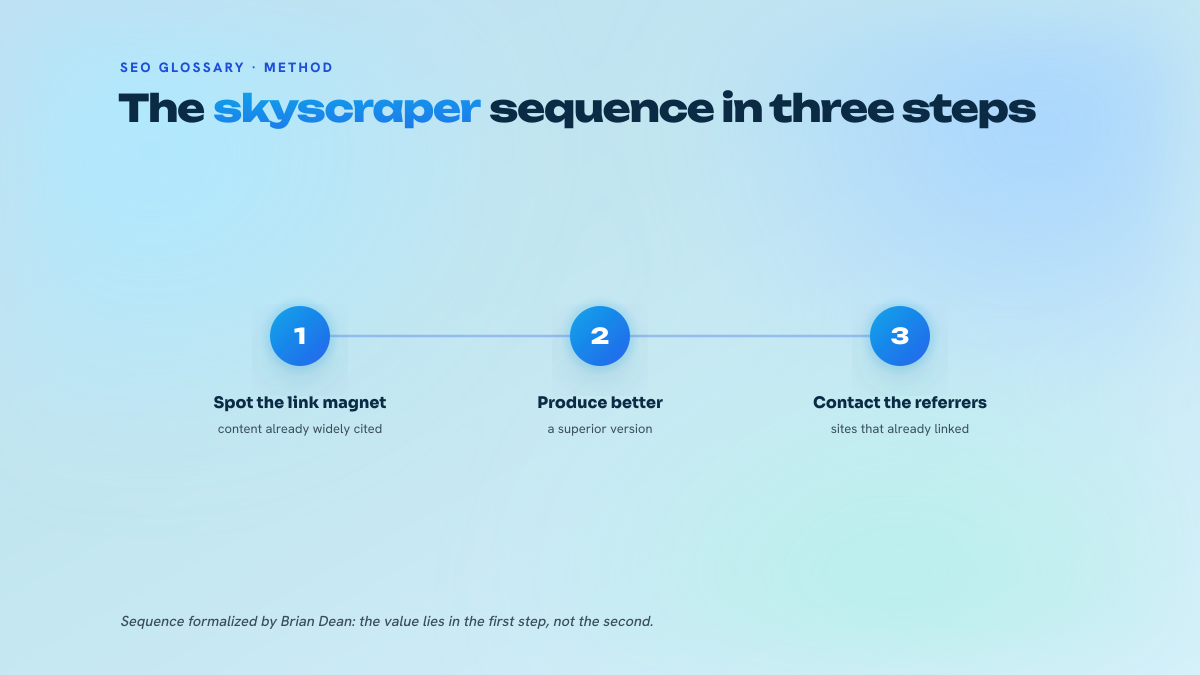
What the skyscraper actually is, and what it never was
Brian Dean coined the term at Backlinko in 2015, and the original recipe had three moves: find a page that already attracts backlinks, publish something demonstrably better, then pitch every site linking to the original. The durable insight was never about word count. It was that link demand is observable: instead of guessing what might earn links, you read the backlink graph of your niche and replicate proven demand. That part still holds, and it is the reason the tactic refuses to die in agency slide decks.
The scarcity it exploits is real and well documented. Backlinko's statistics page, updated on 29 December 2025, reports that 94% of blog posts receive zero external links, that 93% of B2B content earns none, and that only 3% of B2B content attracts links from more than one website. Link-worthy content is genuinely rare, which is exactly the asymmetry the skyscraper was designed to arbitrage.
What has died is the execution template stapled onto that insight: take the ranking listicle, double its length, add stock imagery and a table of contents, then email everyone in the referring-domains export. That version stopped producing sometime between the Penguin era and the current update cadence, yet it is still what most people mean when they say skyscraper. The distinction matters, because the diagnosis (most content earns nothing) is correct while the prescription (make it longer) no longer is.
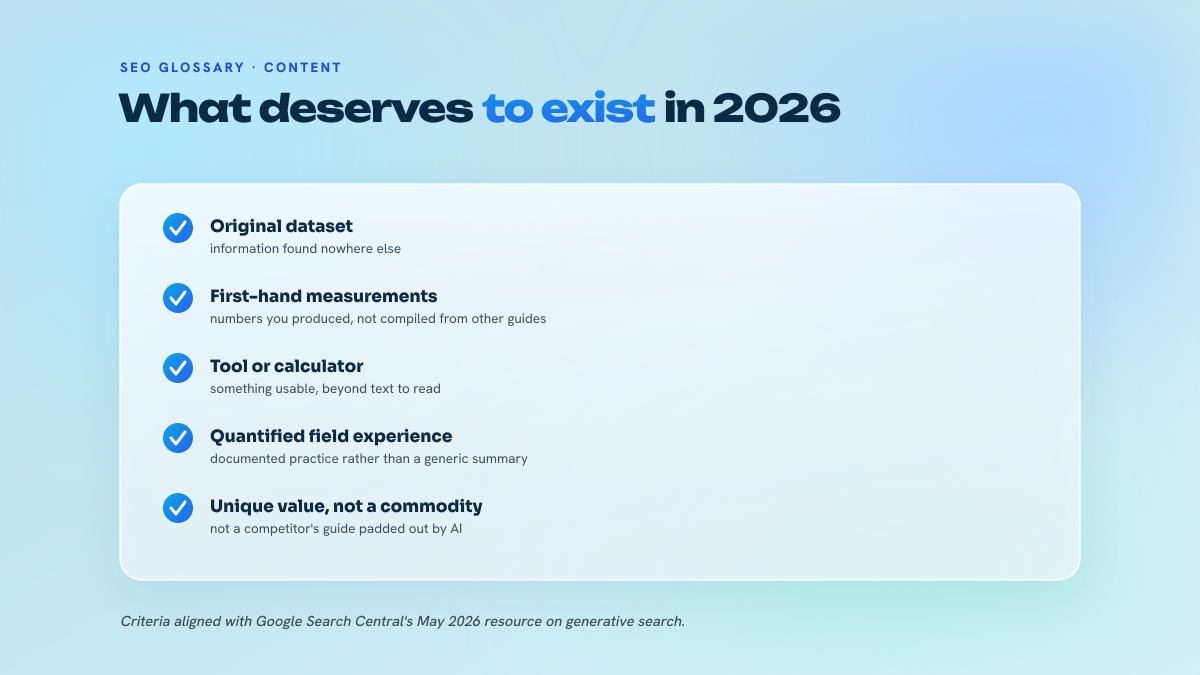
Why 2026 broke the original formula
Three separate developments, all within the last twelve months, converged on the same conclusion. First, Google's enforcement tempo. The Google Search Status Dashboard records three spam updates and three core updates between August 2025 and June 2026, including a March 2026 spam update that completed its rollout in 19 hours 30 minutes and a June 2026 spam update done in two days. Spam classification that used to take weeks now lands in hours, which shortens the life expectancy of any campaign built on manufactured link patterns around a mediocre asset.
Second, Google said the quiet part out loud. On 15 May 2026, Google Search Central published its first dedicated resource on appearing in generative AI features, and the standard it sets is « valuable, unique, non-commodity » content. A longer clone of an existing article is commodity by definition. The document also confirms that ordinary SEO fundamentals still underpin generative visibility, which means the skyscraper's content half now has an explicit bar to clear: originality, not comprehensiveness.
Third, the payoff shrank even when you win. Ahrefs' December 2025 re-study of 300,000 keywords compared Search Console CTR data from December 2023 and December 2025. On keywords triggering an AI Overview, position-one CTR fell from 7.3% to 1.6%, a reduction Ahrefs estimates at roughly 58%. The damage extends down the page: minus 50.8% at position two, minus 46.4% at position three. A perfectly executed skyscraper that reclaims the top spot now collects a fraction of the clicks the same ranking delivered two years ago.
The outreach half decayed in parallel. A 2026 benchmark summary citing Instantly puts the average cold-email reply rate at 3.43%, down from about 5% in 2025 and 8.5% in 2019. The older Backlinko figure of 8.5%, drawn from 12 million outreach emails, still circulates in every skyscraper tutorial; treating it as a current baseline will make you overestimate your pipeline by more than half.
The 2026 version: an asset with a distribution plan
The tactic that replaced the classic skyscraper is visible in survey data. Editorial.link polled 518 SEO professionals and found 48.6% rating digital PR the most effective link-building tactic, against 16% for guest posting and 12% for classic linkable assets. Read carefully, that is not the death of the asset: it is the death of the asset without a story. The modern skyscraper piece is a digital-PR vehicle, built around an original dataset, a proprietary benchmark, a calculator, or expert commentary that a journalist can quote, then pitched on its newsworthiness rather than on « we made a better version of the article you linked to ».
Form still matters at the margin. The same Backlinko statistics page cites Semrush data showing posts with seven or more images generated 55% more backlinks than posts without images. But the load-bearing element is the fact nobody else has. In our own audits, the assets that keep earning links years later are almost always the ones where the data cannot be reproduced by a competitor with a writer and an afternoon.
Measurement changed too. Since 3 June 2026, Google has been rolling out Search Generative AI performance reports in Search Console, with separate visibility views for AI Overviews, AI Mode and generative Discover. For the first time you can check whether your asset is being surfaced inside AI answers rather than only whether it ranks. For a skyscraper campaign, that report, plus branded-search growth and referral traffic, is the honest scoreboard.
Where does this sit in a netlinking operation? Earned links from a strong asset are the ideal complement to placed ones: they diversify anchors, referring-domain types and velocity in a way no catalogue can. The pragmatic split we apply at Nautilinks is to let assets earn what they can and to secure the baseline with placements on media we operate in-house, where we control the editorial context of every link. If you want to see how that looks from the buyer side, you can browse the host media directly on a transparent platform instead of inferring quality from a spreadsheet of third-party metrics.
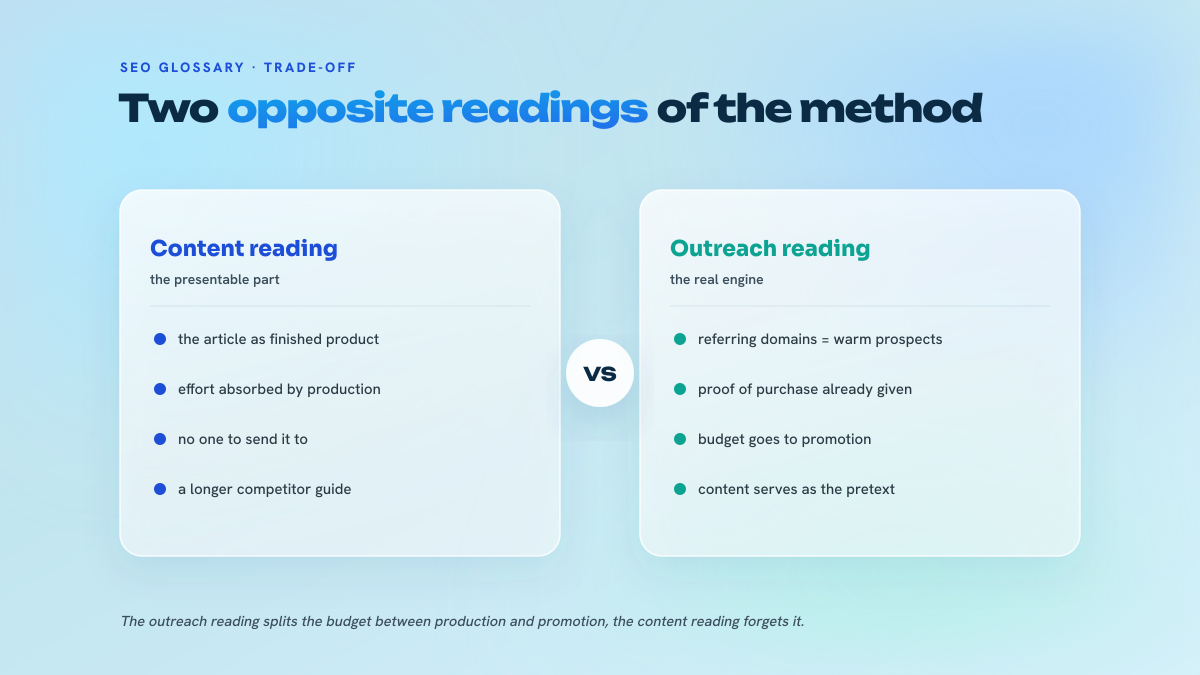
Where skyscraper campaigns fail
The most common failure is the commodity-length trap: producing a piece that is longer, prettier and 10% better, which is precisely the content Google's May 2026 guidance defines out of generative visibility. If your differentiator can be summarized as « more sections », you have built a bigger commodity, and commodities earn links at the 94%-get-zero base rate.
The second failure is spray outreach. At a 3.43% average reply rate, a 500-address blast yields around seventeen replies, most of them negative. The referring-domains export of the competing page is a prospect universe, not a send list: the sites worth pitching are the ones that link editorially, recently, and to content of your asset's type. Everything else is spam-update fuel.
The third is pointing the campaign at a commercial URL. Nobody links voluntarily to a money page, and dressing one up as a resource fools neither editors nor classifiers. Build the asset on an informational URL, let it accumulate authority, and move the equity internally. The commercial pages get covered by other means, whether that is a placement program you run yourself or a decision to hand the campaign to a team that owns the media it publishes on.
The last failure is refusing to do the cost math. Editorial.link's research puts the average acceptable price of one high-quality backlink at $508.95, with agencies allocating 32.1% of SEO budgets to link building. An asset that costs five thousand euros to produce and earns six links has, in pure acquisition terms, roughly matched what buying would have cost, before counting the outreach hours. The asset wins only if it keeps compounding after the campaign ends. Since placement prices are listed publicly, the comparison baseline takes five minutes to establish, and skipping it is how skyscraper projects end up as the most expensive links in the profile.
Tactical takeaways for a working SEO
Prospect from the backlink graph, not the SERP: the page worth outbuilding is the one with the healthiest referring-domain profile, which is not always the one ranking first. Build one asset per quarter with a fact nobody else has, rather than four longer rewrites. Pitch it like PR, with an angle and a deadline, to a short list of writers who have already linked to that content type, and expect single-digit reply rates even when you do it well.
Score the campaign on what 2026 actually pays: citations in the new Search Console AI reports, branded queries, referral traffic that converts, and the residual links that arrive months later without outreach. And treat the technique as one lane in a wider system: it pairs naturally with broken link building on the same prospect list, and it does not replace the steady, calibrated placements that carry a link profile between asset launches. The skyscraper was never a strategy. It is a good tactic that got sold as one.
Nautilinks operates an owned network of editorial media. In-house written articles, transparency disclosures respected, anchor mix calibrated.
Frequently asked questions
Is the skyscraper technique dead in 2026?
The template is, the premise is not. Backlinko's December 2025 data still shows 94% of blog posts earning zero external links, so outbuilding weak-but-linked content remains a rational arbitrage. What died is the execution: longer clones fail Google's May 2026 « unique, non-commodity » standard for generative visibility, and mass outreach returns 3.43% replies. The surviving version is an original-data asset distributed like digital PR.
How is a skyscraper campaign different from broken link building?
Same prospect universe, different trigger. Broken link building offers a replacement for a dead resource, so the pitch solves the editor's problem and converts better per email. The skyscraper asks an editor to swap a working link for a better one, which is a weaker ask. In practice run them together: one prospect list, and lead with the broken-link angle wherever the crawl surfaces dead targets.
What reply rate should I plan for on skyscraper outreach?
Benchmark data citing Instantly puts average cold-email replies at 3.43% in 2026, and replies are not links, so plan on low single digits for placements from a cold list. The 8.5% figure from Backlinko's 12-million-email study describes 2019, not now. The practical consequence: a 60-address list of genuinely matched prospects beats a 600-address export, at a tenth of the spam exposure.
Should the skyscraper asset live on a commercial page?
No. Editors link to resources, not to sales pages, and forcing the two together usually produces a page that neither converts nor earns. Publish the asset on an informational URL, let it attract links, then route authority to commercial pages through internal linking. Cover the commercial pages' link needs separately, with placements whose anchor and context you actually control.
How do I measure success now that AI Overviews absorb most clicks?
Stop reporting rankings as the outcome. Ahrefs' December 2025 study measured position-one CTR at 1.6% on AI Overview keywords, so a won ranking can coexist with negligible traffic. Use the Search Generative AI performance reports Google started rolling out in Search Console on 3 June 2026 to track AI visibility, and complement them with referring domains earned, branded-query growth and referral conversions.
Test your knowledge
Quiz: Skyscraper technique
1/3According to Ahrefs' December 2025 study of 300,000 keywords, what happened to position-one CTR on keywords triggering an AI Overview between December 2023 and December 2025?