- →A naked URL anchor is not signal-free: the search engine tokenises the string, so a keyword slug or an exact-match domain turns a raw URL into a partial-match anchor that most anchor reports will still bucket as neutral.
- →Google's link documentation, updated 10 December 2025, asks for descriptive, concise, relevant anchor text; a raw URL is the weakest compliance with that, which pushes the relevance load onto the sentence around the link.
- →No Google source publishes a safe naked-URL share. The 5 to 15 % figures circulating in agency decks are heuristics, not thresholds, and should never drive a campaign plan.
- →Swapping a paid placement's anchor to a raw URL launders nothing: the spam policy updated 15 May 2026 defines link spam by intent and money flow, and expects rel=sponsored or rel=nofollow regardless of anchor shape.
- →The commercially expensive failure is not a naked anchor, it is a bare address a CMS never linkified: not clickable, passes nothing, invisible to backlink tools, and often counted as a delivered link.
- →Audit naked anchors per landing page against the pages actually competing for the query, not as a sitewide percentage, and treat a sudden mass shift toward raw URLs as a pattern in itself.
What a naked URL anchor really is
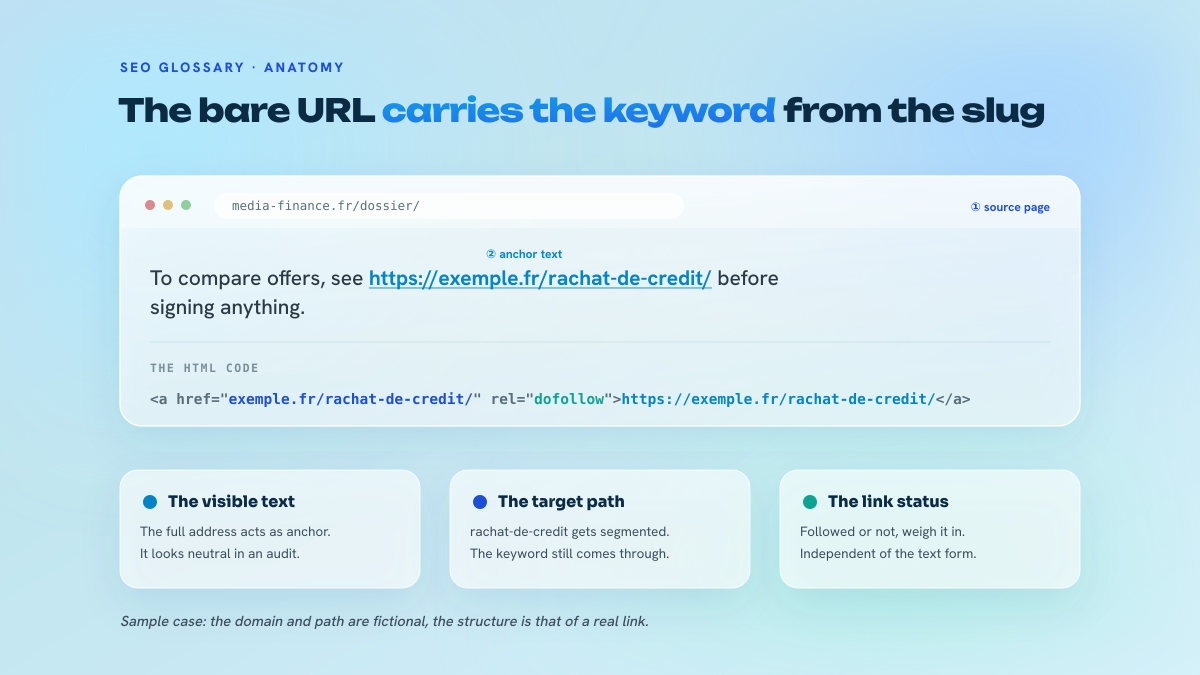
The mechanics take one line and the consequences do not. A naked URL anchor is an anchor element whose visible text repeats its own destination: <a href="https://example.com/guide/">https://example.com/guide/</a>. The href and the link text are the same string. Everything else about that hyperlink behaves as usual: the follow attribute, the position in the document, the paragraph wrapped around it, the crawler path Googlebot takes through it.
Two ambiguities are worth killing straight away. A naked URL anchor has nothing to do with a fragment anchor, the #section jump link that scrolls a reader down a long page. Same word, unrelated mechanism, and a lot of the content ranking on this query conflates the two. It is also not the same thing as a bare address sitting in the page as plain text, wrapped by no anchor tag at all. That second case is the one that costs money: a URL a CMS failed to make clickable passes nothing, appears in no backlink tool, and still gets counted as a delivered link on plenty of press release and forum campaigns we have reviewed.
What matters is what the search engine does with the string. Google tokenises anchor text, and a URL is a string like any other. https://nautilinks.co/ carries a brand token. https://example.com/best-crm-for-startups/ carries four keyword tokens sitting in the slug. So the working model is not « naked equals neutral ». A naked anchor inherits whatever your URL structure already encodes. On a brand domain with an ID-based path it behaves close to a branded anchor. On an exact-match domain with a keyword-loaded slug it is far closer to a partial-match anchor than your anchor report will admit, because the report buckets by shape and not by content. Anyone auditing a profile at scale should reclassify naked anchors by what their URLs actually contain before drawing any conclusion.
Where naked URLs sit in the anchor taxonomy
Every anchor taxonomy in circulation is a variation on the same six buckets: exact match, partial match, branded, generic (the click here family), image links carrying alt text, and the raw URL. The value of the taxonomy is diagnostic, not prescriptive: it tells you how a profile was built, whether the text used to describe a link was chosen by an editor or by a spreadsheet, and where the intent is visible.
A short visual recap of the anchor types, useful if you need to align a client team on the vocabulary before an audit:
Notice what the industry does with the naked bucket. A May 2026 survey of 518 SEO professionals published by editorial.link reported 41.7 % preferring partial-match anchors, 25.1 % exact match and 20.5 % branded, with 48.6 % rating digital PR their most effective link-building tactic. The naked URL share is simply absent from the published result. That absence is the story: raw URLs are treated as something that happens to a link profile, never as something planned into it. That is a mistake in both directions. Teams that never plan them end up with profiles that look assembled, because organic citation in the wild produces raw URLs constantly. Teams that dump them everywhere as a safety blanket waste the only descriptive slot a link gives them.
The honest position: a naked URL is the anchor you choose when the sentence around the link already does the semantic work, or when the citation format demands it. It is not a lever you pull to make a keyword rank, and it is not an insurance policy.
What Google actually says in 2026
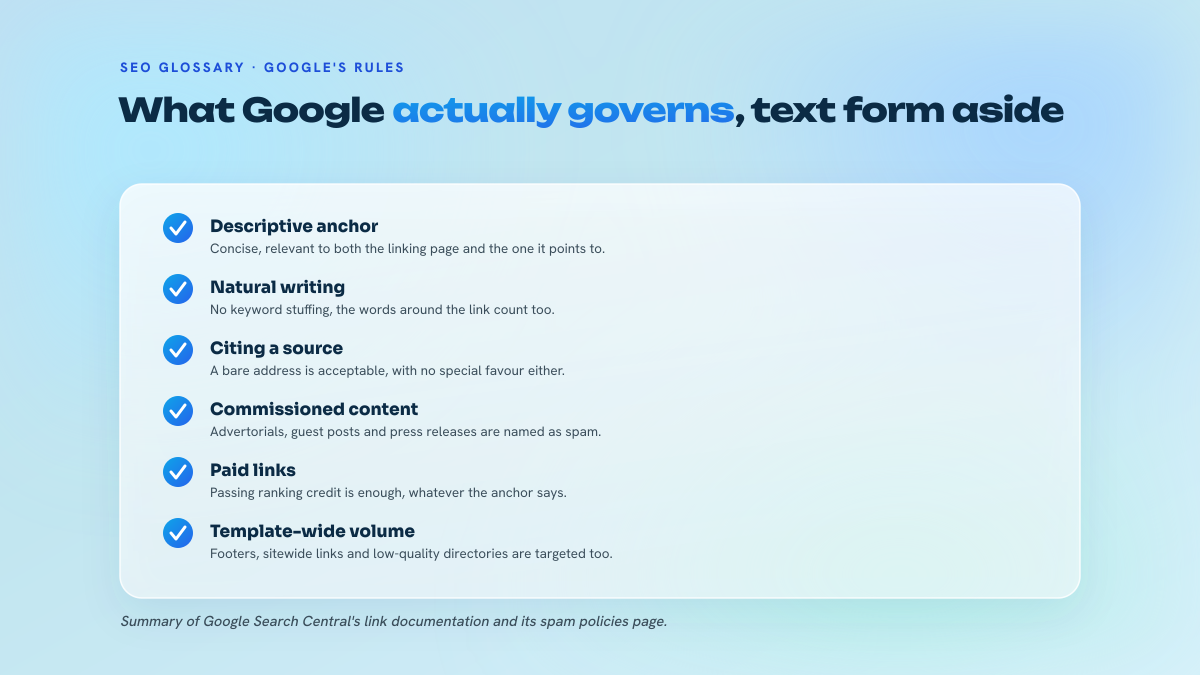
Google's link best practices documentation, updated 10 December 2025, asks for anchor text that is descriptive, reasonably concise and relevant to both the source and the destination page, written naturally, with the words surrounding the link taken into account. Read literally, a raw URL is the weakest possible compliance with that guidance. It describes nothing beyond the tokens the domain and path happen to contain, so the entire relevance burden shifts onto the surrounding sentence and the topic of the host page. That is not a penalty. It is a redistribution of where the signal comes from, and it explains why a naked URL dropped inside a genuinely on-topic paragraph outperforms a keyword anchor parked in a resource list nobody reads.
The spam policy page, updated 15 May 2026, is the other half of the picture. It defines link spam by intent, links created primarily to manipulate rankings, and enumerates the patterns: paid links that pass ranking credit, advertorials and guest posts and press releases with optimised anchors, low-quality directories, forum links with optimised anchors, automated links, excessive exchanges, distributed footer and template links. Paid links stay permissible when marked rel="sponsored" or rel="nofollow". The 2026 revision also extends the policy to attempts at manipulating generative AI responses in Google Search.
The operational conclusion is blunt: swapping a paid placement's anchor to a raw URL launders nothing. The money flow and the intent define the classification, not the shape of the visible text. A network of sites selling the same naked URL from the same template is a distributed pattern, exactly what the policy describes. That is one reason we argue for ordering a placement straight from the publisher, with attribution handled in the open rather than through layers where nobody can tell you what the anchor will be. For the record, the June 2026 spam update ran from 24 June at 09:03 PDT to 26 June at 10:58 PDT, globally and across all languages, and Google published no naked-URL carve-out with it.
Ratios, profiles and the myth of the safe percentage
There is no verified Google statement, and no recent independent study, establishing a preferred share of naked URL anchors. The 5 to 15 % figures that circulate in agency decks are heuristics someone reverse-engineered from a handful of profiles and then repeated until they sounded like documentation. A 2026 agency analysis claiming that first-position pages average roughly 13 % exact-match anchors is a secondary report of Ahrefs data, not a study Ahrefs published, and it should not be used as a benchmark for anything.
Here is the reference point that does hold up. Backlinko's analysis of 11.8 million Google search results, updated 14 April 2025, found that position-one pages had 3.8 times more backlinks on average than positions two to ten, and that linking-domain diversity correlated with rankings. It established nothing whatsoever about anchor shares. The strongest published evidence in this field is still about links and referring domains, not about the ratio of anchor types. Anyone selling you a target percentage is selling a feeling.
This overview of anchor ratio thinking is a fair summary of how practitioners reason about the distribution, with the caveat that none of these numbers come from Google:
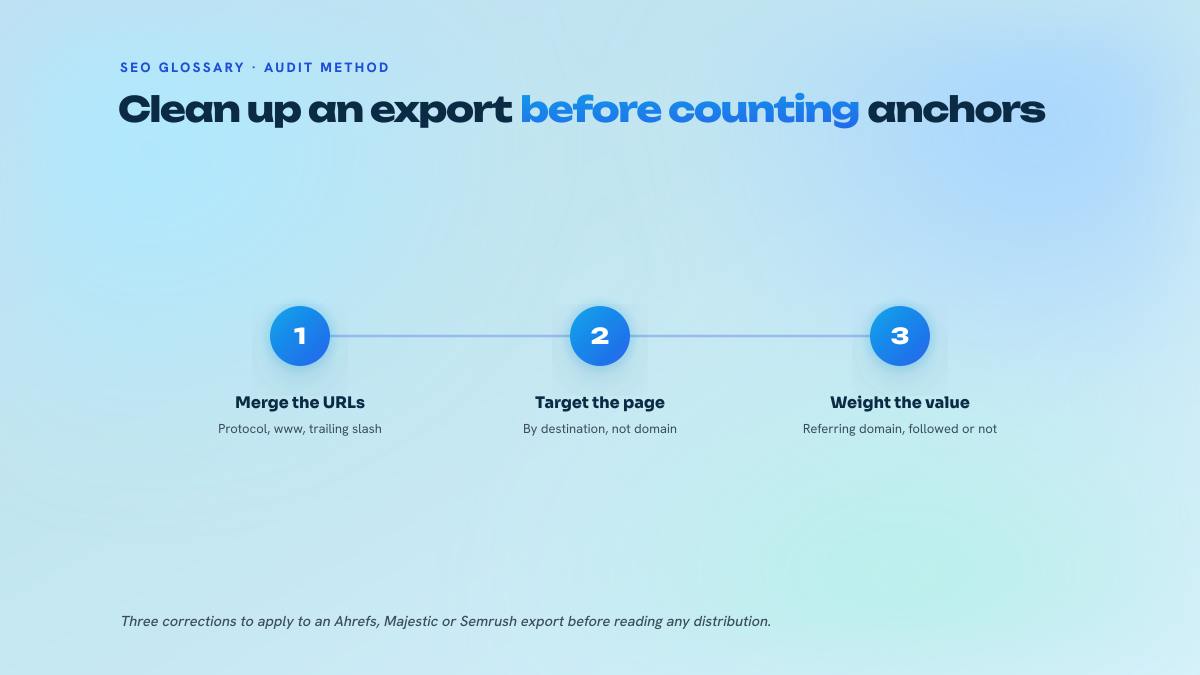
What we actually do in audit: measure per landing page, never sitewide. A sitewide anchor pie is meaningless because the risk concentrates on the two or three pages that carry commercial intent. Pull the anchor distribution of the pages currently ranking for the target query, compare shape rather than percentages, and look at concentration: forty naked URLs from one forum thread is a single source event, not diversity. That is the thinking behind proper spread across anchor types over time, and it is why we prefer to calibrate a link profile over several quarters instead of front-loading a batch and then correcting with raw URLs.
Where naked anchors earn their keep in a netlinking operation
Naked URLs are the correct choice in a narrow set of editorial contexts, and they are excellent there. Source citations at the foot of a methodology note. A statistics roundup crediting the original study. A comparison article pointing at a manufacturer specification sheet. A quote sourced through a journalist request. In all of these, the raw URL is what a serious writer would type, and the sentence around it carries the topical weight the anchor does not. That co-occurrence effect is the whole reason a raw URL inside a relevant paragraph beats a descriptive anchor stranded in a footer.
Across the French editorial media we run in-house at Nautilinks, the anchor is chosen per article by whoever writes it, and a naked URL goes in when the piece genuinely cites a source rather than recommends a service. Publishers who let the buyer dictate the same anchor across every placement produce the template pattern the spam policy describes, whatever the shape of the text. If you want to see the raw material before committing, the media catalogue is browsable without an account, metrics included.
One 2026 shift is worth factoring in. Conductor's benchmark, reported by Search Engine Land on 13 November 2025 across 13,770 domains, found AI referrals accounted for 1.08 % of total website traffic, with ChatGPT supplying 87.4 % of them, and AI Overviews present in 25.11 % of 21.9 million Google searches sampled between 15 September and 12 October 2025. Semrush's 23 December 2025 year review put the AI Overviews peak at 24.6 % of results. None of that says a naked URL is more likely to be cited by a model. What it changes is the audit surface: anchor work now sits next to brand-mention and citation monitoring, and a raw URL contributes a domain token to that entity picture where a generic click here contributes nothing at all.
Building one in HTML, in a CMS, and the mistakes we see
In raw HTML there is nothing to learn: write the address twice, once in the href and once between the tags, and keep both strings byte-identical including the protocol and the trailing slash. In WordPress, pasting a URL into the block editor autolinks it and produces exactly that markup, which is why so much naked anchoring exists by accident. In a Gutenberg block, select the pasted text and confirm the link rather than assuming the paste created one, because a plain-text paste into a code or preformatted block leaves you with an address nobody can click.
The practical walkthrough for the WordPress side, including the fragment-link case people confuse with this one:
The recurring failures, in rough order of how often we find them. First, mismatch between displayed text and destination: showing a clean domain while the href points at a tracked, parameterised deep URL. It reads as deceptive to a human and gives you an anchor whose text describes a page you are not linking to. Second, protocol and slash drift, a naked anchor written as http on a site that redirects to https with a trailing slash, which sends every click and every crawl through an avoidable hop. Third, UTM parameters baked into a link meant to pass equity, which fragments the URL in reporting for no benefit. Fourth, very long raw URLs breaking mobile layout because no overflow rule was set on the content column, a Core Web Vitals problem disguised as an anchor decision.
The fifth one is strategic and the most expensive. After a ranking scare, teams mass-convert descriptive anchors into raw URLs, or order a wave of naked placements to dilute an exact-match ratio. A profile that suddenly turns naked over three weeks is a pattern, and the velocity of that shift is as legible as the ratio it was meant to fix. Correct a profile by earning different links, not by repainting the ones you already have.
Nautilinks operates an owned network of editorial media. In-house written articles, transparency disclosures respected, anchor mix calibrated.
Frequently asked questions
What does a naked URL anchor look like in the source, and how is it different from a jump link?
In the source it is an anchor tag whose text repeats its href: the address appears twice, once as the destination and once as the visible clickable string. A jump link is a different mechanism entirely, an href pointing at a fragment identifier such as #pricing that scrolls the reader to an element with that id on the same page. Same word in common usage, no shared behaviour, and no external link equity involved in the second case.
Does a naked URL pass the same link equity as a descriptive anchor?
The equity transfer depends on the follow attribute, the source page and the link's position, not on the anchor's shape. What changes is the descriptive signal: a raw URL supplies only whatever tokens the domain and slug contain, so relevance has to come from the surrounding sentence and the host page topic. On a brand domain with an opaque path that is close to zero keyword signal. On an exact-match domain with a keyword slug it is closer to a partial-match anchor.
Is there a safe percentage of naked anchors to target?
No source at Google publishes one, and no recent independent study establishes one. The 5 to 15 % ranges circulating in decks are agency heuristics. Benchmark instead against the pages actually ranking for your target query, page by page rather than sitewide, and pay more attention to source concentration than to the percentage: thirty raw URLs from a single forum thread and thirty from thirty publishers are the same number and completely different profiles.
Does using a raw URL make a paid placement safer?
It does not. Google's spam policy, updated 15 May 2026, classifies link spam by intent and by whether the link passes ranking credit in exchange for payment, and explicitly covers advertorials, guest posts and press releases. The anchor shape is not part of that test. What keeps a paid link compliant is the rel=sponsored or rel=nofollow attribution, applied whether the visible text is a keyword phrase or a bare address.
How do I find every naked anchor pointing at a page?
Export the backlink profile from Ahrefs, Semrush or Majestic filtered on the target URL, then reclassify by regex on the anchor string rather than trusting the tool's own bucket: match anchors starting with http or containing your domain. Run the same regex against the URL content to separate brand-token URLs from keyword-slug URLs, since the two behave differently. Crawl the linking pages with Screaming Frog to catch the addresses that were never linkified at all.
Do naked URLs help get cited by AI assistants?
There is no published evidence that they do. What the 2026 data supports is narrower: Conductor's benchmark reported by Search Engine Land on 13 November 2025 put AI referrals at 1.08 % of total traffic, ChatGPT supplying 87.4 % of them, which makes brand and citation monitoring worth adding next to anchor auditing. A raw URL contributes a domain token to that entity picture, which is more than a generic anchor contributes, and less than a brand mention in a sentence.
Test your knowledge
Quiz: Naked URL anchor
1/3Why can a naked URL anchor still act as a partial-match anchor?