- →A dropped domain is released by the registry in a scheduled daily window; you are not buying the name, you are buying a registrar connection that fires in that window, which is why dropcatchers run dozens of accredited connections.
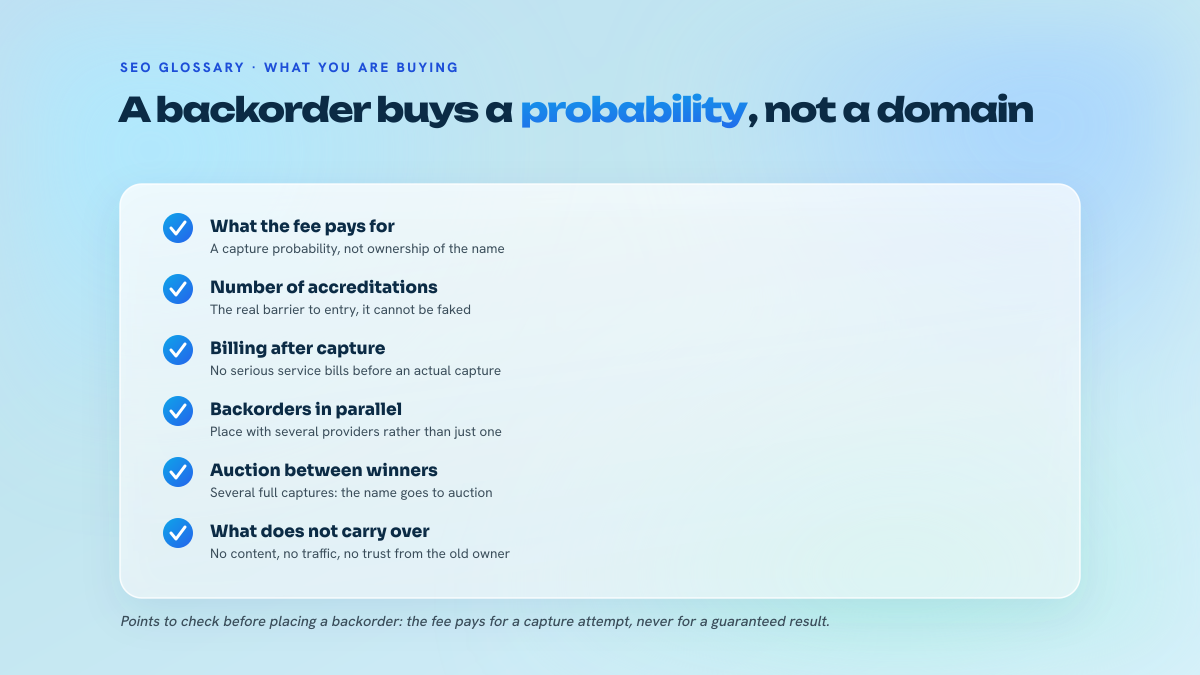
- →DropCatch charges 59 dollars for a full-price .com or .net backorder, billed only on a successful catch, with a Discount Club tier from 15 to 58 dollars at lowest priority (DropCatch terms). Two winning full-price backorders send the name to public auction, which is where the real cost appears.
- →GoDaddy retired its backorder service on 7 October 2025 and pushed expiring inventory into GoDaddy Auctions (BoldDomains, 2025), so genuine deletion-time catching now concentrates on specialist services.
- →Google’s expired-domain-abuse policy, introduced 5 March 2024, targets acquisitions made primarily to manipulate rankings with little or no value content. Relevance and genuine site purpose, not inherited Domain Rating, decide whether a caught domain holds.
- →A September 2025 analysis of 915 expired domains at DR 20+ found 42.2 % turned into money sites or 301 redirects and only 1 % into legitimate rebuilt websites. The dominant use pattern is exactly the one the policy describes.
- →Rankings retained no longer equal traffic retained: Semrush measured AI Overviews on 15.69 % of queries in November 2025, and Ahrefs associated an Overview with a 34.5 % lower CTR for the top organic result. Price a catch on clicks, not on DR.
What drop catching actually buys you
When a registrant stops paying, the name does not become free, it becomes scheduled. The registry walks it through a fixed sequence and, at the end, releases it back into the general pool in a batch window that happens at roughly the same time every day. Drop catching is holding an open registrar connection ready to fire the create command in the fraction of a second after that release. You are not bidding on a domain in any normal sense, you are buying a place in a queue of automated requests.
That is why the field is dominated by a handful of dropcatcher operators rather than by ordinary registrars. Winning a contested .com deletion means submitting hundreds of near-simultaneous requests, which in practice means holding many ICANN accreditations, each with its own connection quota to the registry. A single retail account has no realistic chance on a name anyone else wants. What the service sells you is not search, it is throughput.
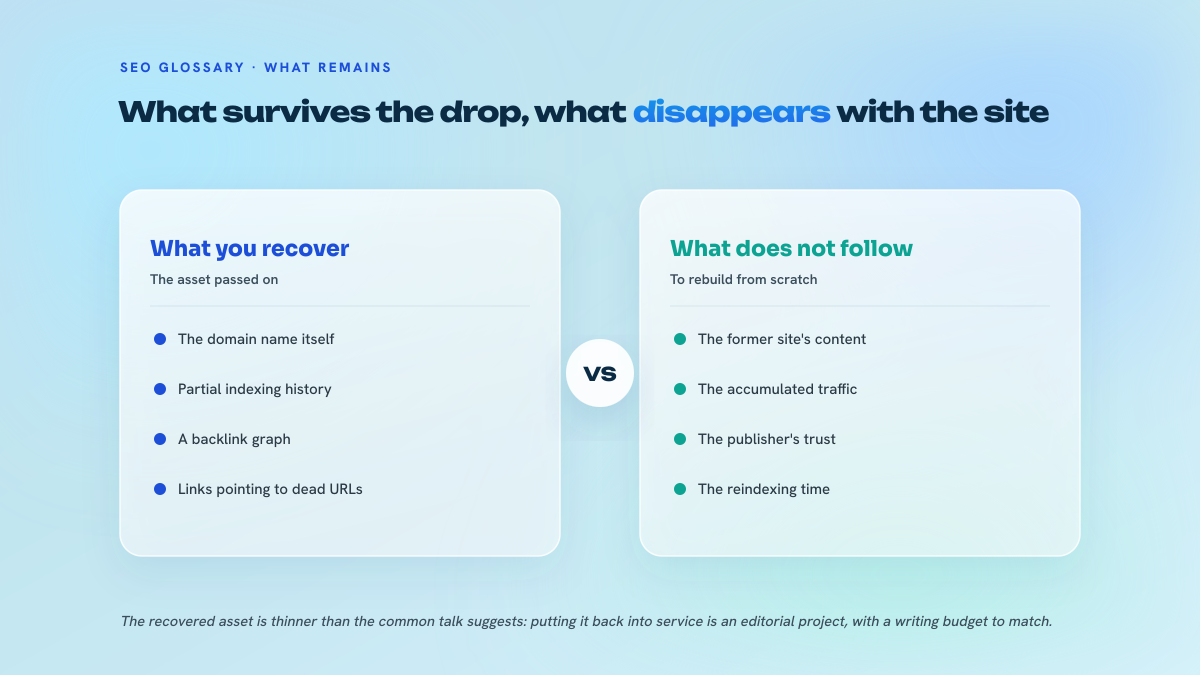
What you are buying on the SEO side is narrower than the marketing around it suggests. You inherit the registration age, whatever archived pages the Wayback Machine holds, and the backlinks that still point at the old URLs. You do not inherit the site’s history with Google in any transferable sense. The link graph is real and measurable, everything else about the domain’s past standing is a hypothesis you are paying to test. Anyone treating a caught name as a ranking shortcut has skipped the part where Google decides whether the new site deserves the old signals, and since March 2024 that decision has an explicit policy behind it.
The honest framing: a caught domain is a raw material with a link graph attached, comparable in function to any other expired domain acquisition but with a harder acquisition mechanic and a shorter decision window. It is worth doing when the name is topically adjacent to something you already publish. It is a waste of money when the plan is to point a high-DR corpse at an unrelated commercial page.
The deletion cycle, and why timing is the whole game
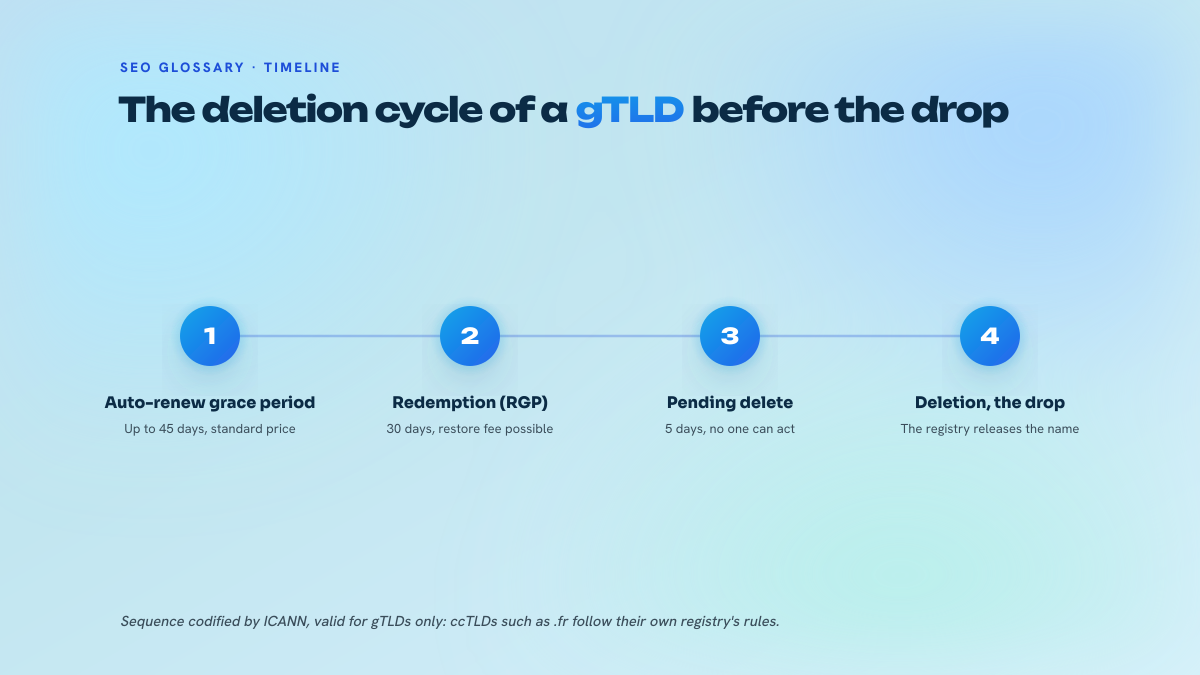
The sequence is registry-level and public, which is what makes catching predictable enough to automate. After expiry, gTLD names sit in an auto-renew grace period during which the original registrant can renew at normal price, typically up to 45 days depending on registrar policy. Then comes the redemption grace period, 30 days at the registry, where the name is dead to the public and can only be restored by the original registrant paying a redemption fee. Then pending delete, five days during which nothing can be done at all. At the end of pending delete, the registry drops the name and the race starts.
Two operational consequences follow. First, the drop date is computable from the expiry date, so drop lists are published days in advance and every serious buyer sees the same inventory at the same time. There is no informational edge in knowing that a domain is dropping. The edge is in evaluating it faster and deciding whether it is worth a backorder before the list gets crowded.
Second, most registrars never let good inventory reach the drop at all. Expiring names with commercial or SEO interest get routed into the registrar’s own expired auction stream well before deletion, which is why the domains that actually reach pending delete skew towards names nobody bid on. That is not automatically bad. Foreign-language ccTLDs, old association and local business sites, and technical domains with genuine editorial backlinks routinely pass through the deletion cycle untouched, because the auction crowd is optimising for brandability and resale, not for a clean referring-domain profile.
Backorder and drop catch are often used interchangeably and should not be. A backorder is an instruction you give a service to attempt the catch on your behalf. The catch is the registry-level event. GoDaddy Auctions selling an expiring name before deletion is an aftermarket transaction, not a catch, and the price behaves accordingly.
What a catch costs in 2026, and what moved
DropCatch’s published terms set a full-price .com or .net backorder at 59 dollars, charged only when the catch succeeds, with a Discount Club tier accepting bids from 15 to 58 dollars at the lowest catching priority. If more than one full-price backorder wins, the name goes to a public auction between the winners. That last clause is where budgets actually break: the 59 dollar figure is the floor, not the price. A May 2026 sample of DropCatch auction results reported by DomainGang included HiphopArchive.org at 6 850 dollars and Accent.org at 3 822 dollars. Those are individual outcomes rather than averages, but they show the distance between the catch fee and the clearing price on anything contested.
The structural change of the last year is that GoDaddy retired its backorder service on 7 October 2025 and steered expiring inventory into GoDaddy Auctions (BoldDomains, 2025). True deletion-time catching has concentrated further on specialist operators, while the largest registrar now competes mainly as an aftermarket channel. For a buyer this narrows where you place backorders and raises the value of watching several sources at once.
Tooling has moved the same direction. CatchDoms reported an API and MCP service aggregating 16 auction and marketplace sources with more than 20 filters and over 100 000 aged ccTLD domains available at registration price. Programmatic filtering against link metrics before a human ever looks at a name is now the normal workflow, and it changes what is worth chasing: if a filter can be written, the cheap end of the market gets picked over quickly, and the remaining value sits in judgement calls a filter cannot make, such as whether the archived content matches the niche you actually publish in.
Set that against the alternative. A contested catch plus auction can cost more than a year of placements on media that already rank and already receive traffic, with none of the reconstruction work. When the arithmetic gets that close, comparing the catch against a published per-media rate card is the fastest way to see whether the domain is a bargain or a hobby.
Where a caught domain fits in a netlinking operation
There are three defensible uses and one indefensible one. Defensible: rebuilding the site as a genuine publication in its original field, redirecting a domain whose content and audience genuinely continue in your own site, and defensive registration of a name tied to your brand or your client’s. Indefensible in 2026: catching a high-authority name and pointing a permanent redirect at an unrelated money page, which is the textbook description of what Google’s expired-domain-abuse policy has covered since 5 March 2024.
The evidence on what the market actually does is not flattering. A September 2025 analysis of 915 expired domains at Ahrefs DR 20 or above, bought on GoDaddy over 14 days in February 2025, classified 42.2 % as money sites or 301 redirects, 22.9 % as flips for resale, 3.82 % as private blog networks and 1 % as legitimate rebuilt websites. That is an industry analysis with an unvalidated classification method, so read it directionally, but the direction is clear: the dominant commercial use is precisely the pattern the policy names.
Enforcement over the same window has been steady rather than dramatic. The August 2025 spam update rolled out over roughly 27 days across all languages (Search Engine Land, September 2025), the December 2025 core update ran about 18 days (Search Engine Land, December 2025), and the March 2026 spam update completed in under 20 hours with no new policy categories introduced (Search Engine Journal, March 2026). Nothing there banned drop catching. What has hardened is the requirement that the new use be relevant and useful, which means inherited authority is now a fragile asset rather than a durable one.
This is why we run owned media rather than rebuilt catches at nautilinks: the French editorial media we operate in-house exist as ordinary publications with their own audience, which removes the entire question of whether a domain’s history survives a change of purpose. A caught domain has to earn that status from scratch, and the rebuild cost is usually underestimated by an order of magnitude. If the objective is a link on a page that already ranks, buying the placement directly from the publisher that owns the media reaches the outcome without the reconstruction project.
What we see go wrong
The most expensive mistake is buying the metric instead of the graph. A DR 40 catch whose referring domains are three scraped directories, a hacked WordPress and a decade-old blogroll is worth nothing, and the metric will not tell you that. Pull the referring domains, check how many are still live, still indexed and still linking to a URL you can actually restore, and discount everything else to zero. Much of the visible authority on a dropped name evaporates on that inspection.
The second mistake is ignoring what the domain was used for between its real life and its death. Names that spent two years parked, or worse, running an adult or gambling redirect under a previous flipper, arrive pre-poisoned. The Wayback Machine timeline answers this in five minutes and is the single highest-yield check in the whole evaluation.
The third is trademark blindness. Old company names, product names and association names carry live rights even when the registration lapsed, and a UDRP complaint does not care that you bought the name legitimately at the drop. If a name maps to an identifiable brand still trading anywhere, that is a pass, regardless of the link profile.
The fourth is measuring success on rankings rather than clicks. Semrush’s study of more than 10 million keywords found AI Overviews on 6.49 % of queries in January 2025, peaking at 24.61 % in July and settling at 15.69 % in November, and Ahrefs, analysing 300 000 keywords, associated the presence of an Overview with a 34.5 % lower CTR for the top-ranking organic page. Semrush’s own analysis found a different pattern, so the magnitude is unsettled, but the direction matters for a caught domain: a rebuild can recover its old positions and still deliver a fraction of the old traffic.
Working rules for a caught domain
Decide the use before you place the backorder, not after the catch. A domain you intend to rebuild has different acceptance criteria from one you intend to redirect: the rebuild needs archived content you can honestly continue, the redirect needs topical equivalence tight enough that the migration would make sense to a human reader.
Cap your auction ceiling in advance and hold it. The catch fee is a rounding error compared with a contested auction, and the discipline that protects a portfolio is walking away at the number you set while sober.
Restore the URL structure that the surviving backlinks point to, not a fresh architecture. Links that resolve into a redirect chain or a soft 404 pass nothing, and this is the most common self-inflicted loss on rebuilt catches.
Give the rebuilt site a real publication rhythm and a real reason to exist before you ask it for anything commercial. If the plan does not survive the question « would this site make sense to someone who has never heard of my money page », the catch was a bad purchase. When the volume you need cannot be sourced this way, calibrating acquisition over several months on media that already exist is the lower-variance route.
Nautilinks operates an owned network of editorial media. In-house written articles, transparency disclosures respected, anchor mix calibrated.
Frequently asked questions
Is drop catching legal, or is it a grey area?
Registering a name the registry has released is a normal registration, legal everywhere. The exposure is trademark law, not domain law. If the name corresponds to a mark still in use, a UDRP complaint can transfer it away from you regardless of how you acquired it, and bad-faith indicators include parking it on ads or offering it back to the rights holder. Screening every candidate against active trademarks before placing a backorder removes almost all of this risk.
Backorder or drop catch, is there a practical difference?
Yes, and confusing them costs money. A backorder is an instruction to attempt a registration at the moment of deletion. A registrar auction on an expiring name happens before deletion, in the aftermarket, and the name never drops at all. Since GoDaddy retired its backorder service in October 2025 and routed expiring inventory to its auctions, the two channels are cleanly separated: specialist services catch at deletion, large registrars sell before it.
Does a caught domain still transfer link value after the expired-domain-abuse policy?
It can, when the new site is a genuine continuation of the old subject. The policy introduced in March 2024 targets acquisitions made primarily to manipulate rankings with little or no value content, not acquisitions as such. What has changed is the risk profile: an off-topic redirect from a high-authority catch is now a documented violation pattern, while a relevant rebuild that publishes real content is ordinary SEO. Assume nothing transfers until the rebuilt site earns its own signals.
How do you evaluate a drop candidate quickly at volume?
Filter programmatically on referring domains that are live, indexed and pointing at recoverable URLs, then reject on history. The Wayback timeline shows whether the name was parked or repurposed between its real life and its deletion, which no metric captures. Aggregators exposing multiple auction and drop sources through an API make the first pass cheap, but the accept-or-reject call on borderline names stays human, because the question is whether the archived subject matches what you can credibly publish.
What should a caught domain realistically cost before it stops making sense?
Price it against what the same link exposure costs on media that already rank. A 59 dollar catch on an uncontested name with a clean profile is excellent value. The same name after a two-way auction at four figures, plus rebuild and hosting, plus six months before it produces anything, rarely beats direct placement. Also discount for AI Overviews: retained rankings no longer mean retained clicks, so model the return on traffic rather than on inherited authority scores.
Are ccTLD drops worth chasing compared with .com?
Often more so for a link-building operation. Contested .com deletions attract the resale market and clear far above the catch fee, while national extensions with old local business, association or institutional history pass through the deletion cycle with little competition and better topical fit for a European campaign. The catch is that ccTLD registries run their own release rules and timings, so the catching infrastructure differs per extension and coverage is uneven across services.
Test your knowledge
Quiz: Drop catching
1/3In the gTLD deletion cycle, what happens during the redemption grace period?