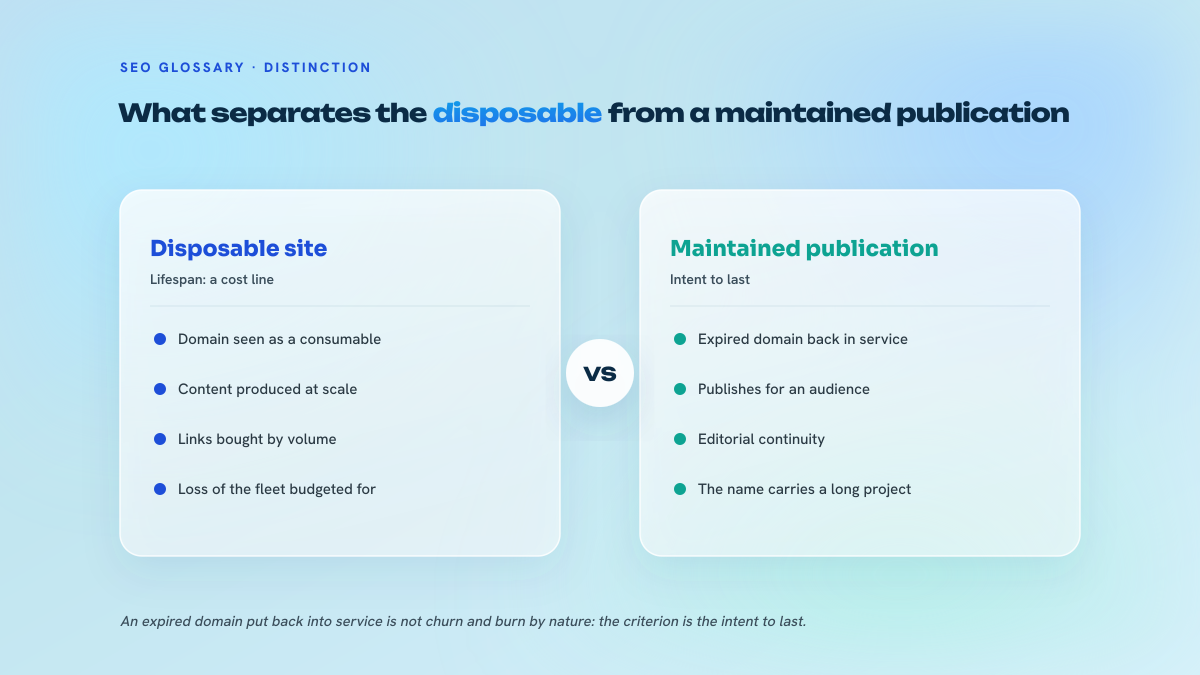
- →Churn and burn is defined by the exit, not the aggressiveness: a site nobody intends to defend, with the loss priced in before the first article ships.
- →Enforcement cadence collapsed the recovery window. The August 2025 spam update rolled out over roughly 27 days; the June 2026 one ran about 49 hours per Google's status dashboard, so a disposable site can lose its visibility inside a weekend.
- →The payoff eroded before any penalty: Ahrefs' December 2025 reanalysis of aggregated Search Console data put position-one CTR on informational keywords at 3.9%, down from 7.6% in December 2023, which is exactly the traffic churn sites monetise.
- →You rarely run churn and burn, you buy from it. Marketplace inventory is where somebody else's disposable estate ends up in your link profile, priced like an editorial placement.
- →The tell is continuity, not metrics: an unbroken traffic curve and a stable topical footprint through the expiry, not a Domain Rating that can be rebuilt in six weeks.
- →Recovery is almost never worth it. A burned domain costs more to rehabilitate than a clean one costs to acquire, which is precisely why the operators abandon it.
Churn and burn, beyond the disposable-site cliché
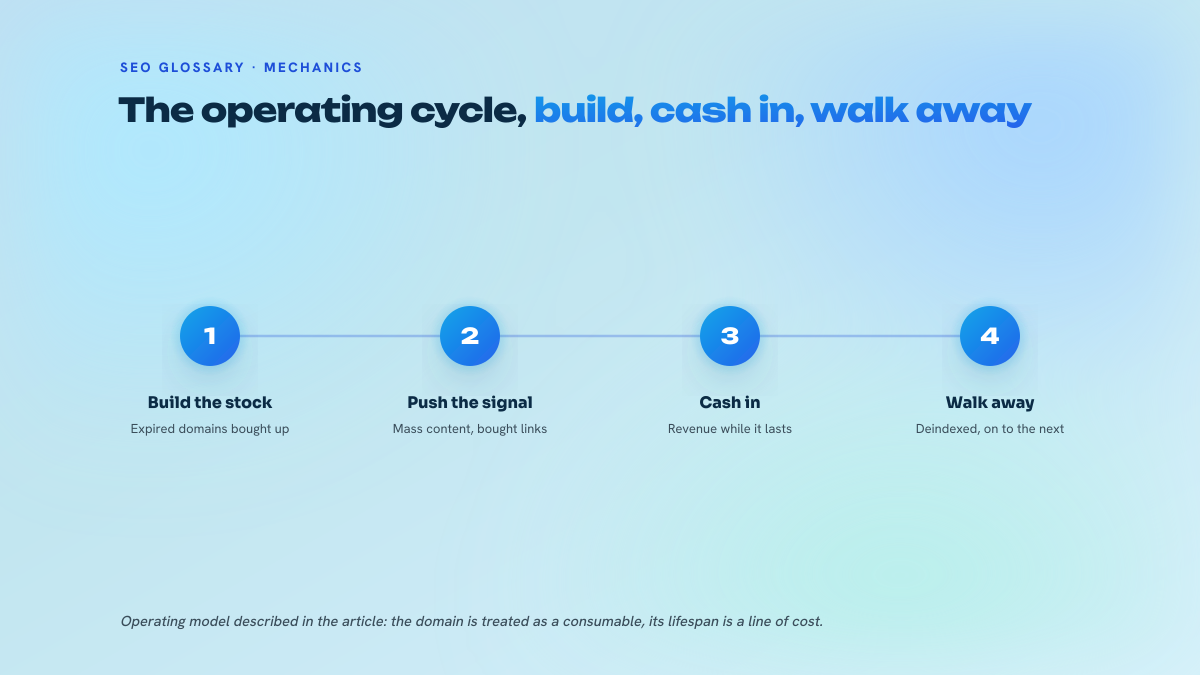
The phrase describes an operating model, not a single technique. Build cheap, rank fast, extract whatever the asset produces, abandon it when the curve breaks, restart on a fresh domain. What makes something churn and burn is not how aggressive the links are, it is the accounting: the domain is a consumable, nobody budgets for its defence, and the loss is priced in before the first article is published. A site with paid links that its owner intends to keep for five years is playing a different game from a site with the exact same link profile that its owner expects to lose by Christmas.
In practice the ingredients are stable and have been for a decade: mass-produced content at a volume no editorial team could sustain, recycled expired domains bought for their residual link graph, footprint-heavy private blog networks, bought links at whatever the going rate is, and increasingly rented subfolders on somebody else's trusted domain. What rotates is the packaging. The 2015 version was thin affiliate satellites; the 2026 version is a few hundred AI-assembled comparison pages on a domain that had a real audience three years ago.
Google's own framing is worth reading carefully, because operators misquote it constantly. The scaled-content policy is written around purpose and usefulness, not around the tool used to produce the text. Volume is not the offence. Volume without a reason for the pages to exist is. That distinction is why a publisher running owned editorial sites with real editorial calendars is not doing the same thing as an operator spinning up fresh domains every quarter, even though a crawler sees a comparable page count.
The 2026 arithmetic: shorter lives, thinner payoffs
The interesting collapse is not on the enforcement side, it is on the revenue side, and it happened first. Pew Research Center's March 2025 browsing-panel study, covering roughly 68,900 searches from 900 US adults, found that searches showing an AI summary produced a click on a traditional result only 8% of the time, against 15% without one. Clicks on a source cited inside the summary landed at 1% of those searches. Ahrefs' December 2025 reanalysis of aggregated Search Console data pointed the same direction: a 58% lower average CTR for the top-ranking page when AI Overviews are present, with position-one CTR on informational keywords falling from 7.6% in December 2023 to 3.9% in December 2025. Seer Interactive's tracker, cited by Semrush, reports organic CTR on AI-Overview queries dropping from 1.76% in June 2024 to 0.61% in September 2025.
Read those numbers as a churn-and-burn operator and the model stops working on its own. Disposable sites monetise informational long tail, because that is the cheapest thing to rank for and the only thing mass content can plausibly cover. That is precisely the segment where the click is disappearing. Semrush's study of more than ten million keywords found AI Overviews on 6.49% of keywords in January 2025, peaking near 25% in July, then sitting at 15.69% in November 2025, with the informational share of triggering queries falling from 89.03% in October 2024 to 57.16% in October 2025. The surface is spreading toward commercial queries, where the operator has no offer, no brand and no conversion path.
So the honest 2026 verdict is not that churn and burn became risky. It became risky and low-margin at the same time. Ranking, by itself, is worth measurably less than it was two years ago, and a disposable asset has nothing else: no branded demand, no email list, no returning audience, no citations that survive the domain. When your entire return depends on a click that a generative panel intercepts, a shorter site lifespan is not even the main problem.
What actually gets a site burned
Enforcement rhythm changed in a way that matters operationally. The August 2025 spam update rolled out from 26 August to 22 September 2025, roughly 27 days, and industry reporting tied it to scaled content abuse, expired-domain abuse, site-reputation abuse and manipulative link schemes. The June 2026 spam update, by Google's status dashboard, ran from 24 to 26 June 2026: about 49 hours end to end. A month-long rollout gives an operator time to notice a slide, cut losses and migrate. Two days gives nothing. The practical consequence is that the disposal step, which used to be a managed exit, is now an unplanned one.
Core updates compound this even without a spam label attached. SE Ranking's comparison across a fixed keyword set found the combined March 2026 spam and core period moved 90.7% of top-10 results, against 83.1% during the December 2025 update, with 24.1% of previously top-10 pages leaving the top 100 entirely, compared with 14.7% after December. That is third-party volatility measurement, not a Google statement of cause, and it should be read as such. But the direction is consistent: thin, low-differentiation inventory is where the churn concentrates.
One more change closed a gap operators had been probing. On 15 May 2026 Google published guidance on appearing in generative Search features and confirmed that existing spam policies, including scaled content abuse, link spam, cloaking, doorway abuse, site-reputation abuse and inauthentic mentions, apply to AI Overviews and AI Mode. The idea that citation surfaces were an unpoliced back door, easier to game than the ten blue links, no longer has a policy basis to lean on.
Where churn and burn touches your own link profile
Most readers of this entry do not operate disposable sites. They buy links, and that is exactly where the exposure sits. A churn estate has to monetise fast, and selling placements is the fastest monetisation there is. Its inventory reaches you laundered through resellers, sometimes through two layers of them, priced and presented like editorial placement on a real magazine. A 2026 survey of 518 SEO professionals put the reported benchmark for an acceptable high-quality backlink at roughly $508.95, with agencies allocating 32.1% of SEO budgets to link building; those are survey averages rather than market prices, but they set the frame. At that level you are not buying a link, you are buying a bet on the host surviving. If the host is a consumable, you paid editorial money for a placement with a scheduled expiry date.
The failure mode is quiet. The link does not turn toxic, it simply evaporates: the host loses its rankings, then its indexation, then its hosting. Your acquisition rhythm shows a clean upward curve for two quarters and then a net-negative one, and the campaign that was supposed to compound instead resets. This is the structural argument for buying from operators who own their inventory rather than brokering it: an owned network has to keep its sites alive because it has no other product, whereas a reseller is indifferent to what happens after settlement. It is also why open marketplace inventory needs harder vetting than a catalogue you can inspect site by site, which is the whole point of publishing the list of media we run in-house rather than describing it in the abstract.
The industry moved in the same direction for its own reasons. Editorial.Link's 2025 study reported 48.6% of respondents naming digital PR the most effective link-building tactic for 2025. The read is not that links stopped counting. It is that the commercially viable link is now one that also produces referral traffic, a brand mention and a citation an LLM might reuse, none of which a site scheduled for disposal can deliver.
Testing a publisher before you place a link on it
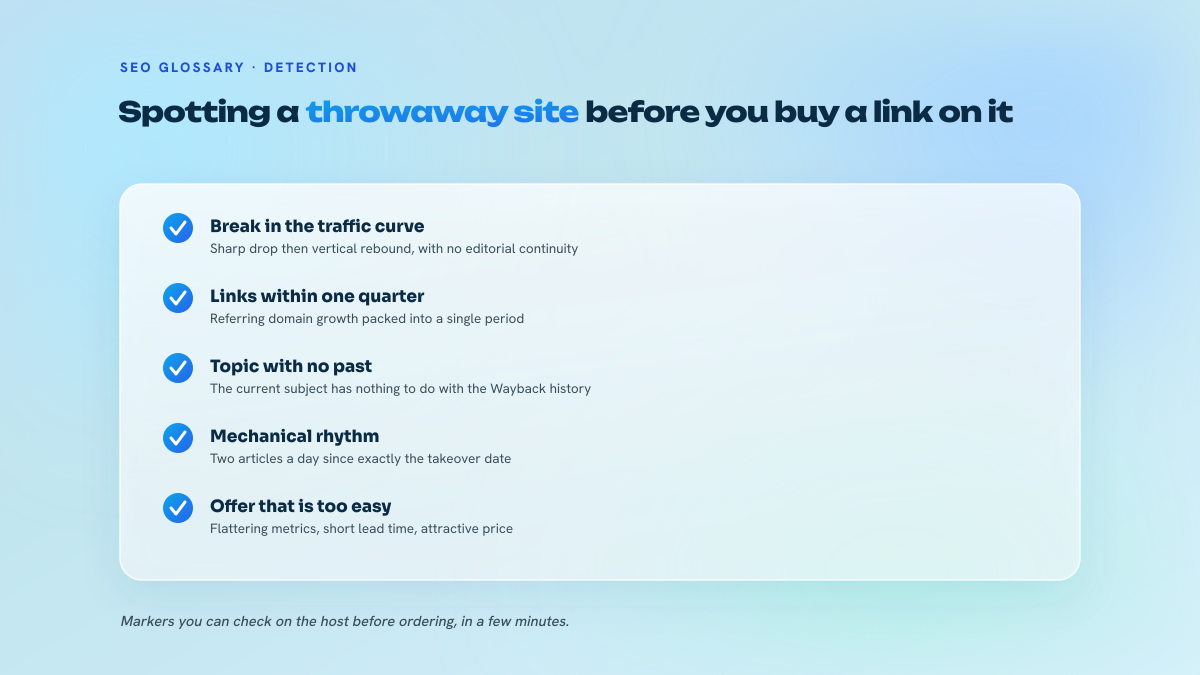
Authority metrics are the wrong instrument here, because they are the one thing a churn operator optimises directly. Domain Rating and Trust Flow can be rebuilt on a recycled domain in weeks. Continuity cannot. The checks that actually separate a durable host from a consumable one are boring and mostly historical.
Look at the traffic curve across the expiry, not just its current level: a real publisher shows an imperfect but continuous line, while a rebuilt shell shows a floor at zero followed by a step. Compare the archived topical footprint before and after the transfer; a domain that covered municipal news in 2021 and now publishes personal finance comparisons was bought for its link graph, not its audience. Check the indexation ratio against the sitemap, because scaled estates almost always ship far more URLs than Google keeps. Read the outbound commercial link density on a handful of articles: three or four monetised outbound links per piece, across every piece, is a pattern no editorial team produces. And read the articles themselves, which remains the single most reliable test and the one nobody runs. Ten minutes on five random pages tells you more than any toolbar score.
When the answer is ambiguous, price it as ambiguous. A placement on a host you cannot verify is a short-term rental and should cost what a rental costs, which is one reason we publish what each placement costs before you talk to anyone instead of quoting per request, and why the catalogue is browsable without an account. Opacity in this market is rarely accidental: when the inventory is disposable, the only way to sell it at editorial prices is to keep the buyer from looking at it.
Nautilinks operates an owned network of editorial media. In-house written articles, transparency disclosures respected, anchor mix calibrated.
Frequently asked questions
Is it churn and burn or turn and burn?
They are different expressions. Turn and burn comes from aviation and trucking and means a fast turnaround: land, refuel, leave. Churn and burn carries the idea of consuming something until it is spent, which is why it attached itself to disposable-domain SEO and to hire-fast-replace-fast workplace cultures. In an SEO conversation, turn and burn is almost always a mishearing. The phrase has also travelled outside both fields recently, including a viral social-media running challenge built on the literal sense of churning cream while covering distance.
How long does a churn-and-burn site actually last in 2026?
There is no published lifespan figure and anyone quoting one is guessing. What is documented is the enforcement rhythm: the August 2025 spam update rolled out over roughly 27 days, and Google's status dashboard records the June 2026 one over about 49 hours. Add core-update volatility, where SE Ranking measured 24.1% of previously top-10 pages leaving the top 100 during the March 2026 period, and the planning assumption should be that a disposable asset can be gone between two reporting cycles.
Can a burned domain be rehabilitated, or should I write it off?
Write it off in almost every case. Rehabilitation means removing or disavowing the manipulative link layer, deleting or rewriting the scaled content, absorbing months with no ranking signal, and then hoping the reassessment lands your way. That is more expensive than acquiring a clean domain and rebuilding. The exception is a domain carrying genuine brand equity or real editorial history that predates the abuse. If the only asset is the link graph, the link graph is what got devalued.
Does buying links from an owned network count as churn and burn?
The distinguishing factor is the exit, not the payment. Churn and burn treats the host as expendable, so quality stops mattering the moment the site starts ranking. An operator who owns their media has the opposite incentive, because the site is the product and losing it destroys the inventory. That said, ownership is a structure, not a guarantee. A network can own its sites and still publish rubbish on them. Judge the articles, not the business model description.
How do I spot churn inventory inside a marketplace catalogue?
Three signals catch most of it. A traffic curve with a flat zero segment followed by a step means the domain was rebuilt rather than run continuously. A topical footprint that changed completely at the point of transfer means it was bought for its links. Uniform outbound commercial link density across every article means the site exists to place them. Metrics will not help you here, because Domain Rating and Trust Flow are the exact numbers the operator optimises before listing.
If AI Overviews cut informational clicks anyway, does any of this still matter?
It matters more, because the margin for waste shrank. Ahrefs' December 2025 reanalysis put position-one CTR on informational keywords at 3.9%, down from 7.6% in December 2023. When ranking converts less, a link has to do something beyond ranking: send referral traffic, carry a brand mention, sit on a page an assistant might cite. A placement on a site scheduled for disposal does none of that, so the erosion penalises disposable inventory first.
Test your knowledge
Quiz: Churn and burn
1/3What most reliably identifies an operation as churn and burn?