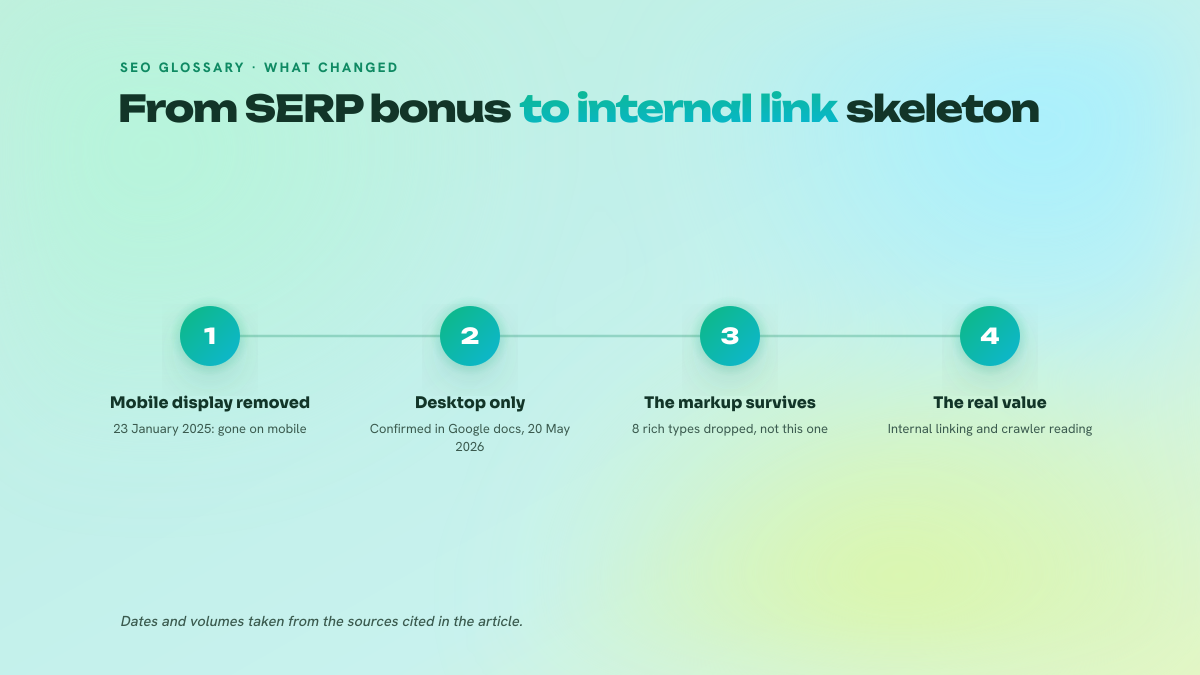
- →Google removed breadcrumb trails from mobile results on January 23, 2025 and made the desktop-only restriction explicit in its documentation on May 20, 2026. The markup kept every other function it had.
- →BreadcrumbList survived a purge of eight rich result types between June 2025 and May 2026, FAQ included. That says more about its status than any blog post does.
- →Ship location-based breadcrumbs generated from the taxonomy. Path-based trails describe one session, not a hierarchy, and should never be marked up as BreadcrumbList.
- →Weight the 8.5% CTR uplift (Sistrix 2023 data) by your desktop share. On a mobile-heavy audience the honest expectation from breadcrumb snippets is close to zero.
- →In a link campaign, breadcrumbs decide where equity travels: a link on a category feeds its children, a link on an article climbs back up and feeds the category.
- →Around 40% of audited sites carry broken breadcrumb schema (crawlix, March 2026), usually a trail that drifted away from its markup after a redesign.
A declared hierarchy, not a navigation widget
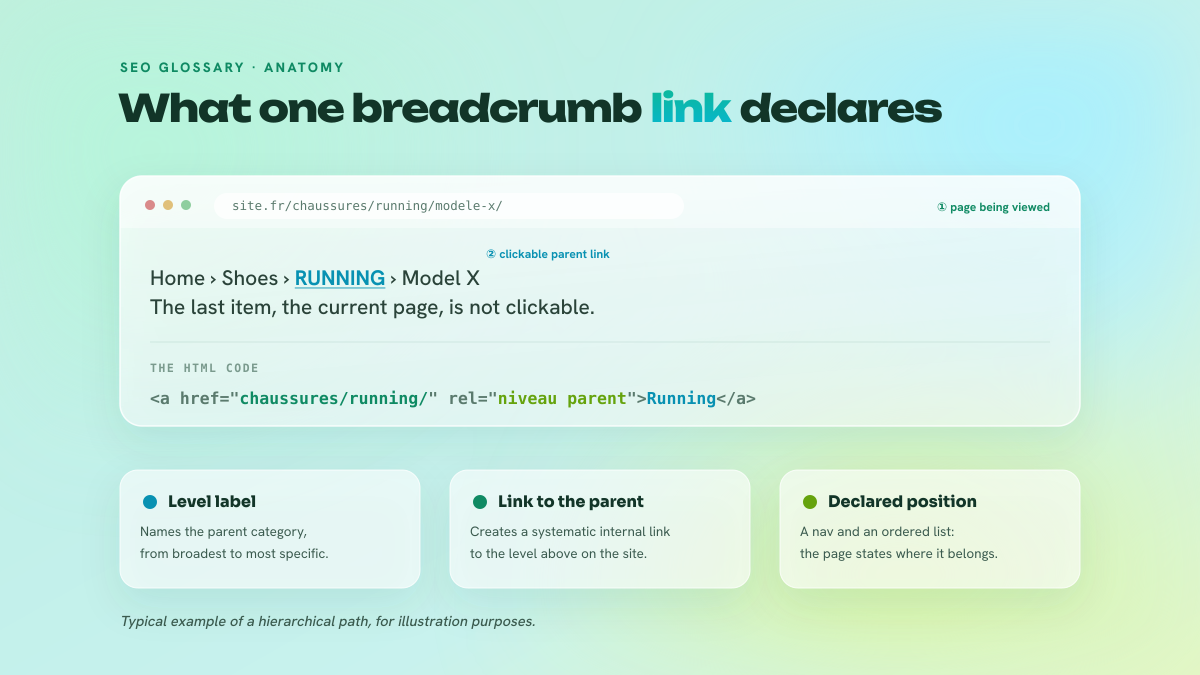
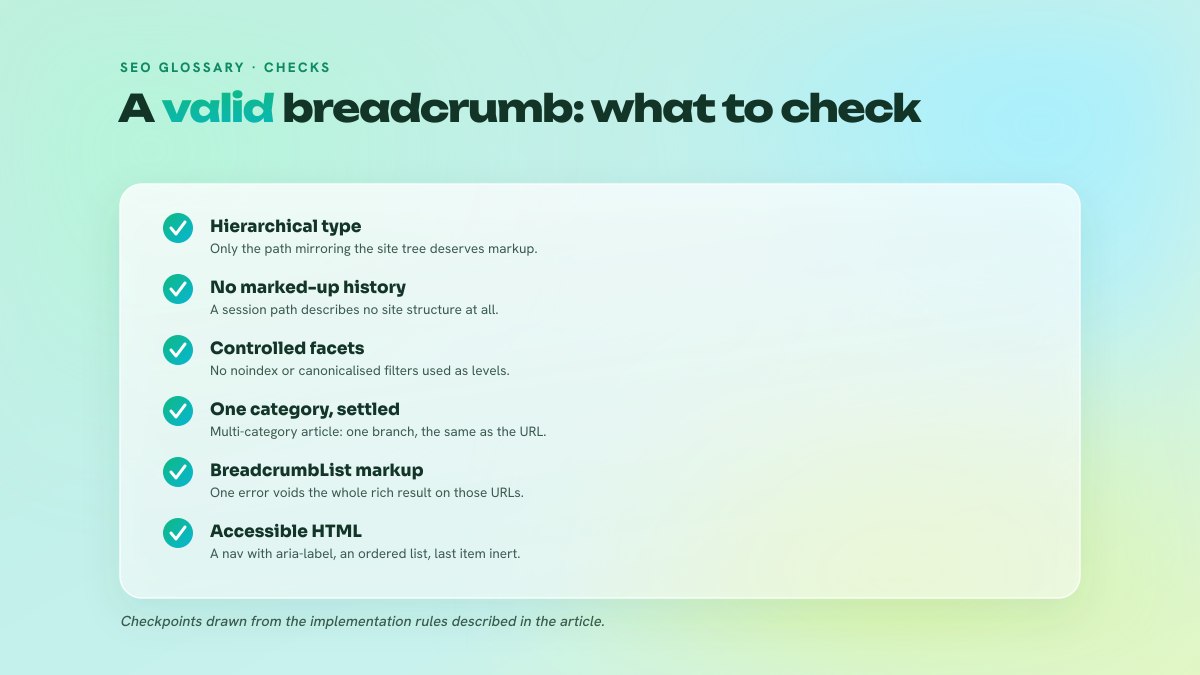
A breadcrumb is two artefacts shipped as one. There is the visible trail near the top of the page, Home > Furniture > Garden furniture > Teak bench, which lets a visitor who landed deep from search climb one level without hunting through the menu. And there is the BreadcrumbList markup, a machine-readable declaration of where that page sits in the site hierarchy. The two layers can disagree, and when they do it is the markup that decides what the search result looks like, not the widget.
The distinction matters because it changes who owns the file. A navigation component is a design decision. A hierarchy declaration is an architecture decision, and it should be generated from the same taxonomy that generates your URLs. Any breadcrumb maintained by hand, or worse assembled from a menu configuration that lives somewhere else entirely, will drift out of sync with the real URL structure inside a year.
Two types exist and they are not interchangeable. Location-based breadcrumbs mirror the site hierarchy and are identical for every visitor on a given URL. Path-based breadcrumbs, sometimes called history breadcrumbs, replay the route this particular visitor took to get there. Path-based navigation is a browsing artefact that changes per session, and it has no business being marked up: you would be telling a crawler that your hierarchy is a function of one user’s clickstream. Ship location-based, always. When an item genuinely belongs to several branches, either pick one canonical parent per URL and hold that line, or emit several BreadcrumbList objects on the page, which the documentation permits and which is the honest representation of a multi-parent product.
What Google actually changed in 2025 and 2026
On January 23, 2025, Google removed the breadcrumb trail from mobile search results across all languages and regions, citing truncation on small screens. Desktop results still show the hierarchy in place of the raw URL when the markup is valid (Search Engine Land, SEO breadcrumbs guide). Google then made the restriction explicit in its own docs: the Search Central changelog, updated May 20, 2026, records the addition of a feature availability section stating that breadcrumbs appear on desktop search results only, not on mobile.
That is a display change, not a withdrawal of support, and the difference is where most of the 2025 commentary went wrong. Everything downstream of the markup survived. The BreadcrumbList type is still documented and still parsed, and Breadcrumbs is still an active Enhancements report in Search Console, where an error blocks the rich result outright (MB Adv Agency, June 1, 2026).
Set that against what happened to the rest of the structured data catalogue. Between June 2025 and May 2026, Google removed or deprecated eight rich result types, among them Course Info, Claim Review, Estimated Salary, Learning Video, Special Announcement, Vehicle Listing and most FAQ results, with FAQ pulled from the SERP on May 7, 2026 and Search Console support ending by August 2026. Practice Problem reporting left Search Console and the Rich Results Test in January 2026. BreadcrumbList came through untouched, and the guidance published during those rollbacks consistently pointed the reallocated effort at Organization, Article and BreadcrumbList. A schema type that survives a cull that aggressive is a type Google is still using for something.
Markup mechanics, and what is worth measuring
JSON-LD in the head is the format to ship. Microdata and RDFa still validate, but nobody wants schema woven through presentational HTML two redesigns from now. The object itself is thin: an itemListElement array of ListItem entries, each carrying a position integer that starts at 1 and increments without gaps, a name, and an item URL. In Google’s own example the final entry, the current page, carries no item URL, which is where a surprising number of implementations quietly diverge from the documentation.
The name field is a navigation label, not a ranking surface. It should read like the category a visitor would recognise, and it is not a second place to restate the page title. Google will rewrite an over-optimised label out of the snippet anyway, so the stuffing buys nothing and costs clarity.
For measurement, three surfaces answer three different questions. The Breadcrumbs enhancement report in Search Console tells you whether the markup parses at scale and which templates are broken. The Rich Results Test tells you what a single URL emits right now, which is what you use after a deploy. And a crawl, Screaming Frog or Sitebulb, is the only tool that answers the question that actually matters: does the parsed hierarchy match the visible trail and the URL path, template by template.
On the click-through side, be careful which number you repeat. A 2026 beginner guide relaying Sistrix 2023 data puts the average CTR improvement of breadcrumb-enhanced snippets over plain URL results at 8.5% (wpdean, 2026). The same page also passes along a 20 to 30% claim attributed to « Glukhov, 2025 » with no methodology attached: drop it. And since January 2025 that uplift only exists on desktop, so weight whatever figure you keep by your desktop share before building a business case on it. On a mobile-heavy consumer site, the honest expected CTR gain from breadcrumbs is close to zero.
Where breadcrumbs matter in a netlinking operation
Breadcrumb links are structural, the backbone kind, and they behave nothing like contextual ones. Every article emits the same two or three upward links, so category pages accumulate site-wide internal links by construction while leaf pages receive almost none in return. On a large catalogue that is the entire point. Search Engine Land’s December 23, 2025 guide frames breadcrumbs as a depth reducer: they shorten the click distance from the home page to deep URLs and raise the odds those URLs are discovered and indexed at all.
The consequence for link acquisition is a targeting rule, not a nice-to-have. A backlink landing on a category page redistributes downward through the breadcrumb graph into its children. A backlink landing on a leaf article climbs back up the same trail and mostly feeds the category. That asymmetry should drive target selection more often than source metrics do, and it is cheap to model: crawl the site, count how many breadcrumb links point at each node, and you have the internal distribution map before you spend a euro externally. External placements are the expensive half of the equation, and it is worth checking what a placement actually costs before pointing one at a page your own architecture is starving.
Across the French editorial media we operate in-house at Stringer, breadcrumbs are generated from the category taxonomy at build time rather than configured site by site, precisely because the failure mode that hurts is silent drift between the trail, the markup and the URL. The same discipline is what makes a media catalogue auditable from outside: anyone browsing the list of sites open without an account can check how a site is structured before buying anything on it, which is the reason to publish it.
One ecommerce figure deserves quoting with its caveat attached. A 2026 architecture piece citing Baymard Institute 2025 research reports that 62% of online shoppers expect to find a product within three clicks, and that sites with well-organised architectures, breadcrumb schema included, see 2.5 times higher conversion rates. The first half is a usability finding you can act on. The second is correlation between well-run sites and good outcomes, and no breadcrumb implementation on its own moves conversion by that factor. Same treatment for the 2025 internal linking study claiming up to a 40% improvement in SEO performance: no isolation of the breadcrumb variable, no cohort, no methodology. It does not belong in a client deck.
The AI search argument, and how much of it holds
The 2026 version of the breadcrumb pitch runs like this: now that the trail is gone from mobile, breadcrumbs have become « the structural blueprint that explains your site’s hierarchy to AI Overviews and crawlers », with the structured data layer carrying what the SERP used to display (Yotpo, June 2, 2026). Half of that is defensible and half is sales copy.
Defensible: a machine-readable hierarchy makes a website easier to parse for anything that ingests it, and BreadcrumbList is one of the few schema types still producing rich results after the 2025 to 2026 rollbacks, so keeping it clean has a known payoff. Sales copy: there is no published evidence that BreadcrumbList is an input to AI Overview source selection, and nobody has isolated the variable.
The tempting misreading comes from the selection data. An Ahrefs study of 863,000 SERPs published in February 2026 found that only 38% of pages cited in Google AI Overviews rank in the top 10 organic results, down from 76% in mid-2025. That gap is real and it is widening, and it creates an obvious vacuum: if classic ranking explains less of AI citation than it used to, something else must, and schema is the nearest available candidate. The inference is unsupported. Maintain BreadcrumbList because it is cheap, still supported and still feeds a desktop rich result, not because someone sold you a generative search mechanism attached to it.
What we see go wrong
A March 22, 2026 audit of breadcrumb schema found the implementation wrong on roughly 40% of the sites examined (crawlix, 2026), and the failure patterns repeat with depressing regularity. The most common is a mismatch between the visible trail and the markup: a redesign moves the component, the JSON-LD stays wired to the old taxonomy, and nothing surfaces until the enhancement report flags it months later. Next is broken position sequencing, numbering that starts at 0 or skips a value, which invalidates the whole list rather than one item.
Then there are the URLs. Breadcrumb items pointing at addresses that 301 elsewhere, or at a category that has since gone 404, are routine on sites that have been through a migration. Each one is a structural link wasted at scale, since the same broken parent is emitted from every child page. Trailing slash inconsistency between the breadcrumb item URL and the canonical is the quiet version of the same bug.
On the design side, two recurring mistakes. Collapsing the trail on mobile is fine, and truncating the middle with an ellipsis beats dropping levels silently. Accessibility is skipped almost universally: the component should be a nav element with an aria-label of Breadcrumb, containing an ordered list, with aria-current set to page on the final item. Screen reader users navigate by landmark, and an unlabelled div of chevrons gives them nothing. It costs one attribute and it is the single most neglected part of every breadcrumb spec we review.
The strategic mistake is treating breadcrumbs as internal linking. They are the floor, not the plan. A trail gives every page a path upward and nothing sideways, so a site with immaculate breadcrumb schema and no contextual links between related articles still has a flat, undifferentiated link graph. Breadcrumbs plus a coherent heading structure get you a legible website. Ranking the pages inside it is a separate job.
Last, a keyword note for anyone targeting this term in English. The bare query breadcrumb, and especially its verb form, is dominated by a dating slang meaning, someone keeping a contact warm with intermittent low-effort messages, and that intent owns a large share of the SERP. If you are building content around the navigation concept, target the qualified variants, breadcrumb navigation, breadcrumb schema, BreadcrumbList, and do not write a page for the head term expecting technical traffic to show up.
Nautilinks operates an owned network of editorial media. In-house written articles, transparency disclosures respected, anchor mix calibrated.
Frequently asked questions
If breadcrumbs no longer show on mobile, is the markup still worth maintaining?
Yes, and the January 23, 2025 change did not touch anything except the mobile display. Desktop snippets still replace the URL with the trail when the markup is valid, the Breadcrumbs Enhancements report in Search Console is still active, and BreadcrumbList survived the removal of eight rich result types between June 2025 and May 2026. Dropping it would sacrifice a working desktop rich result and a clean hierarchy declaration to save a few lines of JSON-LD.
How should we mark up a product that legitimately sits in several categories?
Two acceptable answers. Either pick one canonical parent per URL and enforce it everywhere, which keeps the internal link graph predictable and is what we do on catalogue sites, or emit multiple BreadcrumbList objects on the page, which Google documents and which honestly describes a multi-parent item. What you must not do is generate the trail from the referrer so it changes per visitor. That is path-based navigation, and marking it up tells a crawler your hierarchy depends on one session.
Do breadcrumb anchors carry the same weight as contextual internal links?
No, and they should not be budgeted as if they did. Breadcrumb links are site-wide and identical across thousands of pages, so they carry very little differentiation: they tell Google what the hierarchy is, not which page deserves priority within it. Their real value is crawl depth and discovery of deep URLs, per Search Engine Land’s December 2025 guide. Differentiation comes from contextual links placed inside the body, where anchor and surrounding text vary.
Is BreadcrumbList a lever for getting cited in AI Overviews?
There is no evidence for it. The claim circulates because AI Overview selection is drifting away from classic ranking: an Ahrefs study of 863,000 SERPs from February 2026 found only 38% of cited pages rank in the top 10, down from 76% in mid-2025. That gap invites speculation about which other signals fill it, and schema is the convenient guess. Keep BreadcrumbList for its documented function, not for a generative search benefit nobody has isolated.
Our keyword tool shows big volume on the term breadcrumb. Is that reachable traffic?
Mostly not, if you sell anything technical. The head term and its verb form are dominated by the dating slang sense, someone stringing a contact along with occasional low-effort messages, and Google’s People Also Ask on that query reflects it almost entirely. Volume on the bare term is real but the intent is wrong for you. Target breadcrumb navigation, breadcrumb schema and BreadcrumbList instead, where the volume is smaller and every visitor is a fit.
What is the fastest way to audit breadcrumbs across a large site?
Crawl first, report second. Extract the parsed JSON-LD and the rendered trail per template with Screaming Frog or Sitebulb, then compare three things: the item URLs against the live status codes, the position sequence against 1..n with no gaps, and the trail labels against the actual category names. That catches the drift the Search Console Breadcrumbs report only surfaces weeks later, and it finds the 301 chains inside breadcrumb items that no validator flags as an error.
Test your knowledge
Quiz: Breadcrumb
1/3On what date did Google stop displaying breadcrumb trails in mobile search results?