- →A branded anchor confirms an entity, it does not transmit topical relevance. Stop expecting keyword lift from it and start measuring it as a brand signal.
- →Ahrefs analysed 75,000 brands (run of August 2025, published 27 April 2026) and found branded anchors correlating with AI Overview presence at ρ = 0.527, against ρ ≈ 0.218 for backlink counts. That reordering is the real 2026 news.
- →Count anchors per referring domain, never per link. Sitewide footers and paginated archives inflate a branded share by tens of points and hide an exact-match problem underneath.
- →The 2026 literature converges on branded anchors as the plurality of a healthy profile: 40 to 50 % per Semrush-derived figures cited by Conbersa (28 February 2026), 45 to 60 % per the Opinly report of 22 July 2026.
- →A 95 % branded profile is as much a footprint as a 30 % exact-match one. LinkRocket documentation (14 June 2026) flags both extremes, and one-anchor monotony is the fingerprint of an automated campaign.
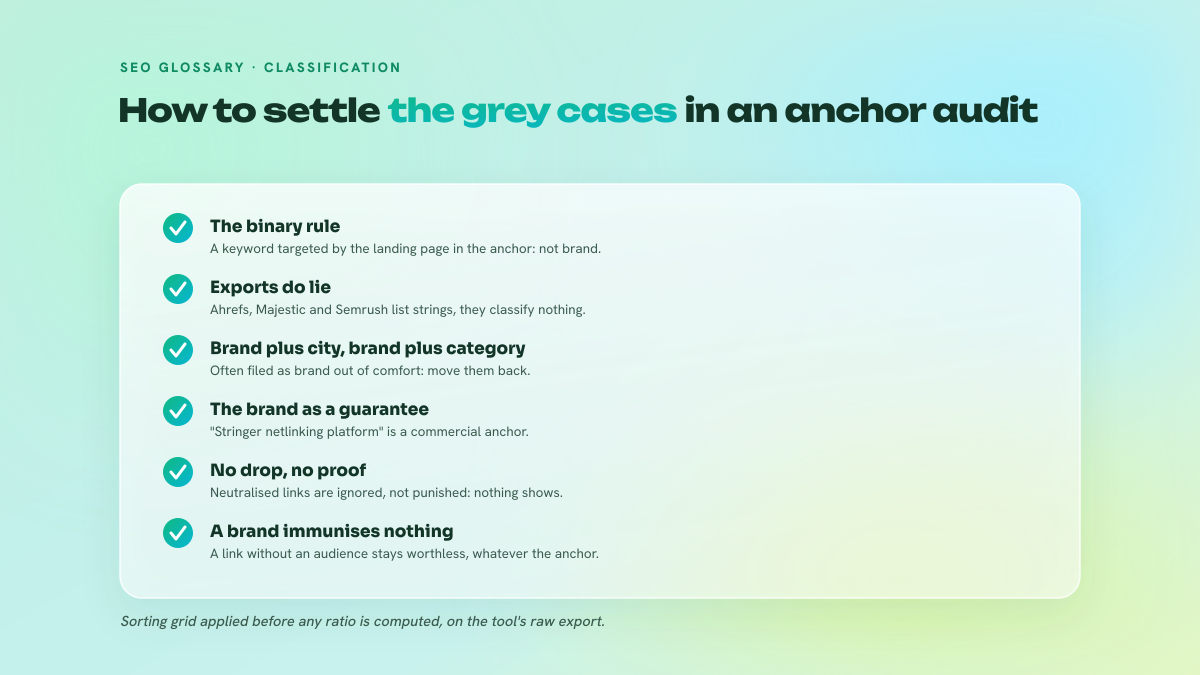
- →Bucketing every anchor that contains the brand name as branded is the most common measurement error we see: compound anchors carry keyword pressure and belong in the partial-match bucket.
What a branded anchor actually is
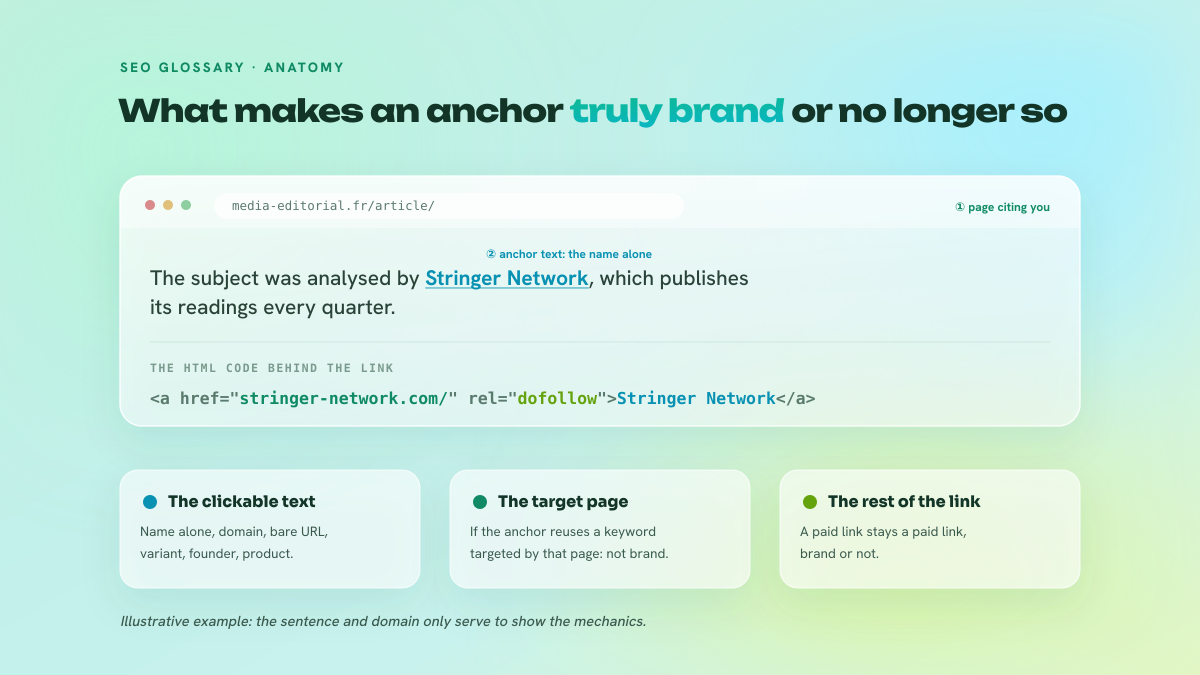
A branded anchor is a link whose visible text is the name of the destination entity: the brand, the company, the product, sometimes the founder’s name or the bare domain read as a name. That is the dictionary half. The operational half is that a branded anchor is the only anchor type you can deploy at scale without ever having to justify it to a spam classifier, because it is what a human editor writes by default when they have no incentive to rank you.
Anchor text remains one of the very few ranking inputs an SEO controls directly, which is exactly why search engines treat it with suspicion. The signal a branded anchor carries is not topical relevance, it is entity confirmation: it tells the crawler that this string and this URL designate the same thing. Repeated across hundreds of referring domains, that redundancy is what turns a domain into an entity rather than a URL that happens to rank.
The distinction most practitioners get wrong is branded versus semi-branded. « Stringer Network » is branded. « the Stringer Network media catalogue » is a compound anchor that carries entity and topic at once. In an audit those two behave very differently: the pure form dilutes commercial pressure, the compound form adds keyword weight while keeping part of the defensive property. Anyone who buckets every anchor containing the brand name as branded ends up reporting a profile that looks considerably safer than it is.
Three cousins sit next to it and get confused with it constantly. A naked URL (https://example.com) is functionally close, since it names the entity through its domain, and most 2026 benchmarks pool the two. A generic anchor (« read more », « here ») names nothing and, per the Ahrefs brand-mentions auditing guide of 3 October 2025, is explicitly weak for brand authority compared with a branded anchor. A brand mention without a link is a different object entirely, weaker in link terms but, as we will see, stronger than expected on AI surfaces.
The stance worth holding: a branded anchor is not the modest option you fall back on when the editor refuses your keyword. It is the load-bearing structure of the profile, and the commercial anchors are the thin layer you can afford to place on top of it.
How it works in 2026, and how to measure it
Mechanically, nothing exotic happens. The anchor is a string associated with a target URL in the link graph, and search engines have used it as a description of the destination since the original PageRank work. What changed is the weighting. Google’s March 2024 core update folded the Helpful Content system into core and shifted weight away from link quantity toward quality and relevance, while the accompanying spam policies targeted scaled content abuse, site reputation abuse and expired domain abuse. All three of those patterns lean on manipulative anchor distributions. The net effect is that aggressive anchors carry more downside than they did in 2019, and the branded anchor became the defensive default by elimination.
The genuinely new development is the AI surface. Ahrefs analysed 75,000 brands in August 2025 and published the results on 27 April 2026: the strongest off-site correlates of appearing in Google AI Overviews were branded web mentions at ρ = 0.664, branded anchors at ρ = 0.527 and branded search volume at ρ = 0.392, while total backlinks came in around ρ = 0.218 and domain rank around 0.25. A synthesis published on 25 March 2026 covering both the August and December 2025 runs reports the same ordering for AI Mode, with branded anchors at ρ = 0.628. Search Engine Land covered the same dataset on 30 April 2026 under the heading of a shift from links to brand signals.
Read that carefully. These are correlations on an observational dataset, not a causal claim, and branded anchor volume is obviously confounded with simply being a known brand. The operational conclusion is still actionable: the anchor type that used to be treated as the harmless remainder of a campaign now sits closer to the metrics that predict visibility than raw link counts do.
Measurement is where most audits fall apart. Search Console does not expose anchor text, so you work from Ahrefs, Semrush or Majestic anchor reports. Two rules make the number meaningful. Deduplicate per referring domain, because one sitewide footer link or a paginated archive can contribute four hundred identical branded anchors and turn a dangerous profile into a green dashboard. And classify by hand on a sample of a hundred anchors before trusting any tool’s automatic bucketing, since compound and misspelled brand variants are routinely misfiled. Then segment per target URL: a homepage at 80 % branded and a commercial landing page at 60 % exact-match is a profile with a problem, even if the sitewide average looks textbook.
Ratios and benchmarks worth trusting
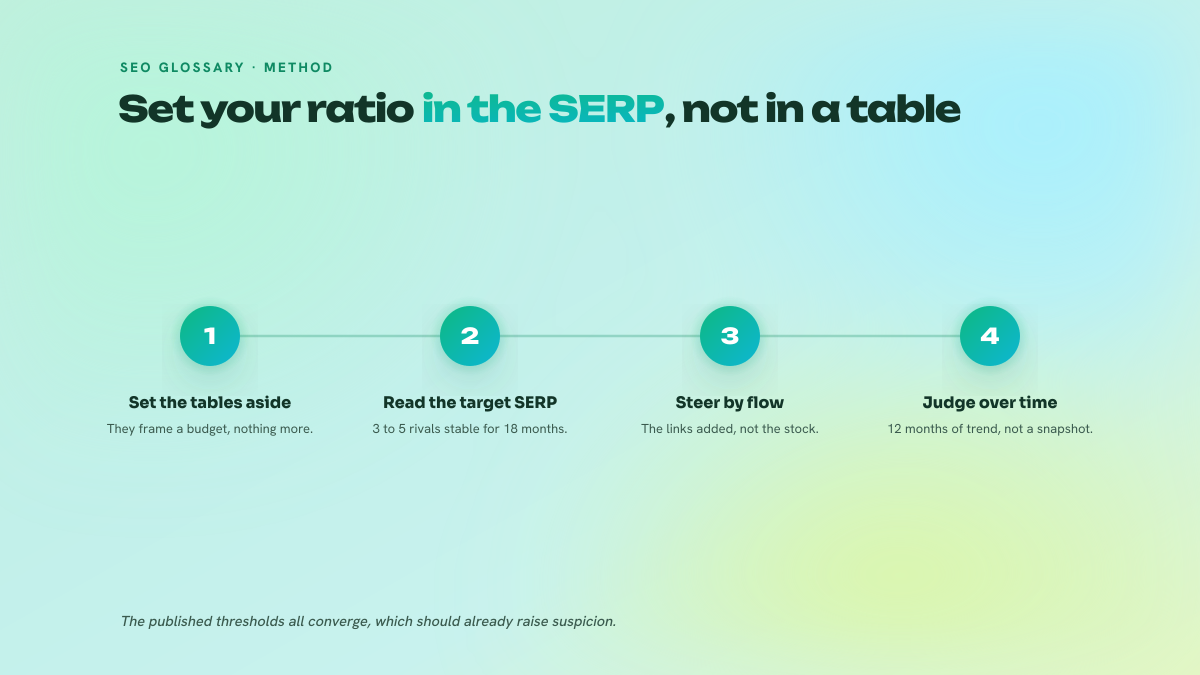
The 2026 literature has converged, which is unusual and worth noting. Figures derived from Semrush research and cited by Conbersa on 28 February 2026 describe a healthy profile as 40 to 50 % branded, 20 to 30 % partial-match, 10 to 15 % generic and 5 to 10 % exact-match. Stellar SEO, publishing on 12 April 2026, puts branded anchors plus naked URLs at roughly 60 to 80 % of links in mature profiles that hold their rankings over time. The Opinly link-building report of 22 July 2026 recommends 45 to 60 % branded in acquired links with exact-match kept under 5 %, and treats 60 to 70 % branded or generic combined as the natural range.
Set that against what practitioners actually do. The Editorial.link survey of 518 SEO experts published on 13 May 2026 found partial-match anchors as the top choice of 41.7 % of respondents, exact-match for 25.1 %, and branded anchors third at 20.5 %. So a quarter of active link builders lead with the anchor type every distribution study caps below 10 %. That gap between recommended and observed practice is the single most useful thing in the survey, and it is why a competitor audit so often reveals an exploitable weakness rather than a model to copy.
On the value of keyword anchors, be honest about the evidence. An Ahrefs study of more than two million pages found that pages whose backlink profiles carried keyword-relevant anchors ranked on average twelve positions higher than those with generic or random anchors, so relevance in anchors is not dead. But a separate Ahrefs analysis of 384,614 pages measured the correlation between exact-match anchors and rankings at a Spearman value of 0.1436, which is weak. Both results can hold: relevance helps, literal repetition of the target query does not, and the profitable zone is the partial-match anchor that reads as prose.
Treat every one of these ranges as a distribution to blend into, not a target to hit. Nobody at Google is checking whether you are at 47 %. What the ranges encode is the shape of a profile nobody had to engineer. If you build campaigns on a link placed inside real editorial prose, the branded share tends to arrive on its own, because that is what a writer naturally types.
Where it matters in a netlinking operation
Three moments in a campaign are decided by the branded share. The first is the opening phase of a young or previously dormant domain. Before any commercial anchor goes out, the entity has to exist: enough branded links that the brand name and the domain are unambiguously associated. Push exact-match anchors at a domain with no branded base and you are asking a classifier to evaluate a profile whose only visible intent is ranking. Pacing that opening phase is inseparable from the rhythm at which the profile accumulates links: branded anchors absorb velocity far better than commercial ones.
The second is anchor budgeting across a campaign. Once you accept that exact-match should stay in the single digits, the arithmetic is brutal: three exact-match anchors means somewhere around forty other links to keep the ratio defensible. That is a budget question before it is an SEO question, and it is the reason we tell clients to look at the cost of a single placement before designing the anchor plan rather than after. A plan that requires forty links you cannot fund is not a plan.
The third is publisher negotiation. Branded anchors are the easiest ask in outreach, since an editor who refuses « best CRM software 2026 » will accept the company name without discussion. Practically, that means never spending negotiation capital on the anchor when the placement itself, the surrounding paragraph and the destination page matter more. On the buying side it also means a catalogue where you choose the medium and write the anchor yourself is worth more than a marketplace where an intermediary decides both: it is exactly the difference between buying a placement directly from the publisher and taking whatever a reseller assigns you.
Our own position colours this, so state it plainly: we operate our own French editorial media, and because the editorial team is in-house the anchor is a parameter we set rather than negotiate. That is convenient, and it is also a trap. Total anchor control is how over-optimised profiles get built, since nothing pushes back. Teams working with us on a campaign calibrated over several months get a branded floor imposed at the plan level for that exact reason.
What goes wrong in real profiles
The failure we see most often is the inflated branded share. An audit reports 68 % branded, everyone relaxes, and the number comes from a single directory sitewide contributing eleven hundred footer links. Deduplicated per referring domain, the real figure is 22 % and the commercial landing page is carrying an exact-match majority. Any anchor report you have not deduplicated is decoration.
The second is monotony. One brand string, identical across every link, no variation in case, no « Brand », no « Brand.com », no « the team at Brand », no naked URL. Real editors are inconsistent, and that inconsistency is itself a signal of authenticity. LinkRocket’s documentation of 14 June 2026 makes the point from the other direction: above roughly 10 % exact-match a profile looks manipulated, but a profile that becomes 90 % or more branded is also a footprint. Both extremes are engineered, and engineered is the thing you are trying not to look like.
The third is treating branded anchors as sufficient. Branded anchors confirm an entity, they do not tell a search engine what you sell. A profile at 85 % branded with no topical anchor anywhere leaves the destination page semantically unanchored, and we regularly see homepages with strong entity signals sitting alongside category pages that rank on nothing because no link ever described them. The fix is partial-match anchors on the money pages, not more brand.
The fourth is confusing branded anchors with brand mentions and skipping the cheaper one. In the Ahrefs dataset, unlinked branded mentions correlate more strongly with AI Overview presence than branded anchors do, and an analysis published on 21 May 2026 on the same data notes that brands in the top quartile for web mentions averaged 169 AI Overview appearances against 14 for the next quartile down. Chasing only linked anchors leaves the stronger signal on the table.
The last one is retrofitting. Trying to repair a profile that is 30 % exact-match by dumping two hundred branded links in a month replaces one anomaly with a second, more visible one. Dilution works over quarters, not weeks, and it works best when the new links come from a catalogue of media you can filter and pace yourself. If you cannot control the rhythm, you cannot dilute anything.
Nautilinks operates an owned network of editorial media. In-house written articles, transparency disclosures respected, anchor mix calibrated.
Frequently asked questions
Should the naked URL bucket be merged with branded anchors in reporting?
Merge them for the health check, separate them for diagnosis. Most 2026 benchmarks pool the two, and Stellar SEO’s April 2026 figures explicitly give branded plus naked URLs at 60 to 80 % of mature profiles. But naked URLs cluster in forums, comments and citation-style placements, so a profile where the safe share is almost entirely naked URLs tells you something about your acquisition mix that a merged number hides. Report the merged total, keep the split visible underneath.
Is it worth paying for outreach to convert generic anchors into branded ones?
Sometimes, and the Ahrefs brand-mentions guide of 3 October 2025 recommends exactly that swap. Our rule: only on referring domains you would pay to acquire today. Converting « click here » to your brand name on a page nobody reads buys nothing, while doing it on a high-traffic industry publication converts an existing asset at near-zero cost. Batch the requests with something else you need from that publisher, since a standalone anchor-change email spends goodwill for a small gain.
Does a branded anchor still pass the same link equity as a keyword anchor?
PageRank flows through the link, not the anchor, so the equity is identical. What differs is the descriptive signal layered on top. That is why the Ahrefs two-million-page study finding keyword-relevant anchors ranking twelve positions higher is not a contradiction: those pages received relevance information the branded ones did not. Branded anchors give you authority and entity confirmation without topical direction, which is why a profile needs both rather than one or the other.
How do you handle branded anchors when the brand name is a generic word?
This is the genuinely hard case. If the brand is « Simple » or « Monday », branded and generic anchors become indistinguishable to a classifier and probably to your own reporting. Practical answer: anchor on the disambiguated form the market actually uses, brand plus category or brand plus domain suffix, and accept that your branded share will look lower than a competitor with a distinctive name. Do not compensate by pushing exact-match anchors instead.
If branded anchors correlate best with AI visibility, should exact-match anchors be dropped entirely?
No, and that inference goes beyond what the data supports. The Ahrefs 75,000-brand analysis measures AI Overview presence, not classic organic ranking, and correlation on observational data cannot separate anchor effects from simply being a known brand. Classic SERPs still reward topical anchors. Keep exact-match under the 5 % that the Opinly report of 22 July 2026 recommends, spend the partial-match budget on your commercial pages, and let branded carry the rest.
What branded share should a site expect from links it never built?
Check before you plan anything: filter your referring domains to the ones you did not acquire and compute the branded share on that subset. A Moz observation cited in 2026 practitioner analysis notes that large national brands run anchor profiles dominated by branded anchors with keyword anchors a much smaller share. If your organic subset already sits above 50 % branded, your acquired links can carry more topical pressure than a benchmark table would suggest.
Test your knowledge
Quiz: Branded anchor
1/3In the Ahrefs analysis of 75,000 brands (run of August 2025, published 27 April 2026), how did branded anchors rank among off-site correlates of AI Overview presence?