- →BERT is not a historical update, it is a named ranking system Google still documents as active in the version of its ranking systems page in force in December 2025, alongside RankBrain, neural matching and link analysis.
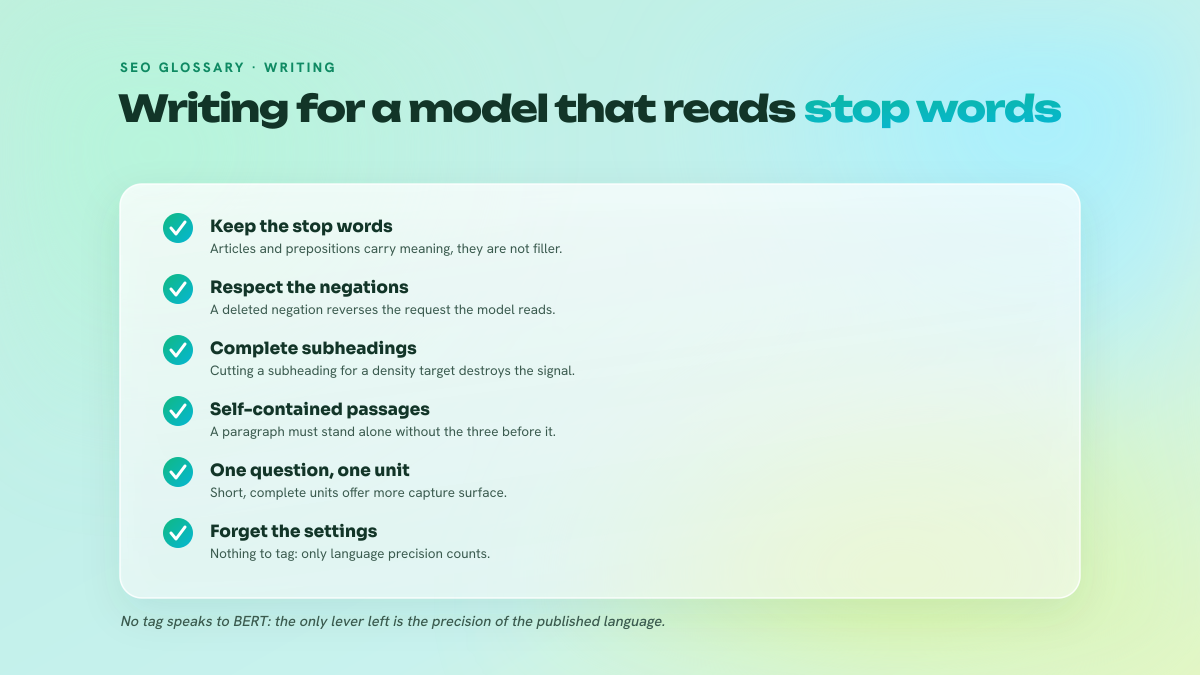
- →You cannot optimise for BERT. It has no dial, no threshold, no score you can inspect. What you can do is remove the ambiguity it has to resolve: explicit entities, explicit qualifiers, one clear intent per URL.
- →DOJ trial documentation summarised in September 2025 describes RankEmbed BERT as trained on 70 days of search logs plus quality rater scores, which is a very different animal from a link-graph signal.
- →Semantic relevance now filters what links can do. An off-topic link from a strong domain moves less than it did five years ago because the receiving page has to pass topical matching first.
- →The commercial consequence is measurable on informational queries: an Ahrefs analysis of 300,000 keywords on December 2025 data found the top organic result loses roughly 58% of its CTR when an AI Overview appears.
- →Anchor text is still parsed in context. Over-optimised exact-match anchors read as a pattern, not as a relevance signal, and they were already a liability before BERT existed.
What BERT really is, beyond the acronym
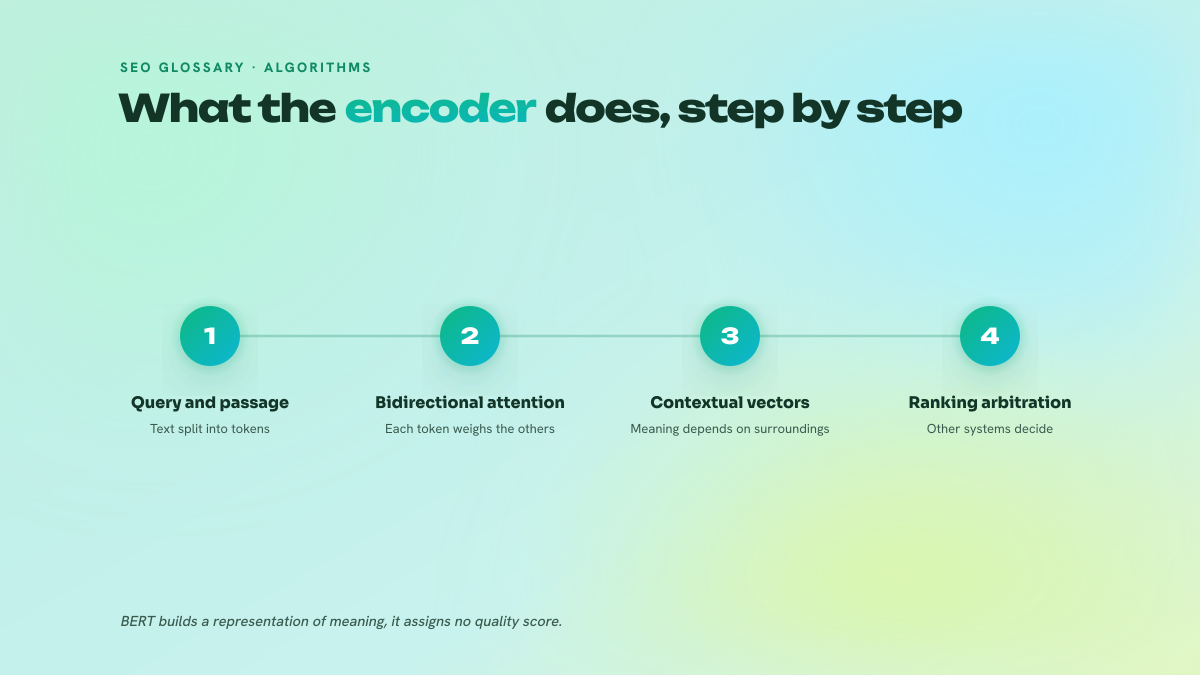
BERT stands for Bidirectional Encoder Representations from Transformers. Google open-sourced the model in 2018 and shipped it into Search in 2019, starting with English before extending it to other languages. The acronym is the least interesting part. The mechanism is what changed the job: BERT reads a token conditioned on everything to its left and everything to its right at the same time, so « bank » in « river bank » and « bank » in « bank transfer » stop being the same word, and the preposition in « 2019 brazil traveler to usa need a visa » stops being a stop word Google can safely throw away.
For anyone who was writing pages before 2019, that is the whole shift. Pre-BERT ranking rewarded lexical overlap plus authority. You matched the string, you pointed links at it, you ranked. Post-BERT, the string matters far less than whether the passage on the page resolves the question the query encodes. Two pages using entirely different vocabulary can compete for the same query, and a page stuffed with the exact query terms can lose to one that never uses them in that order.
The honest framing for a 2026 audit: BERT is not a ranking factor you can influence directly, it is the interpretation layer sitting between the query and everything else Google scores. You do not optimise for it. You either give it an unambiguous document to parse or you make it guess, and when it guesses you inherit whatever it guessed.
Where BERT sits in Google's stack in 2026
The most common error in client decks is treating BERT as legacy, something superseded by MUM, then by Gemini. Google's own ranking systems documentation, in the version in force in December 2025, still lists BERT as an active named system next to RankBrain, neural matching, passage ranking, PageRank and link analysis, and spam detection. Systems Google actually retires get moved to a separate list, which is what happened to the Helpful Content system when it was folded into core ranking on 5 March 2024. BERT was not moved. It is still there.
Technical write-ups based on the 2024 Google API leak place BERT in the pipeline as one of the models that adjusts an initial score before final re-ranking, with Ascorer doing primary scoring and Twiddlers doing the last pass. More useful, because it is sourced from sworn material: DOJ trial documentation summarised in September 2025 by Marie Haynes describes RankEmbed BERT as a deep learning model trained on 70 days of search logs plus quality rater scores, producing an additional ranking signal that reflects user preference and E-E-A-T rather than link metrics. The same analysis notes that PageRank is now nowhere near as important as the information stored about the page itself. Read that sentence twice if you sell links for a living.
The other 2026 context is the answer layer. Gemini 3 Flash became the standard model for AI Mode worldwide between December 2025 and January 2026, and AI Overviews were estimated to reach around 1.5 billion monthly users across more than 200 countries by late 2025. Those answers sit on top of a retrieval and ranking pipeline that still uses BERT-family semantics to decide what is relevant in the first place. The generation model changed. The matching layer underneath did not get thrown away. When a broad core update rolls out and a site loses positions on informational queries, the diagnosis is almost never « BERT changed », it is « the semantic fit between our pages and those queries was always thin and something else stopped compensating for it ».
How BERT works: attention, masking, context
Three ideas carry the whole model. Self-attention lets every token compute a weighted relationship with every other token in the sequence, so the representation of a word is built from its actual neighbourhood rather than from a fixed dictionary vector. Masked language modelling is the pre-training trick: hide 15% of the tokens and force the model to reconstruct them from both sides, which is what makes the encoder genuinely bidirectional instead of two one-directional passes glued together. Next sentence prediction, the second pre-training objective in the original paper, asks whether sentence B plausibly follows sentence A, which is where a crude sense of discourse coherence comes from. Later research questioned how much NSP actually contributes, and several successor models dropped it.
This short overview covers the components in sequence if you want the visual version before we go further into architecture.
Nautilinks operates an owned network of editorial media. In-house written articles, transparency disclosures respected, anchor mix calibrated.
Frequently asked questions
Is BERT still used by Google in 2026, or was it replaced by MUM and Gemini?
Still used. The version of Google's ranking systems documentation in force in December 2025 lists BERT among active named systems, alongside RankBrain, neural matching, passage ranking and link analysis. Retired systems are moved to a separate list, which is where the Helpful Content system went after being merged into core ranking on 5 March 2024. MUM and Gemini added capabilities on top, particularly for AI Mode and AI Overviews, but the encoder layer that matches queries to documents was not removed.
Is BERT supervised or unsupervised, and does that matter for SEO?
Pre-training is self-supervised: the labels are generated from the text itself by masking tokens and asking the model to reconstruct them, so no human annotation is needed. Fine-tuning for a specific task is supervised. It matters indirectly, because RankEmbed BERT, described in DOJ trial documentation summarised in September 2025, was trained on 70 days of search logs plus quality rater scores. That is supervised signal derived from human judgement, which is closer to E-E-A-T than to anything in your backlink profile.
How is BERT different from word2vec for keyword clustering?
word2vec gives one fixed vector per word regardless of context, so « jaguar » is a single blurry average of the car and the animal. BERT produces a different vector for the same word depending on the sentence it sits in. For clustering a keyword list, that means BERT-family encoders separate intents that word2vec merges. If you are building this in-house, a distilled multilingual encoder run locally is enough, and for French corpora CamemBERT is the reference model.
Does BERT read anchor text, and should that change how I write anchors?
Anchor text is text on a page, so it is processed in context like everything else. The practical consequence is that a natural phrase inside a real sentence carries its topical meaning fully, without needing exact-match repetition. Stacking identical exact-match anchors across placements no longer buys extra relevance, it just makes the pattern legible. Vary anchors, let the surrounding paragraph do the topical work, and pick placements where that paragraph is genuinely about the target subject.
Can BERT generate text, and could Google use it to write AI Overviews?
No. BERT is encoder-only: it sees the full sequence at once and outputs representations, which is exactly why it is good at matching and classification and structurally incapable of generating fluent continuations. Generation needs a decoder that predicts the next token. AI Overviews and AI Mode are produced by Gemini models, with Gemini 3 Flash becoming the standard model for AI Mode worldwide between December 2025 and January 2026. The retrieval and ranking underneath still relies on encoder-side semantics.
How does BERT handle a brand name or a word it has never seen?
It splits unknown strings into sub-word units using WordPiece, so nothing is discarded, and it builds a representation from the surrounding context. For a new brand this is good news and a constraint at the same time: the model can learn what your brand is from the sentences around it, but only if those sentences actually define it. A brand mention dropped into a paragraph with no descriptive context contributes almost nothing at the semantic level.
Test your knowledge
Quiz: BERT
1/3What does the bidirectional part of BERT actually refer to?