- →A soft 404 is a status-versus-content contradiction: 200 on the wire, nothing usable on the page. Google resolves it by de-indexing the URL, not by penalizing the site, which makes the damage quieter and slower to surface.
- →Classification can differ between mobile and desktop (Google Search Relations guidance relayed in October 2025), and a client-side router that renders a not-found view under a 200 status manufactures soft 404s at scale.
- →A backlink pointing at a soft-404 destination passes nothing durable. Destination monitoring belongs inside the netlinking workflow, before and after each placement, not in an annual technical audit.
- →Redirecting deleted URLs to the homepage is the most reliable way to convert acquired link equity into a soft 404 classification. Map page-to-page toward equivalent content, or let the URL die with a real 404 or 410.
- →Prioritize fixes by inbound equity: cross Search Console's Page indexing report with a rendering crawler and Ahrefs or Semrush backlink data. The Search Engine Land case of May 2026, roughly 90% of traffic lost across 13 country domains, shows what unmanaged accumulation costs.
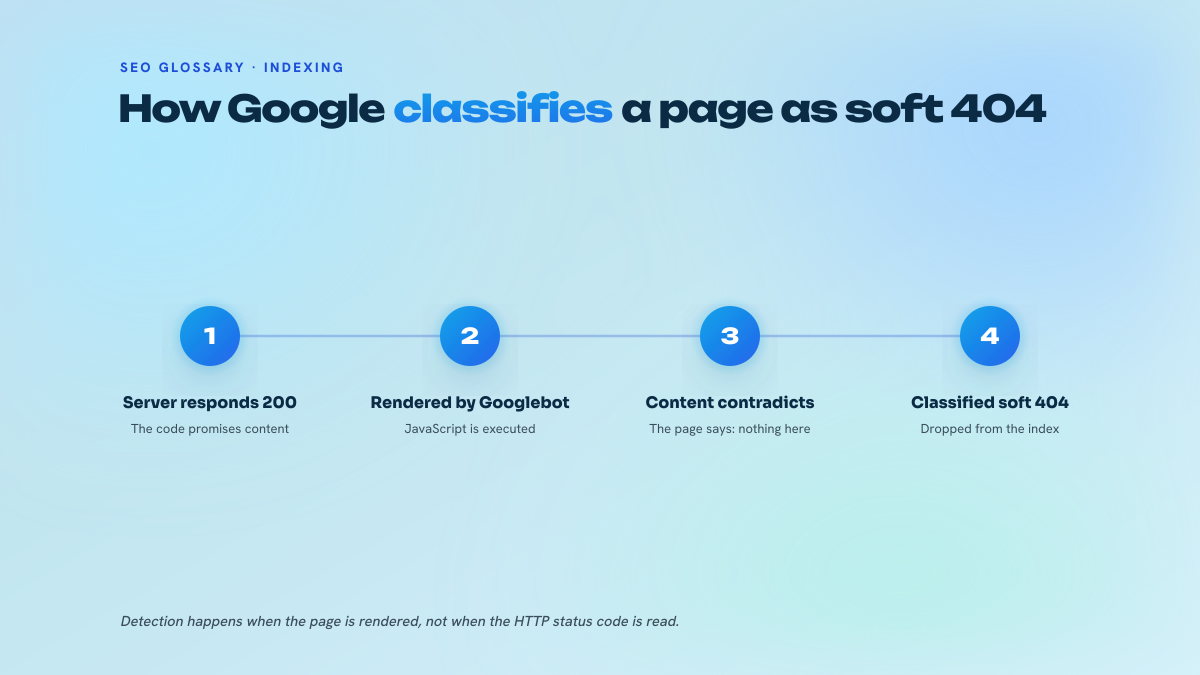
What Google actually flags
Strip away the jargon and a soft 404 is a contradiction between two layers of the same HTTP response: the status line says 200 OK, the content says there is nothing here. Google's systems resolve that contradiction in their own favor. The URL is treated as if it had returned a real 404, removed from or never admitted to the index, and reported under « Soft 404 » in Search Console's Page indexing report. Google's documentation has been consistent on the underlying logic for years: genuine 404 and 410 responses are normal web hygiene and carry no quality or ranking signal. The problem is never the missing page. The problem is lying about the missing page.
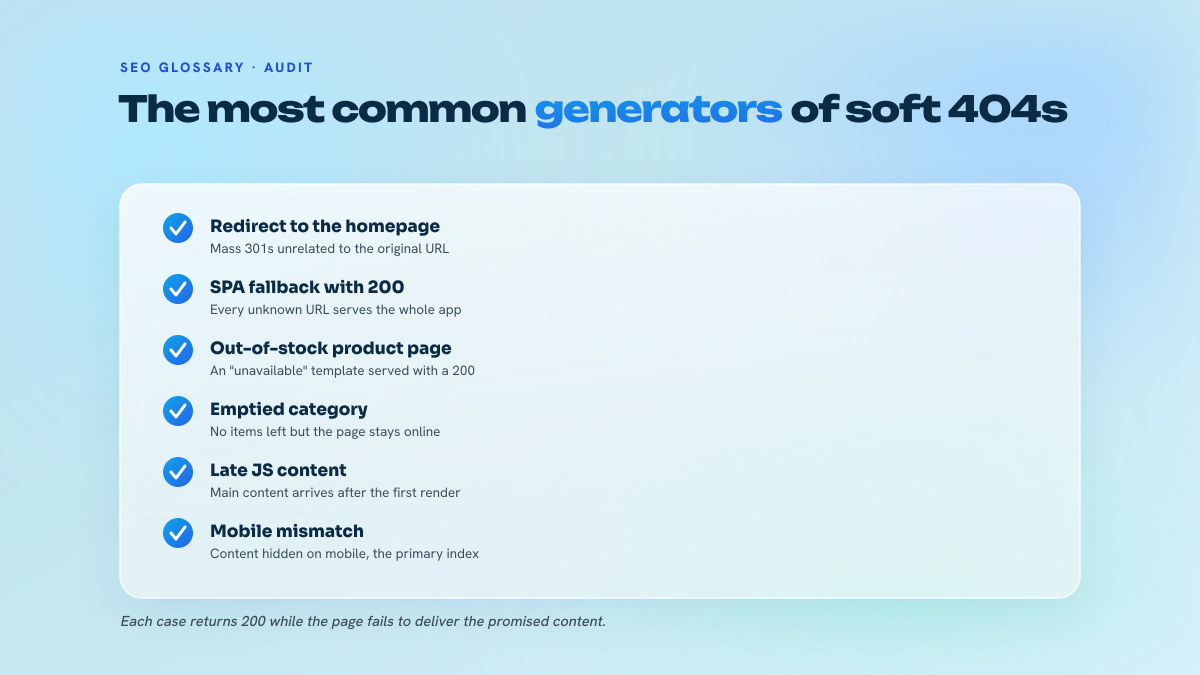
The classic triggers have not changed: empty category pages left online after the inventory was removed, internal search results with zero results, « out of stock » templates that gut the main content but keep the URL alive, error messages rendered inside a healthy 200 template. What has broadened is the scope. Google also applies the label to pages that are technically present but functionally worthless for any query, and to redirects that dump the visitor somewhere unrelated to what they asked for. Redirecting every deleted URL to the homepage is the canonical example: current redirect guidance keeps repeating that a redirect must match the intent of the original URL, otherwise the whole chain can be classified as a soft 404, with the link equity consequences we detail below.
One thing the label is not: a penalty. Nothing in Google's confirmed updates over the past year, including the December 2025 and March 2026 core updates, targets soft 404s as a ranking factor. A site accumulating them is not sanctioned. It is quietly de-indexed one URL at a time, which in practice is worse, because nothing alerts you except a graph in Search Console that most teams look at monthly at best.
How detection works in 2026
Detection is a rendering-level judgment, not a status-code check. Googlebot fetches the URL, renders it, and compares the result against patterns of unavailability: error phrasing, near-empty main content, templates it has already learned to associate with dead inventory on your own site. Two recent shifts matter operationally.
First, classification can differ by device. Industry reporting from October 2025, relaying Google Search Relations guidance, confirmed that a URL can be a soft 404 on mobile and a normal page on desktop, or the reverse. A responsive template that collapses the main block on small viewports, or a mobile-only availability message, can get a page dropped from an index that is mobile-first by default. If your crawler only fetches with a desktop user agent, you are auditing a version of the site Google barely uses.
Second, JavaScript error handling is where modern stacks bleed. Google's documentation update of 18 December 2025 clarified how Googlebot processes non-200 responses, rendering and canonical URLs. The practical reading for single-page applications is now explicit: a client-side router that displays a « not found » view while the server answers 200 is manufacturing soft 404s at scale. The fix belongs at the server or edge layer, returning a real 404 status, not inside the frontend component.
On crawl impact, Gary Illyes was specific at Search Central events in 2025: 404s as such do not consume the crawl allocation Google grants a site the way SEO folklore claims, but expensive error pages do waste server resources, for instance a 404 template that fires several database queries before rendering. Keep error responses computationally cheap. The real crawl damage from soft 404s runs through a different mechanism: Google progressively loses interest in a site whose URLs keep resolving to nothing, and reallocates its crawling elsewhere.
The netlinking angle: link equity into a void
For this glossary's audience the real cost is not traffic, it is wasted links. A backlink pointing at a URL Google has classified as soft 404 passes nothing durable: the target drops out of the index and the link's contribution goes with it. We see three recurring versions of this in audits.
The paid link into a dying page. An advertiser buys a placement toward a product or landing page, the offer is discontinued months later, and the CMS keeps serving a hollow 200. The invoice was real, the equity is gone. Destination monitoring belongs in the netlinking workflow itself, which is why it sits among the checks built into the platform where our placements are managed, run before a link goes live and again afterward, rather than in a yearly technical audit that arrives long after the classification.
The expired-domain redirect. Pointing an acquired domain's entire URL history at a homepage is the pattern most reliably read as a soft 404. Whatever authority the old URLs carried dies at the redirect. Page-to-page mapping through contextually matched permanent redirects toward genuinely equivalent content is slower to build, and it is the only version that holds.
The AI referral leak. Ahrefs' study published on 31 May 2026, using a baseline of 629 million URLs referred by Google, measured that AI assistants send users to 404 pages 2.87 times more often than Google Search, with ChatGPT citing dead URLs at a 2.38% rate against Google's 0.84%. Those figures concern hard 404s, not soft ones, but the operational lesson transfers directly: assistants cite from stale snapshots, so the URLs your links and mentions point to need to outlive your content calendar. A page you let rot into a soft 404 disappears from both the index and the citation pool.
Across the French media we operate in-house at Nautilinks, the rule is structural: no placement toward a URL that does not return a clean 200 with substantive content, and periodic re-checks on every live placement. Not because Google penalizes the publishing site, but because a link into a void is a refund conversation waiting to happen.
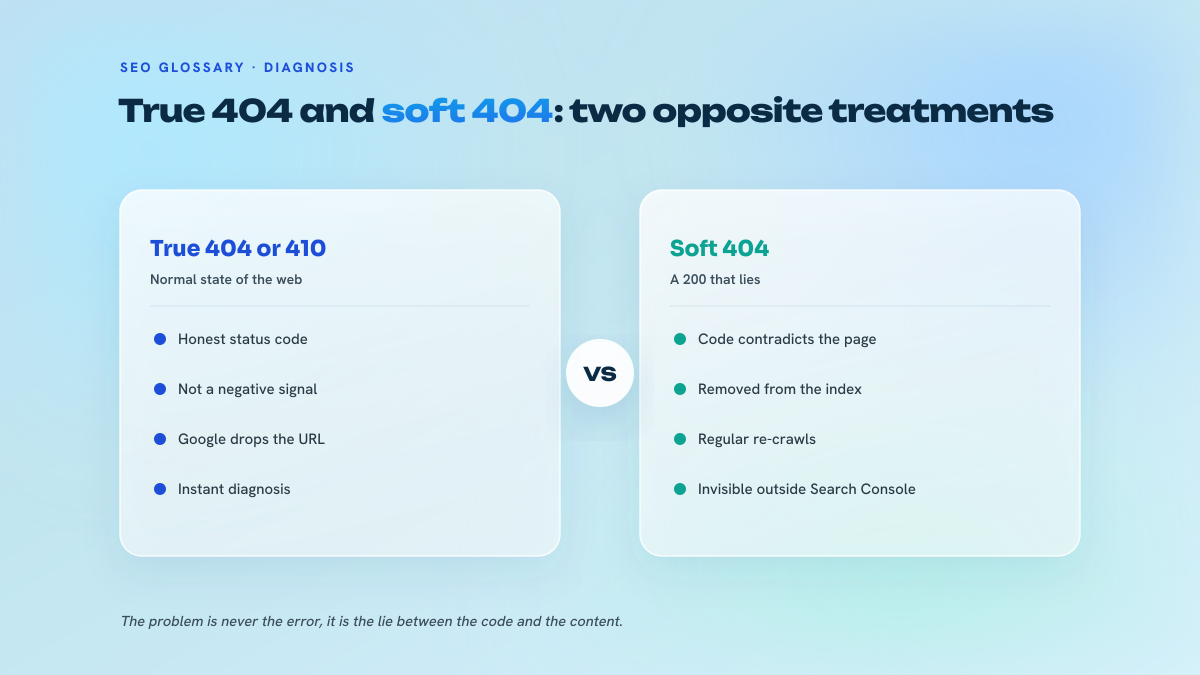
The mistakes we keep seeing
The most expensive mistake is treating the Search Console report as an error list to be cleared rather than a symptom to be interpreted. Teams « fix » soft 404s by adding a paragraph of filler to an empty page, which converts an honest classification problem into a thin-content problem and fools the classifier only briefly. If the page has no reason to exist, let it die properly: return a 404 or 410 and drop it from the sitemap.
The second mistake is disposal by meta tag. Slapping a noindex directive on dead content keeps the URL alive, keeps it crawlable, and postpones the actual decision. For content that is permanently gone, a 410 says so unambiguously; noindex is for pages that should exist but not rank, which is a different situation entirely.
The third is auditing with the wrong eyes: desktop-only crawls, no JavaScript rendering, no mobile user agent. Given the device-specific classification behavior reported in October 2025, that setup will sign off on a site whose mobile rendition is quietly being dropped.
Search Engine Land documented the end state of unmanaged accumulation on 12 May 2026: a multinational publisher lost roughly 90% of its traffic after a domain migration in which soft 404s and indexing issues piled up across 13 country domains. On the French property, daily crawl requests in Search Console fell from 60,000 to 70,000 down to 20,000 to 30,000 as soft 404s accumulated from October 2022 onward. A case study is not a controlled experiment, but the trajectory matches what we observe at smaller scale: soft 404s compound, crawl interest decays, and by the time the traffic graph moves, the index damage is years deep.
A working diagnosis routine
Professional diagnosis in 2026 rests on triangulating three sources, because none is sufficient alone. Search Console's Page indexing report tells you what Google actually decided, but it samples and it lags. A JavaScript-capable crawler, Screaming Frog with rendering enabled or an equivalent, surfaces the status-versus-content mismatches Google will eventually find, provided you crawl with a mobile user agent as well as desktop. Backlink data from Ahrefs or Semrush tells you which of those URLs have inbound equity at stake, which is the only sane prioritization axis: a soft 404 with forty referring domains is an incident, a soft 404 on an orphan filter page is housekeeping.
The triage logic is simple to state. A dead URL with valuable inbound links gets a contextually relevant 301 toward equivalent content, a restoration, or a consolidation into a stronger page. A dead URL with nothing pointing at it gets a true 404 or 410 and removal from the XML sitemap. A live page wrongly flagged gets rebuilt until its main content is unambiguous after rendering, on mobile first. Then verify with the URL Inspection tool rather than waiting for the report to refresh on its own schedule.
Finally, make the check recurrent on the netlinking side. Every placement, bought or earned, deserves a destination check at order time and a re-check on a quarterly cadence. It costs minutes with any crawler and protects the one thing a link campaign actually buys: equity flowing into a page that Google agrees exists.
Nautilinks operates an owned network of editorial media. In-house written articles, transparency disclosures respected, anchor mix calibrated.
Frequently asked questions
Does a soft 404 hurt the rankings of the rest of my site?
Not directly. It is a classification, not a penalty, and none of the recent core updates (December 2025, March 2026) target soft 404s as a ranking signal. The damage is indirect and cumulative: affected URLs leave the index, links into them stop contributing, and Google's crawl interest in the whole site decays. The Search Engine Land case published on 12 May 2026 showed daily crawl requests dropping by more than half as soft 404s accumulated on a single country domain.
Why did Google flag a page that works perfectly fine for users?
Usually because the rendered main content looks unavailable to the classifier: a thin body after JavaScript execution, an availability message, or a template Google has learned to associate with dead pages on your site. Since October 2025, guidance also confirms classification can differ between mobile and desktop rendering. Inspect the mobile-rendered HTML in the URL Inspection tool before assuming a false positive; the desktop view you are checking may not be the one Google indexed.
Is noindex an acceptable way to deal with soft 404s?
No. Noindex keeps the URL alive and crawlable while merely hiding it, which postpones the decision Google is asking you to make. Content that is permanently gone should return 404 or 410 and leave the sitemap. Noindex is the right tool for pages that must exist for users but should not rank, such as internal search results, which is a different problem than dead content wearing a 200 status.
I paid for a link toward a page that later became a soft 404. Is that budget lost?
While the classification stands, effectively yes: the target is out of the index and the link passes nothing durable. The recovery paths are to restore substantive content at that URL, or to 301 it toward a genuinely equivalent page so the equity has somewhere to land. This is why destination monitoring should be part of the placement workflow itself, with a check at order time and periodic re-checks, not something discovered during an annual audit.
Do soft 404s waste crawl budget?
Not in the way folklore claims. Gary Illyes said at Search Central events in 2025 that 404s as such do not meaningfully consume crawl budget, though computationally expensive error pages waste server resources. The real mechanism is slower: a site whose URLs repeatedly resolve to nothing sees Google reallocate crawling away from it over time, which is exactly the crawl-decline pattern documented in the May 2026 Search Engine Land migration case.
Test your knowledge
Quiz: Soft 404
1/3What technically defines a soft 404 in Google's classification?