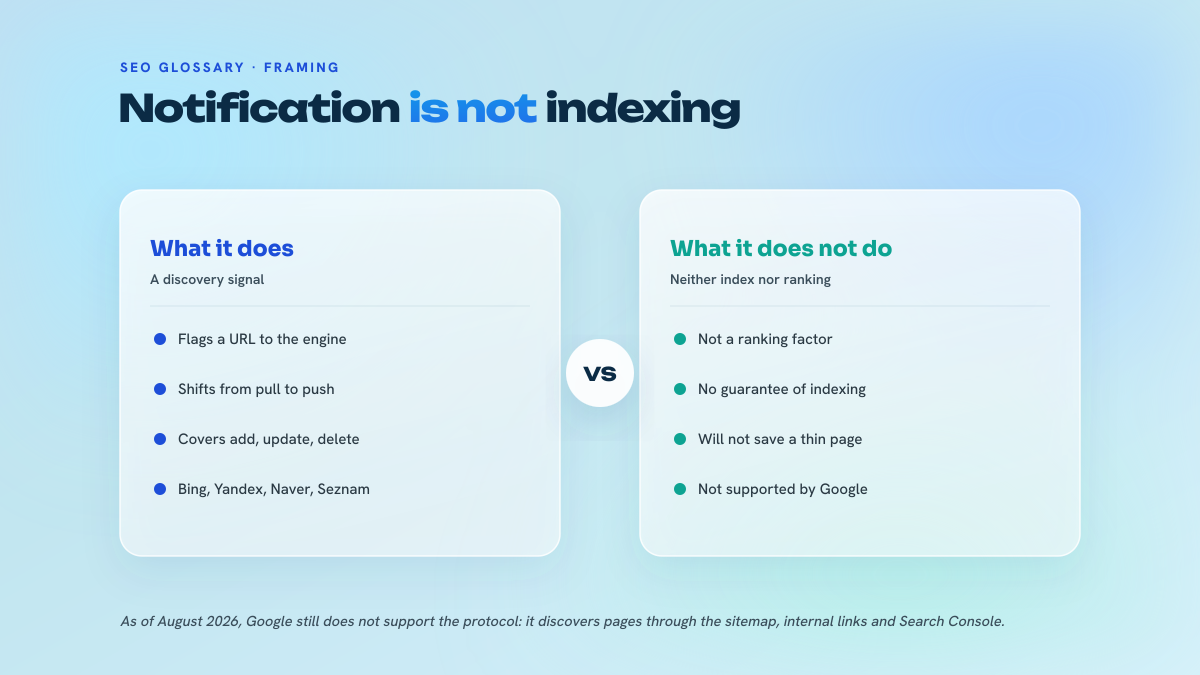
- →IndexNow is a push signal for crawl scheduling, not an indexing promise: submitting a thin page gets it crawled faster and ignored just as fast.
- →Google has not joined the protocol as of mid-2026 and still points publishers to its own Indexing API, officially scoped to JobPosting and BroadcastEvent. Plan your Google discovery separately.
- →The payoff is concentrated on Bing and its downstream surfaces: Microsoft reported that 22 % of clicked URLs in Bing results in late 2025 came from IndexNow submissions, up from 18 % in early 2025.
- →Trigger submissions on real content state changes, not on a cron. Re-pinging unchanged URLs is the fastest way to have your key deprioritised.
- →The key file is the single point of failure. A migration that drops it turns every submission into a silent 403, and nothing in your analytics will tell you.
- →Paid indexing tools at around $9/month are mostly wrappers over a free HTTP endpoint. Build the push into your deploy step instead of renting it.
What IndexNow actually is
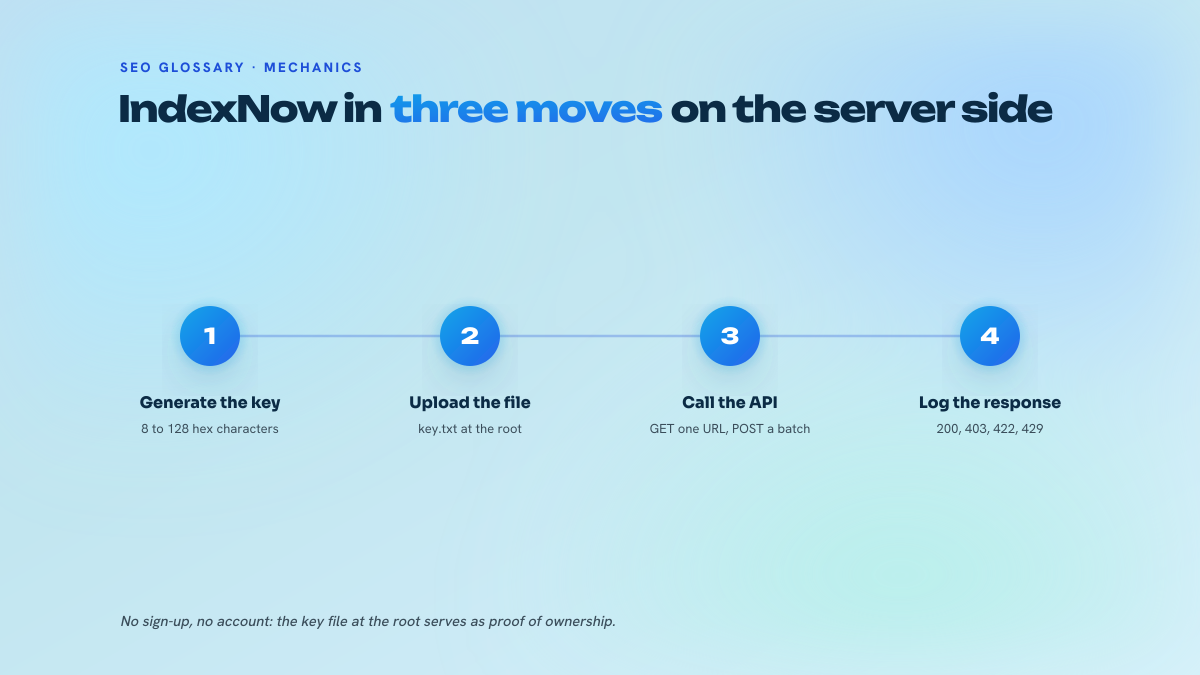
Strip the marketing and IndexNow is three moving parts: a random key you generate, a text file hosting that key at your domain root, and an HTTP POST carrying a list of URLs. That is the entire protocol. Everything else, plugins, dashboards, paid services, is packaging around a free endpoint. The operational shift it produces is small but real: you stop hoping a crawler revisits your site on its own schedule and start telling participating engines, at the moment of publication, that something changed.
Microsoft and Yandex opened the protocol, and the consuming side has widened since: Bing, Yandex, Naver, Seznam and Yep all accept submissions today, and a submission to any one of them is shared with the others. Google has never joined. That single fact should govern how much attention you give it, and we will come back to it.
Adoption is no longer marginal. A February 2026 industry recap reports daily submissions passing 5 billion URLs, up from 3.5 billion in 2024, with more than 80 million websites actively pushing by January 2026. The WordPress plugin ecosystem alone crossed 10 million active IndexNow installations in July 2025. eBay, LinkedIn, MSN, GitHub and Amazon all feed the protocol. It has quietly become infrastructure rather than a tactic.
Here is the official overview from the IndexNow team, which covers the premise in two minutes.
How the protocol works, and how you measure it
You generate a key of 8 to 128 hexadecimal characters, then serve it as plain text at https://votre-domaine.fr/{key}.txt, the file containing nothing but the key itself. That file is the proof of ownership. When you POST to the API, the receiving engine fetches it, compares, and accepts or rejects the batch. A single request can carry one URL as a simple GET, or up to 10 000 URLs as a JSON body with host, key, keyLocation and urlList. The response is immediate and tells you almost nothing useful: a 200 means the submission was received and the key checked out, a 403 means the key file did not validate, a 422 means a URL does not belong to the declared host.
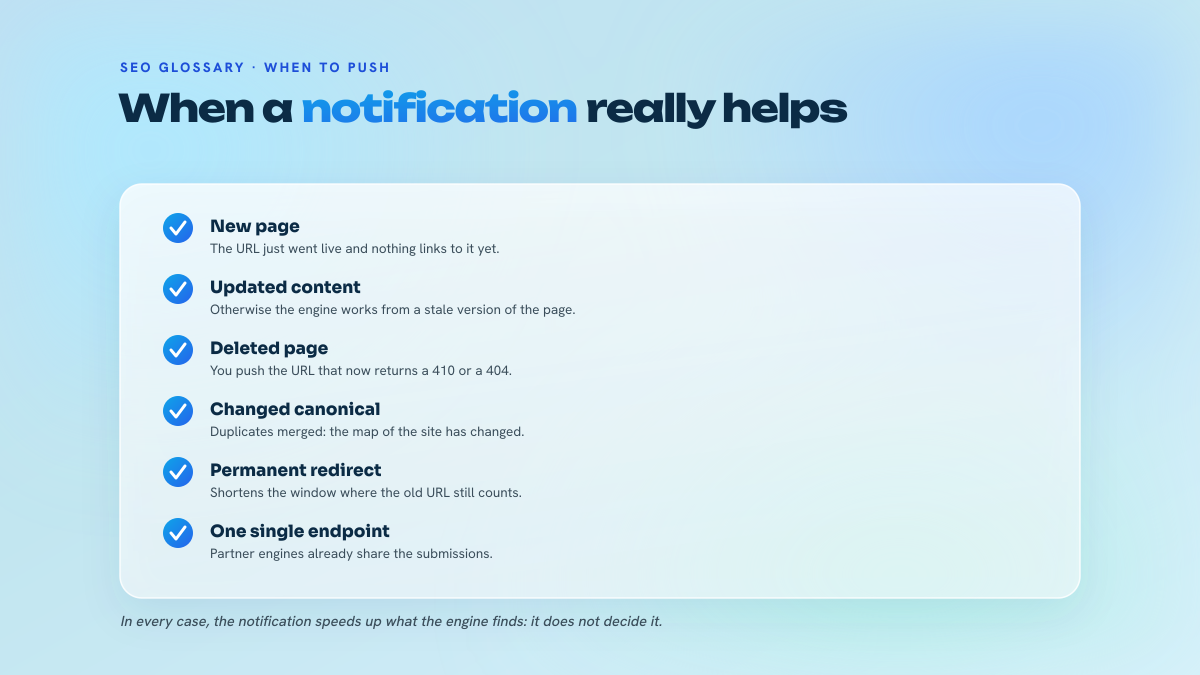
What happens next is where most people over-read the protocol. A 200 buys you a place in a crawl queue. The engine still decides whether to fetch the URL, whether to index what it finds, and whether to rank it. IndexNow compresses the discovery delay, which on a low-authority site can run from days to weeks, down to something closer to minutes. It does nothing to the two stages after that. A page that would have been crawled and discarded gets crawled and discarded sooner.
Measurement is the part almost every tutorial skips. Bing Webmaster Tools added an IndexNow Insights report in March 2024, and that report is the only honest feedback loop you have: submitted URLs, how many were crawled, how many made it into the index. Compare submission timestamps to crawl timestamps in your server logs and you get a real time-to-crawl distribution for your own domain. That number, not the submission count, is the metric worth watching. Microsoft’s own reporting gives a sense of the downstream effect: 22 % of all clicked URLs in Bing results in late 2025 originated from IndexNow submissions, against 18 % in early 2025.
This short explainer covers the mechanics from the publisher side.
Implementing it without ceremony
On WordPress, the decision is already made for you: Microsoft’s official plugin, Yoast, Rank Math and SEOPress all ship submission on publish, and SEOPress includes it in its free tier. Wix and Shopify carry native integrations, with Shopify and Amazon adding schema.org-marked shopping feeds through IndexNow in May 2025. Behind Cloudflare, Crawler Hints does the same job without you writing a line: the CDN detects content changes at the edge and forwards the signal to participating engines. If your stack is any of those, you are ten minutes away from done and the rest of this section is optional.
A custom implementation is barely harder and gives you control over the trigger, which is the part that matters. On the French editorial media we run in-house, the key is derived deterministically from a SHA-256 of the domain, so it never needs storing anywhere, the key file is written into the static build, and the URL push fires as the last step of the deploy after the upload succeeds. That ordering is deliberate: submitting before the pages are actually live earns you a crawl on a 404, and 404s are the one outcome that genuinely costs you crawl budget on a small site.
The video below walks through the API call itself if you want to see the request and response before wiring it up.
One design choice deserves thought: what counts as a change worth submitting. Tie the trigger to the content hash of the rendered page, not to the file’s modification date. A rebuild that touches every page because a footer year changed should not produce a full-site submission. Engines notice sites that declare 4 000 changes a week and deliver 12.
Where it fits in a netlinking operation
A backlink that has never been crawled does not exist. That is the only reason IndexNow belongs in a netlinking conversation at all, and it is a good one. When a placement goes live on a host site, the clock starts on the host’s crawl schedule, not yours. If the publisher pushes the new URL through IndexNow, Bing sees the link the same day. Google, not consuming the protocol, will find it when it finds it, which on a well-crawled editorial site is hours and on a neglected one is weeks.
So the honest framing for a link buyer in 2026 is this: IndexNow tells you something about the operational hygiene of the sites you place on, but it is not a Google lever. When you evaluate hosts, the signals that actually predict fast link pickup on Google are publication frequency, internal linking depth to the new article, and whether the URL enters the sitemap at all. That is worth checking before ordering, and it is the kind of thing you can only assess on a catalogue where each medium is inspectable before you commit rather than through a broker’s spreadsheet.
The second angle is AI surfaces, and it is less speculative than it sounds. A March 2026 AirOps study, cited in Searchbloom’s June 2026 report on IndexNow for AI SEO, found that recently updated pages earned roughly three times the citation share in AI Overviews compared with older pages. Recency behaves as a citation signal. Anything that shortens the gap between an update and its registration by a retrieval index compounds with that, and on Copilot and Bing-grounded assistants the chain runs directly through IndexNow. On Google’s own AI surfaces you are back to conventional discovery, meaning a sitemap that stays your inventory of record and internal links that actually reach the new page.
What goes wrong in practice
The failure we see most often is silent. A site migrates, the build pipeline changes, the key file stops being emitted, and every submission from that day forward returns 403. Nothing in the CMS complains, nothing in analytics moves, and six months later someone notices Bing is a season behind. Monitor the key file with the same alerting you put on the homepage: a single HEAD request expecting a 200.
Second failure: submitting URLs that contradict your own directives. Pushing a page that carries a canonical pointing somewhere else, or a noindex, or a URL blocked in robots.txt, is not neutral. You are spending a trust signal to ask an engine to fetch something you have told it to ignore. Filter the submission list against the same rules that build your sitemap, from one source of truth.
Third: treating the protocol as an indexing service and buying tooling accordingly. The 2026 market is full of thin wrappers around a free endpoint, typically around $9/month for a submission quota and a dashboard, sometimes bundled into broader AI visibility platforms. Some of them are fine, none of them do anything your deploy script cannot. If you have budget to allocate against indexation, it goes into content depth and into placements, where the cost of a placement is published upfront and you can do the arithmetic yourself, not into automating a POST request.
Fourth, and this is the conceptual one: IndexNow does not replace an XML sitemap and never will. The sitemap is a persistent declaration of what exists, readable by any crawler at any time, including Google. IndexNow is an ephemeral notification consumed by a subset of engines. Drop the sitemap and you lose your only complete inventory. Run both, generated from the same list.
What to actually do with it
Implement it, because the cost is one afternoon and the maintenance is one monitored URL. Then stop thinking about it. The mistake is not neglecting IndexNow, it is over-investing in it: building dashboards, running submission audits, treating crawl latency as a KPI on a site whose actual problem is that nobody links to it. Indexation speed is a bottleneck only once discovery is solved, and for most link-selling and editorial properties discovery is solved by links and internal architecture, not by protocols.
The one case where it earns real attention is high-frequency inventory: e-commerce catalogues with moving prices and stock, job boards, event listings, anything where the value of a page decays in days. There, the gap between publication and crawl is the gap between a correct result and a wrong one in the SERP, and on Bing surfaces IndexNow closes it. For a magazine publishing two articles a day, it is hygiene. Useful hygiene, but hygiene.
Nautilinks operates an owned network of editorial media. In-house written articles, transparency disclosures respected, anchor mix calibrated.
Frequently asked questions
Does Google do anything at all with IndexNow submissions?
No. As of mid-2026 Google has not joined the protocol and has announced no intention to, a position confirmed in coverage from February and June 2026. It continues to rely on its own crawling plus the Google Indexing API, which is officially scoped to JobPosting and BroadcastEvent content. Using that API for ordinary pages is a documented gray zone, not a supported path. For Google discovery, your levers stay internal linking, sitemap freshness and inbound links.
Is IndexNow free, and if so where is the cost?
The protocol and the endpoints are free with no account, no quota purchase and no authentication beyond the key file. The cost is engineering: wiring the trigger to real content changes, filtering the URL list against your noindex and canonical rules, and monitoring that the key file still returns 200 after every migration. Paid tools in the $9/month range sell you that plumbing plus a dashboard. That is a build-versus-rent decision, not a licensing one.
Can aggressive submission get a site throttled or penalised?
Penalised, no. Deprioritised, yes. Engines compare what you declare changed against what actually changed when they fetch. A site that submits every URL on every rebuild trains the receiving system to discount its signals, which is the opposite of what you wanted. Rate limits also exist per key and per host. Bind the trigger to a content hash of the rendered page and the problem never arises.
Does a submitted URL get indexed, or just crawled?
Crawled, and only maybe. IndexNow influences crawl scheduling. Indexing remains a separate decision based on quality, duplication and the engine’s own capacity. Bing Webmaster Tools makes this visible through its IndexNow Insights report, added in March 2024, which separates submitted from crawled from indexed. If your submitted-to-indexed ratio is poor, the fix is on the page, not on the protocol.
Should a publisher selling link placements support IndexNow?
Yes, and buyers can reasonably ask. It costs the publisher nothing and it means a new placement registers on Bing the same day rather than whenever the next crawl lands. It says nothing about Google pickup, which is what most buyers actually care about, so treat it as a hygiene indicator rather than a selection criterion. Publication cadence and internal linking to the new article predict Google pickup far better.
Does it help with AI Overviews and assistant citations?
On Bing-grounded surfaces, mechanically yes, since faster indexation means faster availability to retrieval. On Google’s AI surfaces there is no direct path, though recency itself matters: a March 2026 AirOps study cited by Searchbloom found recently updated pages earned roughly three times the citation share in AI Overviews versus older pages. The lesson is to update content and get it discovered fast, by whatever route each engine accepts.
Test your knowledge
Quiz: IndexNow
1/3Which of these search engines does NOT consume IndexNow submissions as of mid-2026?